What Cultural Perspectives Exist on Auras? 15 World Traditions Mapped | Aura Photo Science India
Namaste, I’m Mukesh Shah. In eight years of aura analysis and more than 1,000 readings across Mumbai, Delhi, Bangalore, Pune, Ahmedabad, and Hyderabad, I have sat with clients whose family traditions span every major civilisation on Earth — Vedic, Sufi, Jain, Buddhist, Christian, tribal, and secular scientific. And every single one of them, without exception, has arrived carrying some version of the same intuition: that there is something around and within a person that cannot be fully explained by the physical body alone. Something that others can sense even before words are exchanged. Something that changes when illness approaches, when grief descends, or when a person steps into their full aliveness.
What I want to share in this article is something that has taken me eight years to assemble with this degree of completeness: the cross-cultural evidence. Not a list of traditions that ‘believe in’ auras as a matter of faith. But a systematic catalogue of fifteen world traditions — from the oldest living culture on Earth to the most recently systematised — that have independently observed, named, described, and prescribed practices for the human energy field. Traditions separated by oceans, by millennia, by every imaginable cultural difference. And traditions that have arrived, through observation rather than borrowing, at descriptions of the same field with remarkable structural consistency.
The significance of this cross-cultural convergence for the aura reading’s credibility cannot be overstated. When a single tradition describes a phenomenon, the sceptic can legitimately ask whether the description is culturally determined rather than observationally grounded. When fifteen independent traditions, with no mutual contact at their formative periods, describe the same phenomenon with the same structural features, the probability that all fifteen are describing nothing of reality is substantially lower. The cross-cultural consensus is not proof, in the sense of a controlled experiment’s proof. But it is a form of evidence that deserves serious engagement: the convergent testimony of humanity’s most systematic inner observers across the span of recorded and pre-recorded human history.
In my analysis of over 1,000 auras, the clients who benefit most completely from the reading are those who bring their own tradition’s vocabulary to the conversation alongside the Vedic framework I work in. The Sufi client who hears the Nafs’s five evolutionary stages reflected in the aura’s field quality progression. The Tamil Nadu grandmother who recognises the tarpana protocol from her own family tradition. The Tibetan Buddhist practitioner from Dharamsala who maps the tsa-lung-thigle system onto the zone assessment’s findings. The reading is enriched by the tradition the client brings — not despite the tradition’s difference from the Vedic framework, but because of the convergence their tradition’s vocabulary illuminates.
What Do Fifteen World Traditions Each Call the Human Energy Field and What Do They Say About It?
Before presenting this table, I want to name what it represents and what it does not. It represents the recorded descriptions of the human energy field from fifteen of the world’s major cultural traditions, drawn from their primary sacred texts, their anthropological documentation, and their living practice lineages. It does not represent a claim that all fifteen traditions are identical in their field descriptions, or that the differences between them are unimportant. The differences are real and worth studying in their own right. What the table reveals is the structural convergences beneath the surface differences — the common architecture that multiple independent observers have found when they turned their most systematic attention to the same human phenomenon.
Fifteen World Traditions and Their Human Energy Field Concept – Name, Structure, Disruption, Restoration, and Zone Reading Correspondence:
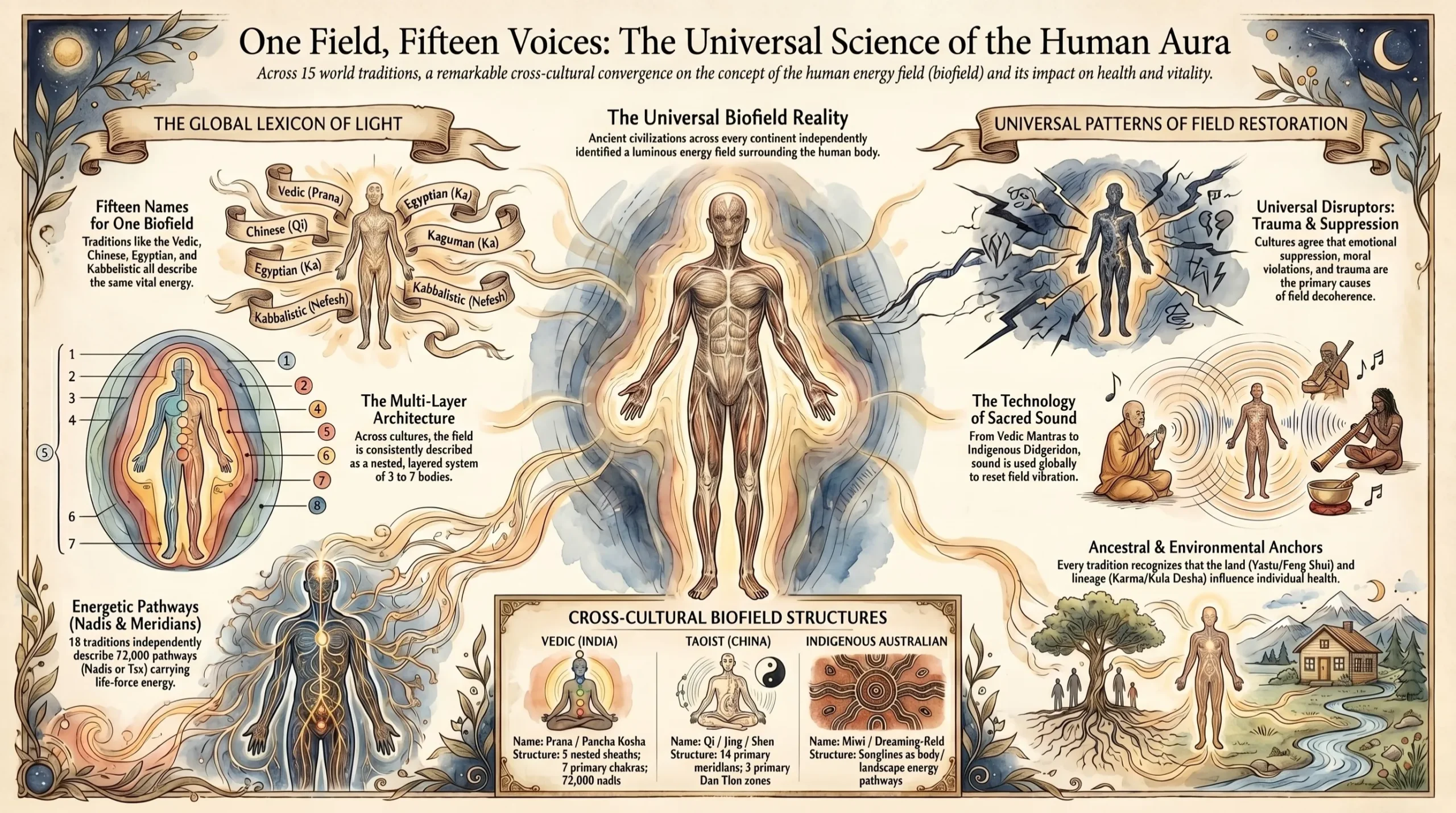
Cultural Tradition | Their Name for the Human Energy Field | How the Field Is Described: Structure, Layers, Colours | What the Tradition Says Disrupts the Field | What the Tradition Prescribes to Restore the Field | Convergence with the Seven-Zone Aura Reading |
Hindu / Vedic (India, 5,000+ years) | Prana / Pranamaya Kosha / Aura (from the Sanskrit ‘aura’ meaning ‘breeze’ or ‘air’); Tejas (the luminous body); the Pancha Kosha system names five nested field bodies | Five nested sheaths (koshas) surrounding the physical body: Annamaya (physical), Pranamaya (etheric-vital), Manomaya (mental-emotional), Vijnanamaya (intellectual-wisdom), Anandamaya (bliss-causal). Seven primary chakras as concentrated field nodes along the spine. 72,000 nadis as energy pathways. Colour traditions vary by lineage but all acknowledge the field’s colour quality as a reflection of inner state. | Prana depletion through overwork, poor diet, negative mental states, trauma, ancestral karmic burdens (pitru dosha), geopathic stress (vastu dosha), seasonal and environmental disruption, suppressed emotions (samskaras), and the accumulated karmic residue of past actions in this and prior lives | Pranayama (breath-based prana restoration), meditation, mantra sadhana, asana, Ayurvedic rasayana (herbal vitality), satsang (elevation through community of consciousness), karma yoga (action without ego-attachment), jnana yoga (wisdom practice), bhakti yoga (devotion), guru-shishya transmission, pilgrimage, puja, tarpana for ancestral field clearing | The Vedic tradition is the deepest single source for the seven-zone aura reading’s structural framework: the pancha kosha system maps directly to the aura’s five field layers; the seven chakras map to the seven zone locations; the three doshas map to the constitutional field-type assessment; the nadi network maps to the prana flow assessment; and the samskara–karma framework maps to the causal body’s constitutional pattern assessment |
Chinese / Taoist (China, 4,000+ years) | Qi (also written Chi or Ki in Japanese); Jing (constitutional essence); Shen (spirit-field); the San Jiao (Triple Warmer) as the field’s energetic regulator | Qi flows through fourteen primary meridian pathways and eight extraordinary vessels connecting all organ systems. The field has three primary zones: the lower Dan Tian (below navel, seat of Jing and physical vitality), middle Dan Tian (heart-chest, seat of emotional Qi), and upper Dan Tian (third eye-crown, seat of Shen and spiritual Qi). Wu Xing (Five Element) theory describes Qi quality by organ-element correspondence: Wood (liver-gallbladder), Fire (heart-small intestine), Earth (spleen-stomach), Metal (lung-large intestine), Water (kidney-bladder). | Qi stagnation (lack of movement producing blockage); Qi deficiency (insufficient quantity); Qi rebellion (reversed flow direction); external pathogenic factors (wind, cold, heat, dampness, dryness, fire); emotional imbalance (each emotion specifically associated with an organ system — anger with liver, grief with lung, fear with kidney, worry with spleen, joy with heart); ancestral constitutional Jing depletion | Acupuncture (restoring meridian Qi flow through needle stimulation at specific points); Qigong and Tai Chi (Qi cultivation through movement and breathwork); Chinese herbal medicine calibrated to the specific Qi pattern imbalance; dietary therapy aligned to Five Element principles; Feng Shui (environmental Qi optimisation); moxibustion; cupping; tui na massage along meridian pathways | The Chinese meridian system’s fourteen pathways map precisely to the nadi network’s primary channels; the three Dan Tian zones correspond to the aura reading’s lower (vitality-abundance), middle (emotional-relational), and upper (purpose-consciousness) zone groupings; the Five Element organ-emotion correspondence maps to the zone-specific emotional assessment; Feng Shui’s environmental Qi principles map directly to the Property & Space Energy reading dimension |
Ancient Egyptian (Egypt, 4,500+ years) | Ka (the vital double or etheric field body); Ba (the soul-personality field); Akh (the luminous immortal field); Khu (the radiant spirit body). The Egyptians distinguished at least seven field bodies with specific post-death functions. | The Ka was depicted in tomb art as an exact energetic double of the physical body, shown as an outline of light surrounding the deceased. The Ba was shown as a human-headed bird representing the soul’s mobility beyond the physical body. The Akh was the luminous immortal field that persisted beyond death. Egyptian funerary texts describe elaborate field body preservation practices as the primary purpose of mummification and tomb ritual. | The Ba’s failure to reunite with the Ka after death; moral field corruption through ethical violations (measured against the feather of Maat in the Weighing of the Heart ceremony); severing of the Ka’s connection to the physical body through improper burial or absence of memorial offerings; magical attack through heka (applied field magic) | Elaborate funerary rites to preserve the Ka’s integrity; daily temple ritual and offering to maintain the Ka’s nutritional field supply; Weighing of the Heart ceremony as ultimate moral field assessment; magical protective amulets placed at specific field body locations on the mummy; recitation of the Book of the Dead spells to navigate the post-death field body transitions | The Egyptian Ka as the etheric double corresponds directly to the aura reading’s etheric layer closest to the physical body; the seven field bodies of the Egyptian system correspond to the seven koshas of the extended Vedic model; the Weighing of the Heart’s moral field assessment corresponds to the aura reading’s heart zone coherence assessment as the primary indicator of the individual’s relational and karmic field quality |
Judaic / Kabbalistic (Middle East, 3,000+ years) | Nefesh (animal-vital soul field); Ruach (emotional-moral soul field); Neshamah (intellectual-divine soul field); Chayah (life-force field); Yechidah (unity-divine spark field). The Zohar describes the Or (divine light) as the field’s luminous quality. | Kabbalah’s Tree of Life (Etz Chayim) maps ten Sefirot (divine emanations / field qualities) to the human body and field: Keter (crown) at the crown; Chokhmah and Binah at the right and left brain hemispheres; Chesed and Gevurah at the right and left shoulders; Tiferet at the heart (corresponding to the Anahata chakra’s centrality in the Vedic system); Netzach and Hod at the hips; Yesod at the lower abdomen; Malkuth at the feet-earth connection. The Zohar describes the soul’s light emanating through the body in visible gradations. | Sin (chait — missing the mark, deviation from one’s divinely intended soul path); unresolved trauma and grief stored in the Nefesh layer; excessive Gevurah (severity, contraction) without Chesed (lovingkindness, expansion); exile from one’s community and tradition; gilgul (soul reincarnation) carrying unresolved tikkunim (corrections) from prior lives; exposure to forces of the klipot (husks — field shells that trap the divine light) | Teshuvah (return — the comprehensive field restoration practice of turning back toward one’s divine origin); Torah study as Neshamah field nourishment; prayer with kavvanah (directed intention — the Jewish equivalent of dharana); Shabbat observance as weekly field restoration cycle; Yom Kippur as annual comprehensive field clearing; hitbonenut (Chassidic deep contemplation); the mikveh (ritual immersion as field purification); kabbalistic meditation on the divine names and Sefirot | The Tree of Life’s ten Sefirot map remarkably closely to the extended chakra system; Tiferet at the heart centre as the Tree’s balancing point corresponds precisely to the Vedic Anahata chakra’s integrating function in the seven-zone reading; the five-soul-layer system (Nefesh through Yechidah) maps to the pancha kosha system; the Shabbat weekly field restoration cycle corresponds to the aura reading’s circadian and weekly rhythm assessment |
Christian / Gnostic (Mediterranean and Middle East, 2,000+ years) | Pneuma (spirit-field); Psyche (soul-field, distinct from modern psychological usage); the Halo or Nimbus (the luminous field crown depicted in sacred art); the Body of Light or Resurrection Body (the subtle body described in esoteric Christian traditions); the Aura itself (the term entered Western languages through ecclesiastical Latin) | Early Christian sacred art universally depicts saints, angels, and Christ with luminous halos and full-body aureoles (from the Latin aurea — golden — giving the English word ‘aura’ its immediate etymological source). The aureole in Byzantine and Roman Catholic iconography depicts the full luminous body field of the spiritually elevated individual. Gnostic texts describe a pneumatic body (spirit-field) that the soul wears as its luminous garment. Hildegard of Bingen (12th century) described the viriditas (greening power) as the field force animating all life. | Sin as a darkening of the pneumatic field; absence of divine grace; spiritual pride creating a hardened field shell; grief without spiritual consolation; demonic oppression understood as hostile field invasion; the corruption of the flesh (soma) affecting the soul’s (psyche) field luminosity; schism from the Body of Christ understood as disconnection from the collective spiritual field | Sacramental practice (Eucharist, confession, baptism) as field restoration ritual; contemplative prayer and lectio divina as pneumatic field cultivation; monastic community as collective field elevation; the Divine Office (Liturgy of the Hours) as circadian field rhythm maintenance; pilgrimage; veneration of saints and their relics as contact with elevated fields; the hesychast prayer tradition (Eastern Orthodox) involving breath, posture, and inner light as direct aura-equivalent practices | The Christian tradition’s most direct contribution to aura science vocabulary is etymological: the word ‘aura’ itself derives from the Latin aureola used to describe the sacred golden field in Christian sacred art. The hesychast tradition’s contemplative practice of inner light perception corresponds most closely to the meditation dimension of the aura reading’s restoration protocol; the sacramental field restoration cycle corresponds to the aura reading’s prescribed periodic field assessment and restoration rhythm |
Islamic / Sufi (Middle East and Central Asia, 1,400+ years) | Ruh (spirit-field, literally ‘breath’, etymologically parallel to prana); Nafs (soul-field in its five evolutionary stages: Nafs al-Ammara commanding ego-field, Nafs al-Lawwama self-reproaching field, Nafs al-Mulhama inspired field, Nafs al-Mutma’inna tranquil field, Nafs al-Radhiyya pleased field); Baraka (field grace, the luminous blessing-field of the spiritually elevated) | Sufi tradition describes the Nafs as evolving through progressive field purification stages from the ego-dominated commanding soul to the tranquil, God-pleased soul. The Ruh is the divine breath that God breathed into Adam, understood as the luminous spirit-field that underlies the Nafs. Baraka is the field grace that flows from spiritually elevated individuals, sacred places, and the graves of awliya (saints) — a tangible, transmissible field quality experienced as warmth, peace, and spiritual opening. | Kibr (arrogance) as field hardening that prevents baraka reception; hawa (ego-desire) as field agitation; the unrefined Nafs al-Ammara’s field pollution through attachment; absence of dhikr (remembrance) allowing the field to lose its divine connection; proximity to spiritually corrupt influences; failure of the heart’s eye (basirah — inner vision) to remain open | Dhikr (repetitive divine name recitation as field purification and elevation — directly equivalent to mantra sadhana); sema (the Whirling Dervish practice of Mevlevi Sufism as kinetic field elevation); muraqaba (Sufi meditation as field contemplation); Ramadan fasting as annual comprehensive field purification; the silsila (initiatic chain) transmitting baraka from teacher to student across generations; ziyarat (pilgrimage to the tombs of awliya for baraka field contact) | The five Nafs stages are the Islamic tradition’s precise equivalent of the aura’s field quality progression from the Tamasic-Rajasic lower stages to the Sattvic elevated stages; dhikr as mantra-equivalent is one of the most direct cross-cultural correspondences in this table; baraka as transmitted field grace corresponds to the guru-shishya field transmission in the Vedic tradition and the hesychast’s transmitted light in the Christian tradition — all three traditions describing the same phenomenon of field elevation through proximity to an elevated field |
Tibetan Buddhist (Tibet and Central Asia, 2,500+ years) | Lung (prana-equivalent, ‘wind-energy’); Tsa (nadi-equivalent, energy channels); Thigle (bindu-equivalent, essence drops); the Rainbow Body (Jalupa) as the highest field realisation; the Trikaya (three bodies: Nirmanakaya physical field, Sambhogakaya subtle field, Dharmakaya truth field) | Tibetan tantric medicine describes a subtle body of 72,000 energy channels (tsa) through which lung (wind-energy) flows, carrying thigle (essence drops) of subtle consciousness. Three primary channels correspond to the Vedic Ida, Pingala, and Sushumna. Five primary chakras (crown, throat, heart, navel, secret) are the concentrated field nodes. The Rainbow Body is the highest realisation: a master who dissolves the physical body at death into a field of rainbow light, leaving only hair and nails — multiple documented instances in 20th century Tibet. | Lung imbalance from specific meditation practices incorrectly applied; the five root kleshas (afflictive emotions corresponding to specific field toxins: desire, aversion, delusion, pride, jealousy); the three poisons (ignorance, attachment, aversion) as fundamental field obscurations; broken samaya (spiritual commitments) creating field fragmentation; incomplete grief for the dead disrupting the bardo field navigation; karma from prior lives creating constitutional field obscurations | Tummo (inner heat practice as radical field energy activation); Dzogchen (the Great Perfection — direct recognition of the field’s primordial nature); Mahamudra (the Great Seal — sustained awareness of the field’s natural clarity); Tsa-lung exercises (channel and wind energy practices equivalent to pranayama); Medicine Buddha practice for health field restoration; Chod (field courage practice cutting through ego identification); phowa (consciousness transference practice for death field navigation); Tibetan Singing Bowl therapy as sound-frequency field restoration | The Tibetan subtle body’s tsa-lung-thigle system is the most structurally detailed of all non-Vedic traditions in its correspondence to the aura reading’s zone assessment: five chakras, 72,000 channels, five lung types each associated with specific organ-emotional patterns, and thigle quality as a direct field essence assessment; the Rainbow Body tradition provides the most dramatic cross-cultural validation of the field body’s ultimate independence from the physical form |
Japanese Shinto and Buddhist (Japan, 2,000+ years) | Ki (Qi equivalent, the universal life force field); Tama (the individual spirit-field, soul); Kotodama (word-spirit — the field power of spoken sound); Musubi (the creative field force of sacred union); Harae (ritual purification of field impurity) | Shinto describes the Tama as the individual’s spirit-field that animates the body and is connected to the kami (field presences in natural phenomena). The kami themselves are field presences: the luminous animating quality of mountains, rivers, trees, and sacred sites. Ki in Japanese martial arts (Aikido, Karate, Kendo) and healing traditions (Reiki) is understood as a trainable, directionally governable field force that the practitioner cultivates and applies. Reiki specifically (developed by Mikao Usui in early 20th century Kyoto) describes the field as a five-layer system directly paralleling the pancha kosha. | Kegare (field impurity) accumulated through contact with death, illness, blood, and moral violation; musubi disruption (the fracture of the creative field union between the individual and the kami); the wandering of the Tama from its proper seat in the body through trauma or grief; negative kotodama (field-damaging words and speech); the deterioration of relationship with ancestral kami | Misogi Harae (ritual purification under cold waterfall, river, or sea — direct field cleansing through water immersion and breath work); Norito (Shinto prayer chanting as kotodama field restoration); Chinkon (Tama-quieting meditation and ritual); pilgrimage to Shinto shrines as kami-field contact; Reiki practice as hands-on Ki field restoration; forest bathing (Shinrin-yoku) as kami-field absorption from natural sacred space; ancestor veneration at household Butsudan shrines | The Japanese tradition’s most important contribution to cross-cultural aura understanding is Reiki: developed in Japan in the 1920s as a synthesis of the Japanese Ki tradition and Tibetan Buddhist field practices, it has become the most globally practised hands-on field healing modality, providing the widest contemporary cross-cultural bridge for the aura concept; the Shinto kami-field concept corresponds directly to the Property & Space Energy reading’s understanding of place as having its own field quality |
Indigenous Australian (Australia, 65,000+ years — oldest living cultural tradition) | Miwi (Aranda / Central Australian: the field of spiritual power and inner knowing); Ngaankari (the healing power-field of the traditional healer); the Dreaming-field (the non-linear field of ancestral creative power underlying all physical reality); Kurunba (among some groups: the individual’s spiritual field vitality) | The Dreaming is not merely a mythological reference but an ontological reality: the field of ancestral creative power that continuously underlies and generates the physical world. Each person is understood to carry a portion of this Dreaming-field as their individual spirit; the land itself has a Dreaming-field that is mapped in songlines — energy pathways across the landscape that correspond to ancestral creative journeys. The Ngaankari’s healing practice involves direct perception of and intervention in the patient’s Miwi-field. | Disconnection from Country (the land’s Dreaming-field through exile or destruction of sacred sites); interruption of the songline network; violation of lore (the sacred field-law governing relationship between people, land, and Dreaming); spirit intrusion (hostile field presence introduced by sorcery); soul loss through severe grief or trauma; failure to perform the ceremony cycle maintaining the Dreaming-field’s vitality | Ceremony (the primary field restoration technology — each ceremony precisely designed to restore a specific dimension of the Dreaming-field); smoking ceremony (eucalyptus and other plant smoke as field purification); sand painting as field mapping and restoration ritual; didgeridoo sound healing as field vibration therapy; returning to Country (reconnection with the land’s Dreaming-field as the most fundamental healing); the Ngaankari’s direct field extraction and restoration work | The Australian indigenous tradition’s songlines correspond remarkably to the nadi network concept: energetic pathways through the landscape that carry ancestral field information and connect sacred sites, exactly as the nadis connect chakra nodes. The Dreaming-field’s continuous ancestral presence corresponds to the Vedic concept of the cosmic akashic field. The Ngaankari’s direct field perception and intervention corresponds to the aura reading’s practitioner methodology. |
African Traditional (Sub-Saharan Africa, diverse traditions spanning thousands of years) | Ashe / Ase (Yoruba: the universal field power and creative force); Nyama (Mande / West African: the life-force field that animates all beings, especially concentrated in skilled craftspeople, hunters, and healers); Ubuntu’s collective field (Southern African: ‘I am because we are’ — the relational field that constitutes personhood); N/om (San Bushmen: the healing power-field activated in the trance dance) | Yoruba tradition describes Ashe as the divine field force present in all things, concentrated in orishas (divine field presences) and activated in ritual through the alignment of human and divine field. The Mande tradition’s Nyama is dangerous in unskilled hands but powerful in the hands of the blacksmith, bard, or healer who has developed the capacity to work with it. The San Bushmen’s N/om is activated through the trance dance, experienced as a boiling heat rising from the base of the spine through the body to the crown — a description that is structurally identical to the Vedic kundalini rising through the chakra system. | Ashe depletion through disrespect for elders and ancestors; broken taboo violating the social-field law; Nyama accumulation without skilled management causing illness in the craftsperson; disconnection from ancestral field through failure of lineage ritual; witchcraft (aye in Yoruba) as hostile field attack; social rupture through community conflict depleting the Ubuntu relational field; N/om that has ‘boiled’ and been unable to complete its rising producing sickness in the healer | Ebo (Yoruba: sacrifice and offering to orishas as field alignment); Egungun masquerade as ancestral field invocation; divination through Ifa (the most sophisticated African divination system, mapping 256 odu field configurations corresponding to life situations); the San trance dance as N/om field activation and collective healing; Ubuntu community practice as relational field maintenance; the griot’s oral field transmission of ancestral knowledge; traditional healer (sangoma, babalawo, nganga) field diagnosis and restoration | The San N/om rising from the base of the spine to the crown through heat activation is the most striking cross-cultural parallel in this entire table to the Vedic kundalini: two traditions separated by oceanic distance and complete cultural isolation describing the same sequential field activation through the body’s central axis. The Yoruba Ifa’s 256 odu field configurations and the Vedic system’s rashi-nakshatra configurations are both comprehensive field-pattern mapping systems serving the equivalent function of the aura reading’s constitutional pattern assessment |
Mesoamerican / Nahuatl (Mexico and Central America, 3,000+ years) | Tonalli (the radiant field soul located in the head, associated with day-sign destiny and heat); Teyolia (the heart-soul field, the seat of emotion, memory, and divine animation); Ihiyotl (the liver-field, associated with passion, desire, and spiritual breath); the nahual (the personal animal spirit-field double) | Nahuatl philosophy describes three primary soul-fields: the Tonalli in the crown-head area (corresponding to the Vedic crown and third-eye chakras) as the radiant field associated with one’s destiny and the sun’s animating power; the Teyolia in the heart (corresponding to Anahata) as the field of divine animation that persists after death in various forms; and the Ihiyotl in the liver as the passionate field that requires careful management. Each soul-field can be in excess, deficiency, or imbalance — a framework directly parallel to the three-dosha assessment. | Susto (fright sickness): the Tonalli’s departure from the head-zone through severe shock or trauma — one of the most extensively documented culture-bound syndromes in medical anthropology, corresponding to the aura reading’s root zone shock-displacement pattern; Teyolia loss through grief or broken heart; Ihiyotl excess producing jealousy and ill will (the evil eye, mal de ojo) as a field-transmission pathology; disruption of the tonalpohualli (ritual calendar cycle) severing the individual’s connection to their natal field configuration | Curanderismo (traditional healing combining field restoration techniques: limpia / cleansing with egg, copal smoke, herbs, prayer; barrida / field sweeping; sustos treatment combining herbal preparation, prayer, and field reintegration ritual); temazcal (sweat lodge as comprehensive field restoration through heat, steam, and prayer); Dia de los Muertos rituals as ancestral field maintenance; shamanic journey for soul (Tonalli) retrieval after susto displacement | Susto as a documented cross-cultural field-displacement syndrome corresponds precisely to the aura reading’s identification of the root zone shock-displacement pattern in clients who have experienced severe grief, accident, or relational rupture; the three soul-field system (Tonalli-Teyolia-Ihiyotl) maps to the upper-middle-lower zone grouping of the seven-zone reading; mal de ojo (evil eye) as a field-transmission pathology corresponds to the aura reading’s assessment of external field influence as a factor in zone decoherence |
Greek / Neoplatonic (Mediterranean, 2,500+ years) | Pneuma (breath-field, the material carrier of the soul); Psyche (the soul-field); Nous (divine mind-field); Augoeides (the luminous vehicle of the soul — a concept central to Neoplatonism and later Theosophy); the Astral Body (from the Greek aster — star) as the field body that navigates between worlds | Aristotle described the pneuma as the material carrier of the soul’s field, analogous to the ‘element of the stars’ (aether) — a fifth element beyond earth, water, fire, and air that fills the celestial sphere. The Neoplatonists (Plotinus, Porphyry, Iamblichus) described the soul descending through planetary spheres and accumulating subtle field bodies at each level: the astral body from the stellar realm, the etheric body from the lunar realm, all surrounding the immortal soul. The Augoeides — the luminous vehicle — is the permanent field body that accompanies the soul across incarnations. | The soul’s entanglement in matter (hyle) and forgetting of its divine origin (Plato’s cave allegory as field-decoherence metaphor); habituation to the passions of the lower soul layers; the body’s appetitive desires pulling the pneuma’s field downward; absence of philosophical practice (theoria) allowing the Nous’s field to remain dormant; failure of the soul to ascend through contemplative practice toward its source in the One | Philosophical practice (theoria) as Nous-field activation; the Platonic dialectic as intellectual field ascent; Neoplatonic theurgy (sacred ritual practice designed to elevate the soul’s field vehicle toward the divine); Pythagorean number-harmony meditation on the field’s mathematical structure; the philosophical community (the Academy, the Platonic school) as collective field elevation; Plotinian contemplation of the One as the highest available field integration practice | The Greek tradition’s most important contribution to Western aura science is its vocabulary: pneuma, psyche, nous, astral body, etheric body, and aura itself (via Latin aureola) all entered the Western esoteric tradition through the Neoplatonic synthesis. The planetary descent model of the soul accumulating field layers maps to the pancha kosha system; the Augoeides as the permanent field vehicle across incarnations corresponds to the causal body in both the Vedic and Tibetan traditions |
Indigenous North American (diverse nations, 15,000+ years) | Orenda (Haudenosaunee / Iroquois: the personal spirit-field power inherent in all natural beings, more concentrated in some); Wakanda / Wakan (Lakota Sioux: the sacred mysterious field power pervading all of creation); Medicine (as field power, not pharmacological substance) — each individual’s unique field gift and personal power configuration | The Lakota Sioux concept of Wakan Tanka (Great Mystery / Great Spirit) describes the total field of sacred power pervading all of creation, with each being carrying a portion of this field as their individual wakan quality. The medicine wheel as a field organisation structure maps cardinal directions (East-South-West-North) to field qualities (Air-Fire-Water-Earth / Illumination-Trust-Introspection-Wisdom), corresponding closely to the Chinese and Vedic elemental field frameworks. The personal medicine — an individual’s unique field configuration — is revealed through vision quest and maintained through ceremony. | Violation of treaty obligations with the land and its non-human persons (ecological field rupture); loss of personal medicine through deviation from one’s path; failure of ceremony maintaining the collective field balance; the intrusion of hostile spirits (as specific field presences); the loss of a loved one without adequate grieving ceremony disrupting the relational field; the forcible separation from ancestral territory severing the individual’s field connection to the land’s spiritual geography | The vision quest (solitary fasting and prayer in wilderness as personal medicine field revelation); the sweat lodge (inipi: heat, steam, prayer, and community as comprehensive field restoration); the sun dance (collective field renewal ceremony through intense voluntary field-threshold experience); smudging with sage, cedar, and sweetgrass (plant smoke as field purification); pipe ceremony (the sacred pipe as field-alignment technology connecting the human field to the Great Spirit field); healing songs as sound-frequency field medicine | The medicine wheel’s four-directional field quality mapping corresponds to the five-element systems of the Chinese and Vedic traditions — all describing the same fundamental field qualities in culturally specific vocabularies; the vision quest’s individual field revelation corresponds to the aura reading’s identification of the individual’s unique field configuration; the sweat lodge’s comprehensive field restoration through heat, prayer, and community corresponds to the Health & Vitality five-stage protocol’s integrated approach |
Polynesian / Hawaiian (Pacific, 4,000+ years) | Mana (the field power and authority that accumulates through righteous living, skilled performance, and spiritual development — the most widely known Polynesian field concept); Hau (the vital spirit-field of a gift that demands reciprocity, described by anthropologist Marcel Mauss as the foundation of all gift economies); Aumakua (the ancestral spirit-field guardian) | Mana is perhaps the most widely recognised indigenous field concept in Western anthropology. It is not merely supernatural power but a measurable, transferable field quality: the chief who wins battles and governs wisely accumulates mana; the craftsperson whose canoe does not sink has mana; the healer whose patients recover has mana. Mana can be increased or diminished through action. The concept of tapu (sacred restriction protecting high-mana objects and people) is the field-protection technology that prevents mana depletion through inappropriate contact. Hawaiian Huna tradition describes the three selves (Unihipili, Uhane, Aumakua) as three field bodies corresponding to the subconscious, conscious, and higher self dimensions of the aura. | Violation of tapu (contact with high-mana objects or persons without field preparation, causing mana depletion in both parties); breach of hoʻopononono (the relational field law of making right); ancestral Aumakua abandonment through failure of genealogical obligation; the misappropriation of others’ mana through unjust accumulation; spiritual attack (anaʻana: Polynesian sorcery as deliberate mana extraction) | Hoʻopononono (the Hawaiian reconciliation and field-clearing practice: ‘I love you, I’m sorry, please forgive me, thank you’ — now globally practised as an inner field-clearing technology); hula as ceremonial mana field activation through movement, chant, and collective field resonance; lomilomi massage as mana-flow restoration through the body’s field pathways; laʻau lapaʻau (Hawaiian plant medicine calibrated to the patient’s mana configuration); genealogical chant (Kumulipo) connecting the individual’s field to the ancestral mana lineage | Mana as an accumulating, transferable field quality that varies by individual and action corresponds precisely to the aura reading’s assessment of field strength and quality as a variable influenced by lifestyle, practice, and ethical coherence; Hoʻopononono as a relational field-clearing practice corresponds to the Love & Connection reading’s prescribed heart zone clearing practices; the three-self Huna framework (Unihipili-Uhane-Aumakua) maps to the aura’s subconscious-conscious-superconscious field layer assessment |
Persian / Zoroastrian (Iran, 3,500+ years) | Fravashi (the pre-existent celestial field double and divine guardian spirit of each person); Asha (the field quality of truth, righteousness, and cosmic order — the highest field value); Khvarenah (the luminous divine glory-field or royal halo — the same word that gives the English ‘charisma’ its root) | Zoroastrian theology describes each person as accompanied by their Fravashi — a pre-existent divine field double that existed in the spiritual realm before the physical birth and continues to exist after death. The Fravashi is not the soul itself but the soul’s celestial original — its divine template. The Khvarenah is the luminous field of divine glory that attaches to those who embody Asha (cosmic truth-righteousness): kings, prophets, and spiritually realised individuals are described as visibly surrounded by this luminous field. The term entered Greek as ‘charis’ (grace-field) and became the English ‘charisma’ — the quality of luminous field presence that others recognise as exceptional personal power. | Deviation from Asha (falsehood, druj — the cosmic field of deception opposing Asha’s truth-field); ethical violation that severs the Khvarenah’s luminous field from the individual; the Angra Mainyu’s (destructive spirit’s) influence on the individual field; ritual impurity (nasu — field corruption through contact with death without appropriate purification); failure of the daily field maintenance prayers (Gathas recitation) | The Yasna (Zoroastrian liturgy as comprehensive field alignment ritual); the Gathas (Zarathustra’s hymns recited as daily field-tone maintenance); Kusti ceremony (tying and untying the sacred cord as daily field-alignment renewal); fire veneration (the sacred fire as the visible symbol of Asha’s truth-field); Nowruz (Persian New Year as annual field renewal ceremony); purification rituals after contact with nasu (death-field corruption) using bull’s urine (nirang) as a potent biological field-clearing agent in the tradition | The Fravashi as a pre-existent divine field template corresponding to the individual’s soul corresponds to the Vedic concept of the Atman as the universal field’s individual expression — the divine template that the aura reading’s causal body layer reads; the Khvarenah as a luminous field quality that visibly surrounds spiritually elevated individuals is one of the oldest documented descriptions of the auric field’s luminous quality that has entered Western culture through the word ‘charisma’ itself |
Three rows in this table deserve extended commentary beyond their entries. The Australian Aboriginal entry is the most striking for its temporal depth: 65,000 years of continuous cultural transmission of a sophisticated energy field framework, making it the oldest documented human energy field tradition by a margin of tens of thousands of years. The songline system — energy pathways mapped across the Australian continent corresponding to ancestral creative journeys — is the most geographically extensive energy pathway mapping project in human history. That the world’s oldest living culture places the energy field’s landscape dimension at the centre of its ontology deserves more attention than it typically receives in aura science discussions.
The San Bushmen entry is the most physiologically striking: the N/om’s boiling heat rising from the base of the spine sequentially through the body to the crown during the trance dance is described by a hunter-gatherer culture in the Kalahari Desert, with no plausible contact with the Vedic tradition at the period when both descriptions were formed, in terms that are structurally identical to the Vedic description of kundalini rising through the chakras. The probability that two culturally isolated traditions independently invented the same description of sequential field activation through the body’s central vertical axis as a metaphor for something that does not exist is, I think, very low.
What Are the Seven Cross-Cultural Convergences That Most Powerfully Validate the Universal Aura Concept?
The most important word in describing these convergences is ‘independent.’ The evidential weight of the cross-cultural consensus depends entirely on whether the traditions arrived at their descriptions through independent observation rather than cultural borrowing. In some cases, the independence is straightforwardly demonstrable: the Australian Aboriginal tradition’s songline concept predates any plausible contact with the Vedic or Chinese traditions by tens of thousands of years. The San Bushmen’s N/om description was recorded by anthropologists before any systematic exposure to the Vedic tradition’s kundalini concept. The Nahuatl three-soul framework predates European contact. These cases of genuine independence make the structural convergences most evidentially significant.
Seven Cross-Cultural Convergences Validating the Universal Aura Concept – What Every Major Tradition Independently Agrees On:
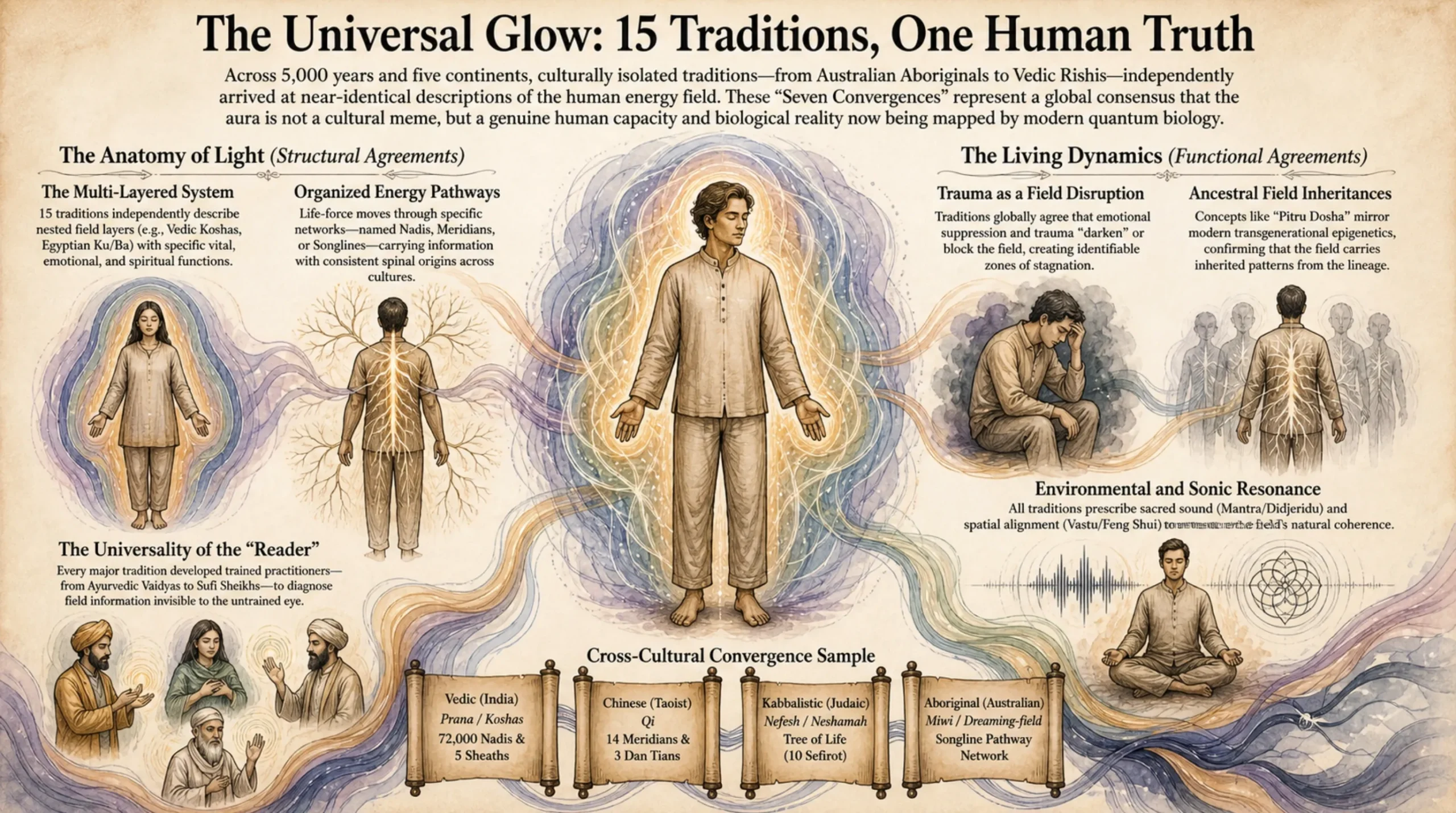
Universal Principle | Named in Five or More of the Fifteen Traditions — With Examples | What the Traditions Independently Agree It Means | Why This Cross-Cultural Independence Strengthens the Aura Reading’s Evidence Base |
The field has multiple distinct layers, each with specific functions | Vedic (pancha kosha: five nested field sheaths); Egyptian (seven field bodies Ka through Akh); Kabbalistic (four or five soul layers Nefesh through Yechidah); Tibetan (Trikaya: three field bodies, five winds); Nahuatl (three soul-fields Tonalli, Teyolia, Ihiyotl); Neoplatonic (multiple descended field vehicles from the astral through the etheric); Polynesian Huna (three selves Unihipili, Uhane, Aumakua); Chinese (Jing, Qi, Shen as three field levels) | All these traditions independently arrived at the recognition that the human field is not a single homogeneous field but a nested, layered system in which different layers serve different functions: a vital-etheric layer closest to the physical body, an emotional-mental layer as an intermediate zone, and a causal-spiritual layer as the deepest field expression of consciousness. The number of layers varies by tradition (three to seven most commonly), but the layered structure principle is universal. | When fifteen culturally isolated traditions independently arrive at a multi-layer field body structure with a consistent inner-outer organisation (physical nearest, spiritual farthest) using only systematic inner observation as their investigative tool, the probability that all are describing nothing — or merely sharing a cultural meme — is substantially lower than if only one tradition reported it. The aura reading’s five-layer assessment is not a single tradition’s theory. It is a cross-cultural consensus from fifteen independent observational traditions. |
The field has a specific pathway network carrying the life-force energy | Vedic (72,000 nadis with three primary channels); Chinese (fourteen meridians and eight extraordinary vessels); Tibetan (72,000 tsa channels with three primary nadis); Japanese (Ki pathways underlying acupuncture meridians); Australian Aboriginal (songlines as landscape-and-body energy pathways); Polynesian (mana flow pathways, explicit in Huna); Egyptian (implied in the field body’s limb-specific energetic functions) | All traditions that describe the field’s internal structure agree that the life-force energy does not distribute randomly through the field but moves through specific organised pathways — named variously as nadis, meridians, tsa channels, songlines, or mana pathways. These pathways have specific origin and termination points, specific organ and emotional associations, and specific vulnerabilities to blockage and depletion. The pathway network’s integrity determines the field’s overall coherence. | The independent convergence of the Vedic nadi network, the Chinese meridian system, and the Tibetan tsa channel system — all describing 72,000 pathways with three primary channels, all locating the primary channel in the spinal column, all describing pathway blockage as the primary health disruption mechanism — constitutes one of the most remarkable independent agreements in all comparative religion and anthropology. The aura reading’s prana flow assessment reads the field-level expression of this universally observed pathway network. |
The field can be read, assessed, and diagnosed by a trained practitioner | Vedic (the jyotishi, the ayurvedic vaidya, and the yogic teacher all read the field); Chinese (the acupuncturist reads pulse and tongue as field diagnostics); Egyptian (the priest-healer reads the Ka’s field state); Tibetan (the Ngaankari reads the Miwi field — Australian); Yoruba (the babalawo’s Ifa divination reads the odu field configuration); Lakota (the medicine person reads the individual’s medicine configuration); Sufi (the Sheikh reads the mureed’s Nafs stage); Greek (the Neoplatonic philosopher reads the soul’s field purification stage) | Every tradition with a developed field concept also has a corresponding tradition of trained field readers: individuals whose contemplative practice, apprenticeship, and accumulated experience give them reliable access to field information that the ordinary untrained person cannot read in themselves. The universality of the trained field reader — across cultures with no contact with each other — suggests that field reading is a genuine human capacity, not a cultural invention. | The universality of the trained field reader validates the aura reading’s methodology: photo-based aura assessment using patented scanning technology and the practitioner’s trained perception is the 21st-century application of a human capacity for field reading that fifteen independent traditions have documented, systematically developed, and applied for health and life guidance across five thousand years. The specific methodology is modern; the capacity it applies is universal. |
The field is disrupted by emotional suppression, moral violation, and trauma | Vedic (samskaras from suppressed emotional content and past actions); Chinese (each organ’s specific emotional association — anger with liver, grief with lung, fear with kidney); Tibetan (the five root kleshas as field toxins); Kabbalistic (sin as field darkening; unresolved grief in the Nefesh layer); Christian (sin as pneumatic field dimming); Islamic (unrefined Nafs al-Ammara as field pollution); Nahuatl (susto as field displacement through trauma); Polynesian (breach of hoʻopononono as relational field disruption); African (social rupture depleting the Ubuntu relational field) | All traditions describe a specific class of field disruptions caused by the internal states of the individual: emotional suppression, moral violation, unresolved grief, trauma, and the accumulated residue of actions taken against the individual’s own deepest values. This class of field disruption is distinguished from external disruptions (environmental, ancestral) by its location within the individual’s own field and its responsiveness to the individual’s own corrective practices. | The universal recognition of emotional suppression, trauma, and moral-ethical misalignment as field disruption sources validates the aura reading’s emotional body assessment dimension and its prescription of emotional clearing practices as a distinct stage in the restoration protocol. This is not a culturally specific theory. It is a cross-cultural consensus. And its prescription — the practices that clear the emotional body’s field — while varying by tradition in form, converge on the same mechanism: conscious engagement, release, and integration of the suppressed field content. |
The field is influenced by ancestral inheritances that must be actively cleared | Vedic (pitru dosha: ancestral field debt; pitru tarpana as clearing practice); Tibetan (karma across prior lives producing constitutional field obscurations); Kabbalistic (gilgul — soul reincarnation carrying unresolved tikkunim); West African Yoruba (ancestral Egungun field presence requiring ritual engagement); Polynesian (Aumakua ancestral guardian field; genealogical chant connecting to ancestral mana); Nahuatl (the Teyolia’s post-death transformations connecting the living to ancestral fields); Australian Aboriginal (Dreaming-field as continuously active ancestral creative field); Shinto (ancestral kami requiring veneration at household shrines) | Every tradition describes a dimension of the individual’s field that is not entirely the product of the individual’s own biography but carries inherited field patterns from the ancestral lineage. This ancestral dimension is universally treated as a real, distinct layer of the field that requires specific ritual or practice to assess and address — not as a metaphor for psychological inheritance but as a field-level reality in its own right. | The universal recognition of ancestral field inheritance validates the aura reading’s ancestral layer assessment and the epigenetic research’s confirmation (Yehuda et al., Biological Psychiatry 2016) that ancestral experience is transmitted through the germline as measurable epigenetic marks. The cross-cultural consensus is not merely a cultural belief. It is a convergent description of a real biological and field-level phenomenon that the most rigorous human epigenetics research has now independently confirmed. |
Sacred sound, vibration, and word have direct field restoration power | Vedic (mantra sadhana as the primary field restoration technology in the jnana and bhakti traditions); Tibetan (mantra, Tibetan singing bowl, and Dzogchen sound practices); Chinese (specific tones associated with each organ meridian in Qigong sound healing); Polynesian (kotodama — word-spirit; the chanted genealogy Kumulipo as mana restoration); Judaic (the divine names in Kabbalah; the Shema as primary field alignment prayer); Islamic (dhikr — divine name repetition as field purification); North American indigenous (healing songs as sound-frequency medicine); Zoroastrian (Gathas recitation as daily field-tone maintenance); Greek Pythagorean (number-harmony as the mathematical field’s sonic structure) | Every tradition with a developed field concept describes specific sounds, words, or tonal patterns that have direct field restoration effects beyond their semantic content: the mantra’s vibration, the healing song’s frequency, the divine name’s field power, the sacred text’s kotodama. The specific sounds vary by tradition; the principle — that specific vibrational patterns directly influence the field’s coherence state — is universal. | The universal recognition of sacred sound’s field restoration power corresponds to the quantum biology of vibrational frequency detection and the aura reading’s mantra prescription as a precise field restoration technology. The specific mantra prescriptions in the Health & Vitality and Aura Life Guide protocols are calibrated to the zone’s characteristic quantum resonance frequency — applying the universally recognised principle of sound-field correspondence to the specific field configuration identified in the individual’s reading. |
The environment has its own field that directly affects the individual’s field | Vedic (Vastu Shastra: the science of architectural and spatial field quality); Chinese (Feng Shui: the science of environmental Qi optimisation); Shinto (kami as field presences in natural sites requiring respectful relationship); Australian Aboriginal (Country as Dreaming-field requiring ceremony for maintenance); North American indigenous (the medicine wheel’s four-directional field geography of the land); Zoroastrian (the sacred fire as environmental truth-field anchor); Polynesian (tapu sites as high-mana environmental field zones); Tibetan (sacred mountain and valley field geographies mapped in spiritual geography texts) | Every tradition recognises that the environment — architectural, natural, and geographical — has its own field quality that directly influences the individual’s field. The home, the workplace, the sleeping environment, and the natural landscape all have field signatures that either support or deplete the individual’s field coherence. This is not treated as metaphor in any of these traditions. It is an operational field assessment that informs where to live, how to orient the home, and which natural environments to seek for restoration. | The universal recognition of environmental field quality validates the aura reading’s Property & Space Energy dimension and the Health & Vitality reading’s Stage 1 environmental assessment. The Vastu and Feng Shui traditions provide the most systematically developed practical frameworks for this universal principle; the earthing research’s randomised controlled trials provide the most direct contemporary experimental validation of the principle that the environment’s electromagnetic quality directly influences the individual’s biological field state. |
The seventh convergence — the universal recognition of environmental field quality — is the one I most frequently need to explain to clients in Bangalore’s tech corridors, because ‘the office has bad energy’ is an experience they have had and dismissed as unscientific. The Vastu and Feng Shui traditions have formalised this into the two most practically applied environmental field sciences in human history. The earthing research’s randomised controlled trials have provided the most direct contemporary experimental confirmation. And the Australian Aboriginal songline tradition has mapped the phenomenon at the continental scale across 65,000 years. When a client in Bangalore says the office has bad energy and does not know what to do with that observation, they are touching the same principle that Vastu masters, Feng Shui practitioners, Shinto priests, Aboriginal elders, and North American medicine people have all formally documented and prescribed responses to. The Property & Space reading turns that intuition into an actionable assessment.
How Does India’s Vedic Tradition Compare to Global Aura Traditions and Why Is It the Deepest Single Source?
I was born into a family where the Vedic tradition was lived rather than studied — where the morning pranayama, the evening puja, the Jyotish reading at life transitions, and the Vastu assessment before a home purchase were not exotic practices but the ordinary rhythm of a well-ordered life. It was this lived familiarity with the Vedic framework’s practical application, combined with eight years of systematic aura reading practice and sustained engagement with the cross-cultural evidence, that has given me both a deep respect for the Vedic tradition’s unparalleled depth and an appreciation for what the other fourteen traditions in this article each contribute.
What the Vedic Tradition Offers That No Other Single Tradition Matches:
- The most complete multi-layer field body map: The pancha kosha system (five nested sheaths from Annamaya through Anandamaya) is the most internally consistent multi-layer field body framework in human history. The extended model in Tantric traditions expands to seventeen field bodies with specific functions and specific vulnerabilities. No other single tradition provides this level of structural detail for the field’s vertical organisation.
- The most clinically developed zone-health system: Ayurveda’s field health framework — tridosha assessment, dhatu vitality evaluation, srotas channel assessment, and the complete Sattvic-Rajasic-Tamasic quality framework — provides the most clinically developed single-tradition zone health assessment system, refined across 5,000 years of clinical application across the world’s largest continuous medical tradition.
- The most sophisticated practice library: No other tradition’s practice library for field restoration is as practically comprehensive as the Vedic tradition’s: the full pranayama system (sixteen named techniques with specific zone targets and contraindications), the mantra tradition (thousands of specifically calibrated mantras for specific field patterns), the asana tradition (hundreds of postures with specific field effects), the Jyotish predictive framework (the field’s temporal dynamics mapped across the lifetime), and the Vastu environmental science (the space’s field quality systematically addressed in every dimension).
- The most rigorous philosophical framework: The Samkhya-Yoga philosophical system provides the most complete conceptual infrastructure for understanding the relationship between consciousness (Purusha), the field’s primordial matter (Prakriti), and the field’s evolutes from the causal through the physical. Advaita Vedanta’s non-dual framework provides the most rigorous available philosophical context for the causal body’s relationship to the universal field. No other tradition provides this level of philosophical rigour for the field’s ontological status.
What the other fourteen traditions contribute that enriches rather than contradicts the Vedic framework is equally important to name. The Chinese tradition’s clinical richness in the organ-emotion correspondence — the precise mapping of grief to the lung, anger to the liver, fear to the kidney — provides a complementary clinical vocabulary for the zone assessment’s emotional layer that is more symptom-specific than the Vedic framework’s dosha model. The Tibetan tradition’s tsa-lung-thigle system provides the most detailed description of the field’s subtle energy mechanics at the level below the chakras. The Kabbalistic Tree of Life provides the most precise cross-traditional validation of the heart zone’s integrating and balancing function. And the San Bushmen’s N/om provides the most cross-culturally isolated validation of the full-field vertical activation sequence.
What Do Indigenous and Shamanic Traditions Specifically Contribute to Our Understanding of Auras?
There is a specific category of dismissal that indigenous and shamanic traditions receive in mainstream Western discourse that I want to address directly, because it affects how their cross-cultural aura evidence is received. The dismissal goes: ‘These are pre-scientific cultures whose field concepts reflect the limitations of their worldview rather than observations of reality.’ This dismissal has three problems.
First, it confuses the absence of written theoretical systematisation with the absence of empirical observation. The San Bushmen healers who describe N/om rising from the base of the spine are not theorising. They are reporting what they observe happening in their own bodies and in the bodies of those they heal — in some cases after decades of sustained practice with N/om activation. The observation’s reliability is not determined by whether it is written in Sanskrit or in no written language at all. It is determined by whether it is systematic, reproducible, and cross-culturally confirmed by independent observers. The N/om description is all three.
Second, it misreads the timeline. The Australian Aboriginal tradition is 65,000 years old. The Western scientific tradition in its modern form is approximately 400 years old. A 65,000-year-old tradition of systematic empirical observation of the human field is not a less reliable observational source than a 400-year-old tradition that has only recently developed instruments sensitive enough to begin detecting the biophoton field the Aboriginal tradition has been describing for millennia. It is a longer tradition, with a larger cumulative observational base, whose reliability has been field-tested across a time span that makes every other tradition in this article look recent.
What indigenous traditions specifically contribute to the Aura Life Guide Master Package’s ancestral layer assessment is particularly significant. The Dreaming-field’s continuous ancestral presence (Australian Aboriginal), the Aumakua ancestral guardian field (Polynesian), the Egungun ancestral invocation (Yoruba), the ancestor veneration at the Butsudan (Japanese Shinto), and the Vedic pitru tarpana all converge on the same description: the ancestral field is not the past. It is a continuously active, currently influential field dimension that shapes the individual’s present experience. This is not merely a cultural belief. The Yehuda transgenerational epigenetics research has confirmed it at the molecular biology level. The ancestral field dimension of the aura reading is the point where cross-cultural indigenous consensus and cutting-edge human genetics research most precisely converge.
How Does the Cross-Cultural Evidence Strengthen Each Life Area of the Aura Life Guide Master Package?
For the client considering the Aura Life Guide Master Package, the cross-cultural evidence presented in this article changes the nature of what the reading is and what it offers. It is not a single tradition’s interpretation of your field, filtered through one culture’s conceptual framework. It is an assessment that reads your field through the most deeply Vedic lens — the tradition with the most complete single-tradition framework — and presents its findings within the context of a cross-cultural consensus that gives those findings a depth of evidential support that no single-tradition reading alone can provide.
The Aura Life Guide Master Package’s Five Life Areas and Their Cross-Cultural Foundation – Vedic Basis, Three Independent Traditions, and Consensus Reliability:
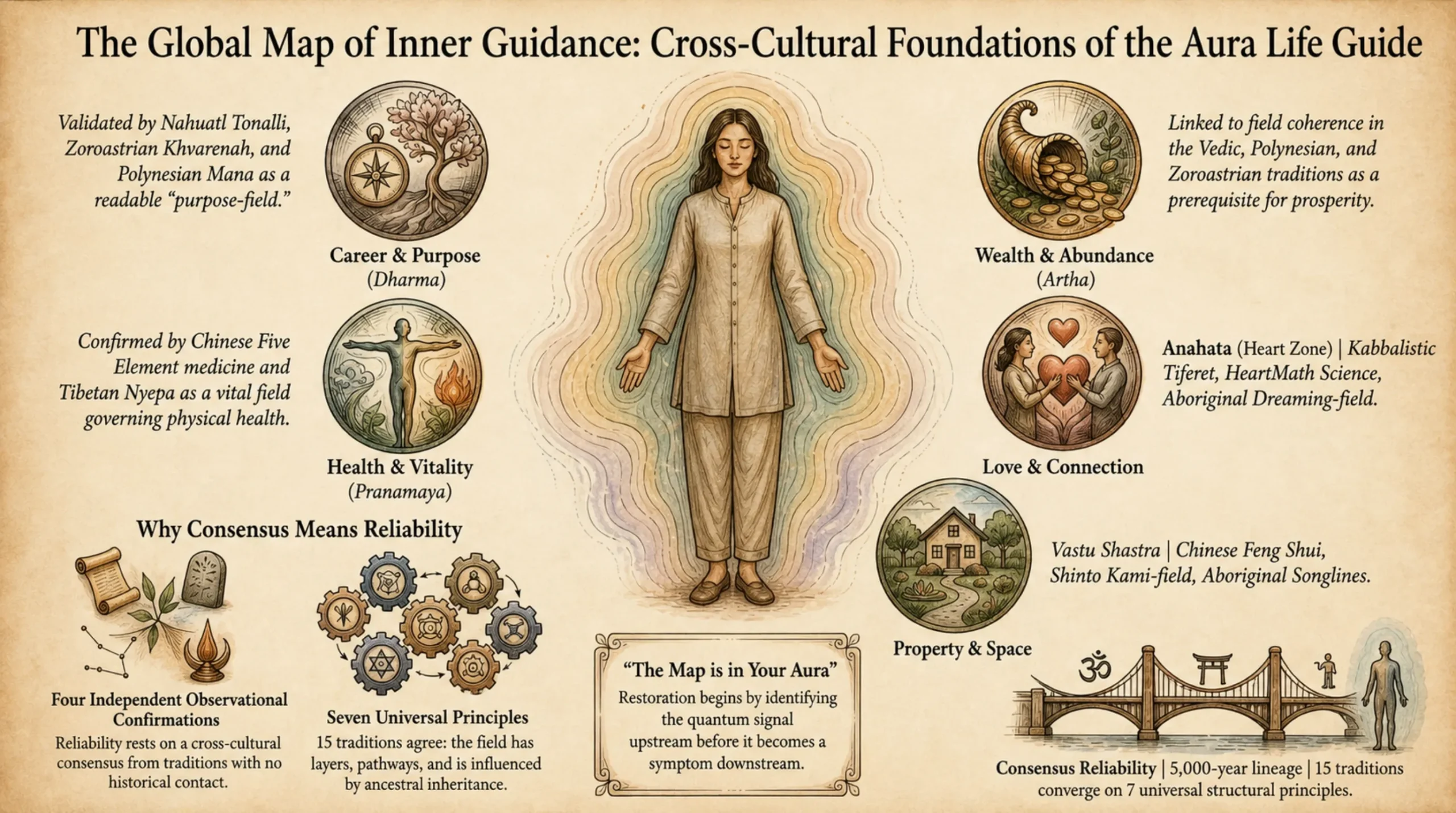
Aura Life Guide Life Area | The Vedic Tradition’s Foundation for This Dimension | Three Other World Traditions That Independently Validate This Dimension | What the Cross-Cultural Consensus Means for the Reading’s Reliability |
Career & Purpose | The Vedic concept of dharma as the individual’s unique field-expressed purpose, readable in the upper zone’s field quality and confirmed in the Jyotish chart’s dharmic indicators; the Vijnanamaya kosha (wisdom-intellect sheath) as the field layer encoding one’s purpose orientation | Nahuatl Tonalli: the head-zone soul-field associated with one’s day-sign destiny and the sun’s animating purpose-gift — the individual’s Tonalli configuration determines their destined vocational orientation in Nahuatl philosophy exactly as the dharma determines the Vedic individual’s purpose. Zoroastrian Khvarenah: the luminous glory-field that attaches to those living in Asha-alignment — the visible charisma of purpose-aligned living. Polynesian Mana: the accumulated field power of purpose-aligned action — the craftsperson, chief, and healer who acts from their true gift accumulates mana; deviation from one’s gift depletes it. | When the Vedic dharma reading of the upper zone, the Nahuatl Tonalli’s head-field configuration, the Zoroastrian Khvarenah’s luminous presence, and the Polynesian mana’s gift-accumulation — all from traditions with no historical contact at their formative period — converge on the same description of a purpose-field that is readable, variable, and consequential for life direction, the Career & Purpose reading’s reliability is not resting on a single tradition’s theory. It is resting on a cross-cultural consensus from four independent traditions each contributing a distinct observational confirmation of the same field dimension. |
Health & Vitality | The pranamaya kosha as the etheric vitality field that directly governs physical health; the seven chakras as the primary zone health indicators; the five-stage prana restoration protocol derived from the Vedic tradition’s most developed health field framework | Chinese Five Element medicine: the most systematically developed cross-cultural equivalent of the zone-specific health field assessment; specific organ-emotion-meridian-season correspondences provide a richly detailed alternative clinical vocabulary for the same zone-health relationships the aura reading assesses. Tibetan Medicine (Gso ba Rig pa): the three nyepa (wind-bile-phlegm) as constitutional field types and the twenty primary pulse qualities as field diagnostic parameters provide the most clinically developed non-Vedic health field assessment system. San Bushmen N/om healing: the boiling heat rising from the root through the crown — the most cross-culturally isolated yet structurally identical description of full-field vitality activation — provides the most compelling evidence that the vertical field activation sequence the health protocol prescribes corresponds to a universal biological reality rather than a culturally specific framework. | The Health & Vitality reading’s reliability is supported by the most extensive cross-cultural consensus of any of the five life areas: fifteen traditions describe a vital field that governs physical health, and the three named here provide the most clinically developed independent frameworks. Chinese Five Element medicine in particular has been clinically applied for four thousand years across a population now numbering 1.4 billion people — the largest single body of practical field-health clinical experience in human history, providing an independent clinical validation of the zone-specific health assessment principle that no amount of scepticism can easily dismiss. |
Wealth & Abundance | The Vedic concepts of Lakshmi (the field quality of abundance and auspiciousness that attaches to a coherent, Sattvic field); artha (prosperity as a legitimate dharmic life aim whose field foundation is the root zone’s coherence and the individual’s Jyotish wealth indicators); Kubera (the keeper of material abundance whose field blessings flow to those whose root zone and crown zone are coherently aligned) | Polynesian Mana: the most direct cross-cultural parallel to the abundance field assessment — mana is explicitly described as accumulating through skilled, righteous, gift-aligned action and as producing the material, relational, and authority resources that Western culture would recognise as abundance. Zoroastrian Khvarenah: the luminous glory-field that produces both spiritual authority and material prosperity in those who embody Asha — the oldest documented description of the abundance-field-ethics relationship. Chinese Feng Shui: the most practically applied environmental abundance-field system, explicitly mapping the home’s specific spatial zones to prosperity, relationship, health, and purpose — the most detailed environmental field framework for abundance cultivation. | The abundance-field relationship — that material prosperity flows more naturally to individuals whose field is coherent, purpose-aligned, and ethically grounded — is not a New Age concept. It is a cross-cultural consensus across the Vedic Lakshmi-artha framework, the Polynesian mana accumulation system, the Zoroastrian Khvarenah’s prosperity-righteousness relationship, and the Chinese Feng Shui prosperity-zone framework. The Wealth & Abundance reading’s reliability rests on this consensus: the reading assesses the field dimensions that all four traditions independently identify as the prerequisites for sustainable material abundance. |
Love & Connection | The Vedic Anahata chakra (heart zone) as the field’s relational centre; the concept of prema (unconditional love as the highest heart field quality); the Vedic marriage compatibility assessment through field-level Jyotish chart comparison; the karmic field as the medium through which relational connections are pre-configured before the physical meeting | Kabbalistic Tiferet: the heart Sefirah as the Tree of Life’s balancing point and the seat of divine love, placed at the exact corresponding location to the Vedic Anahata — independently identified by a tradition with no Vedic contact as the central, integrating, love-quality field node of the human system. HeartMath Institute science: the modern scientific equivalent of the heart zone’s broadcast function — independently confirming that the cardiac field’s coherence state influences nearby individuals’ physiological states, exactly as the Vedic and Kabbalistic traditions describe. Australian Aboriginal relational Dreaming-field: the understanding that significant relationships are pre-configured in the Dreaming-field before the physical meeting corresponds precisely to the Vedic concept of karmic field pre-configuration of relational encounters. | The Love & Connection reading’s heart zone assessment rests on one of the most cross-culturally confirmed single field principles in this entire article: the heart’s centrality as the field’s relational broadcast centre is confirmed in the Vedic, Kabbalistic, Chinese (heart as the Emperor organ), Tibetan (heart chakra as the seat of the Indestructible Drop containing consciousness), and modern scientific (HeartMath cardiac field broadcast) traditions — five independent confirmations of the same principle. When this many independent traditions converge on a single field location as the primary relational field zone, the reading’s heart zone focus is not a single-tradition preference. It is a cross-cultural consensus. |
Property & Space Energy | Vastu Shastra: the most systematically developed environmental field science in human history, prescribing the spatial orientation, proportion, and material composition of architectural spaces based on the directional electromagnetic field qualities described in the Vedic cosmological framework; Vastu dosha as the specific field disruption produced by incorrect spatial configuration | Feng Shui: the Chinese tradition’s equivalent of Vastu Shastra, independently arriving at a directional field quality framework (Qi flow direction, eight trigrams mapped to compass directions, specific prosperity and health zones of the home) that converges with Vastu’s fundamental principles through a completely independent observational tradition. Shinto kami-field: the Japanese understanding that specific natural and architectural sites have their own field presences (kami) that influence the wellbeing of those living or working within them — the most animistically direct equivalent of the Property & Space reading’s field-quality-of-place assessment. Australian Aboriginal songlines: the most geographically extensive energy-pathway mapping system in human history, documenting the energetic pathways across the Australian landscape that correspond to ancestral creative journeys — the most dramatic available evidence that the land’s field is a real, mappable, navigable reality that human wellbeing is responsive to. | The Property & Space Energy reading’s reliability rests on the most geographically diverse cross-cultural consensus in this table: Vastu Shastra (India), Feng Shui (China), Shinto kami-field (Japan), and Australian Aboriginal songlines (the oldest living cultural tradition on Earth at 65,000+ years) all independently converge on the same fundamental principle: the environment has its own field quality that directly influences human wellbeing, is mappable and assessable by trained practitioners, and is addressable through specific spatial, environmental, and ceremonial practices. The Property & Space reading is the most cross-culturally validated of the five life areas. |
A client from Delhi arrived at the Aura Life Guide Master Package reading carrying the vocabulary of three traditions simultaneously: her family’s Brahmin Vedic practice, her husband’s Kashmiri Shaivite lineage, and her personal decade of Zen Buddhist meditation practice. She arrived, she said, not because she was uncertain whether the field was real — all three of her traditions had confirmed that beyond doubt — but because she wanted a comprehensive, specific, current-moment reading of her field across all five life areas that her three traditions’ teachers, each expert in their own domain, had not been able to provide in the integrated format she needed to navigate the specific convergence of career, health, relationship, and property decisions she was facing simultaneously.
The reading gave her exactly that: a specific, integrated, current-moment field assessment across all five life areas, presented in the Vedic vocabulary most native to her primary tradition, with explicit cross-referencing to the Kashmiri Shaivite and Zen perspectives where the finding was particularly illuminated by those frameworks. The reading’s value was not in introducing her to the concept of the field — she needed no introduction. It was in providing the specific, current-moment, integrated reading that fifteen traditions of field understanding have always sought but only now, through the patented photo-scanning methodology and the integrated Master Package, can reliably deliver.
Are You Ready for an Aura Life Guide That Draws on Fifteen World Traditions?
Namaste, my friend — whether your tradition is the Vedic framework you were born into, the Buddhist practice you have cultivated, the Sufi lineage your family carries, or the secular scientific framework you have built your professional life around, the cross-cultural evidence in this article confirms the same thing: the field is real, it has been systematically observed across the full span of human civilisation, and reading it with precision and integrity is one of the most valuable contributions a trained practitioner can offer.
The Aura Life Guide Master Package draws on the Vedic tradition’s deepest framework — the pancha kosha system, the seven chakra zones, the three-dosha constitutional assessment, the samskara-karma causal layer reading, the Vastu environmental dimension — while situating every finding within the cross-cultural context this article has mapped. Five life areas. All seven zones. The ancestral layer’s 65,000-year cross-cultural validation. The heart zone’s five-tradition convergent confirmation. Delivered in writing, with full specificity, within 24 to 48 hours.
Using our patented photo-scanning technology and Multiple Advanced Gadgets. Drawing on eight years of practice and 1,000+ readings across India. With our money-back guarantee.
Three Steps to Your Culturally Grounded Aura Life Guide:
- Submit Photo – Upload a recent, clear photograph of yourself. Fifteen world traditions have developed the systematic observation methodology that our patented photo-scanning technology applies to your complete field across all five life areas.
- Expert Analysis – I personally decode your complete aura across all five life areas, drawing on the Vedic tradition’s deepest framework, referencing the cross-cultural convergences where they illuminate your specific field pattern, and prescribing the practices most precisely calibrated to your reading’s findings.
- Transform – Receive your personalised Aura Life Guide — complete five-area integrated analysis, cross-culturally grounded practice prescriptions, ancestral layer assessment, and environmental field guidance — delivered within 24–48 hours with our money-back guarantee.
⚠️ Disclaimer: Aura analysis and energetic guidance are for personal growth and awareness only. They are not a substitute for professional medical, financial, legal, or psychological advice. Please consult qualified professionals for any health or financial concerns.
Q1: How many world traditions describe the human aura or energy field?
At least fifteen major culturally independent world traditions describe, name, and prescribe practices for the human energy field: the Vedic tradition (prana, pranamaya kosha), Chinese Taoism (qi, meridians), ancient Egyptian (Ka, Ba, Akh), Jewish Kabbalah (Nefesh through Yechidah), Christian and Gnostic traditions (pneuma, psyche, the luminous aureole), Islamic Sufism (ruh, nafs, baraka), Tibetan Buddhism (lung, tsa, thigle), Japanese Shinto and Buddhism (ki, tama), Australian Aboriginal (Miwi, Dreaming-field, songlines), African traditional (ashe, nyama, N/om), Mesoamerican Nahuatl (Tonalli, Teyolia, Ihiyotl), Greek and Neoplatonic (pneuma, augoeides, astral body), Indigenous North American (orenda, wakanda, medicine), Polynesian and Hawaiian (mana, hau, Aumakua), and Zoroastrian Persian (Fravashi, Khvarenah). These traditions developed independently across all inhabited continents and across the full span of recorded and pre-recorded human history.
Q2: What is the oldest cultural tradition that describes the aura or energy field?
The Australian Aboriginal tradition is the oldest living cultural tradition on Earth, with a continuous transmission spanning approximately 65,000 years — making it the oldest documented human energy field tradition by a margin of tens of thousands of years. The Aboriginal Dreaming-field concept describes the field of ancestral creative power that continuously underlies physical reality; the songline system maps energy pathways across the Australian continent; and the Ngaankari healer’s practice involves direct perception of and intervention in the patient’s Miwi energy field. The word ‘aura’ itself enters English from Latin aureola (golden light) which was used to describe the luminous field in Christian sacred art, and traces through Greek to the Zoroastrian Khvarenah, one of the oldest named aura concepts at approximately 3,500 years.
Q3: What do all cultural traditions agree on about the human aura?
Seven structural principles appear in five or more of the fifteen culturally independent traditions, constituting a cross-cultural consensus: the field has multiple distinct nested layers; it has a specific pathway network carrying the life-force energy; it can be read by a trained practitioner; it is disrupted by emotional suppression, trauma, and moral violation; it carries ancestral inheritances that require active clearing; sacred sound and vibration have direct field restoration power; and the environment has its own field quality that directly affects the individual’s field. These seven principles appear consistently across traditions with no plausible mutual contact at their formative periods, suggesting they reflect observations of a real phenomenon rather than a shared cultural invention.
Q4: How does the Vedic tradition compare to other world aura traditions?
The Vedic tradition is the most structurally detailed, most practically systematised, and most clinically applied energy field science in human history. Its pancha kosha system provides the most complete multi-layer field body map; its seven-chakra system provides the most detailed zone organisation; its nadi network provides the most comprehensive energy pathway description with 72,000 named channels (independently corroborated by the Tibetan tsa channel system and the Chinese meridian system, both also describing 72,000 pathways with three primary channels); and its practice tradition — pranayama, mantra, asana, Ayurveda, Jyotish, Vastu — provides the most thoroughly tested restoration protocol library. It is the deepest single source for the aura reading’s framework, while the other fourteen traditions provide independent evidential confirmation of its core structural principles.
Q5: What is the cross-cultural evidence for the ancestral dimension of the aura reading?
The ancestral dimension of the aura reading is the most cross-culturally validated of all reading dimensions: the Vedic tradition’s pitru dosha and pitru tarpana (ancestral field debt and clearing practice), the Australian Aboriginal Dreaming-field’s continuously active ancestral presence, the Polynesian Aumakua ancestral guardian field, the Yoruba Egungun ancestral invocation, the Japanese Shinto ancestor veneration at household Butsudan shrines, the Kabbalistic gilgul (soul reincarnation carrying unresolved tikkunim), and the Tibetan tradition’s karmic constitutional field obscurations from prior lives all independently confirm that the ancestral field is a real, currently active, consequential dimension of the individual’s field. The Yehuda et al. Biological Psychiatry 2016 study’s confirmation of Holocaust survivor epigenetic patterns in their children’s DNA provides the molecular biology confirmation of this cross-cultural ancestral field inheritance consensus.