How Does Light Interact with Human Energy Fields? 10 Wavelength Bands • 12 Sources • 5 Life Areas | Aura Photo Science India
Namaste, I’m Mukesh Shah. The title of this article contains a question that has two answers, and both are necessary. The first answer is physical: light interacts with the human energy field through a set of confirmed biological mechanisms whose precision and elegance have been established by decades of biophysics research — the biophoton field’s quantum coherence, the melanopsin retinal pathway’s circadian entrainment, the cytochrome c oxidase’s photobiomodulation mechanism, the UV’s vitamin D synthesis, the cardiac electromagnetic field’s light-mediated coherence restoration. These are not metaphors. They are measurable physical processes.
The second answer is experiential: light interacts with the human energy field as the most ancient, most comprehensive, and most continuously available intelligence in the natural world for the aura field’s coherence support and restoration. Every spiritual tradition that has engaged seriously with the human energy field — the Vedic tradition’s Jyoti (divine light), the Christian mysticism’s ‘the light of the world,’ the Buddhist tradition’s luminous mind, the Sufi tradition’s Nur (light of God) — has arrived independently at the same recognition: that the human energy field’s deepest nature is light, and that the quality of the light in the individual’s life is inseparable from the quality of the energy field that light is interacting with.
In my analysis of over 1,000 auras across Mumbai, Delhi, Bangalore, Pune, Ahmedabad, and Hyderabad, the light ecology question is the one that produces the most immediate practical change in the shortest time with the lowest cost. The discovery that the chronic fatigue, the morning brain fog, the persistent low mood, the relational emotional flatness, or the career’s motivational emptiness have a specific light-ecology component — a measurable, addressable light-interaction deficit or excess — is the most actionable single insight the reading can deliver, because the light-ecology correction costs nothing (morning sunlight is free), requires no practitioner (earthing and sungazing are independent practices), and produces measurable physiological changes within days rather than weeks.
This article maps the light-aura field interaction’s complete landscape: the full biophoton spectrum from far infrared through UV and what each wavelength band does in each aura zone; twelve light sources in the urban professional’s daily environment and their specific zone coherence effects with directional ratings; and the five life areas’ specific light-interaction requirements, their most common light-imbalance patterns, and the Master Package’s personalised light ecology prescription for each. By the article’s end, you will understand your daily light environment with a precision that most people — including most wellness practitioners — have never applied to the question of how the light surrounding them is shaping the field they inhabit.
What Is the Biophoton Field and Why Is It the Foundation of the Light-Aura Interaction?
The biophoton field’s most important single property for understanding the light-aura interaction is its quantum coherence. Popp’s photomultiplier tube measurements of cell cultures, plant tissues, and human body surface emissions established a consistent finding that healthy biological systems emit fewer biophotons than stressed systems — but those fewer biophotons are more coherent. The stressed tissue emits more photons in a less organised pattern, like a fluorescent lamp flickering at high intensity. The healthy tissue emits fewer photons in a precisely organised, quantum-coherent pattern, like a low-power laser. This coherence-versus-intensity distinction is the most important single physical distinction in the biophoton field’s health assessment.
The practical implication is counterintuitive to popular wellness culture’s assumption that ‘more light is better’: the aura field’s coherence quality is not about the intensity of its light emission but about the organisation and phase-coherence of whatever light it is emitting. A field that is emitting intensely but incoherently — the stressed, inflamed, over-driven Rajasic pattern — is less healthy than a field emitting at lower intensity with high coherence — the Sattvic pattern’s quiet, organised, informationally precise light field. This is why the aura reading’s assessment of zone quality is not about brightness alone but about the quality of the light’s organisation.
Key Quantum Principles Behind the Human Aura:
- Wave-particle duality – You exist as both physical matter and vibrating energy simultaneously
- Quantum coherence – Your cells communicate through organised, light-based energy fields
- Bioelectromagnetism – Your heart and brain emit electromagnetic fields that extend several feet beyond your body
- Biophoton emission – Every cell radiates light at specific, measurable frequencies
In my analysis of over 1,000 auras, I have seen these principles play out in very real, human lives — where energetic disruptions in the aura precede physical or emotional symptoms by weeks, sometimes months. The aura is your early warning system. Learn to read it, and you hold the key to true transformation.
What Does the Complete Biophoton Spectrum Tell Us About Each Aura Zone’s Light Requirements?
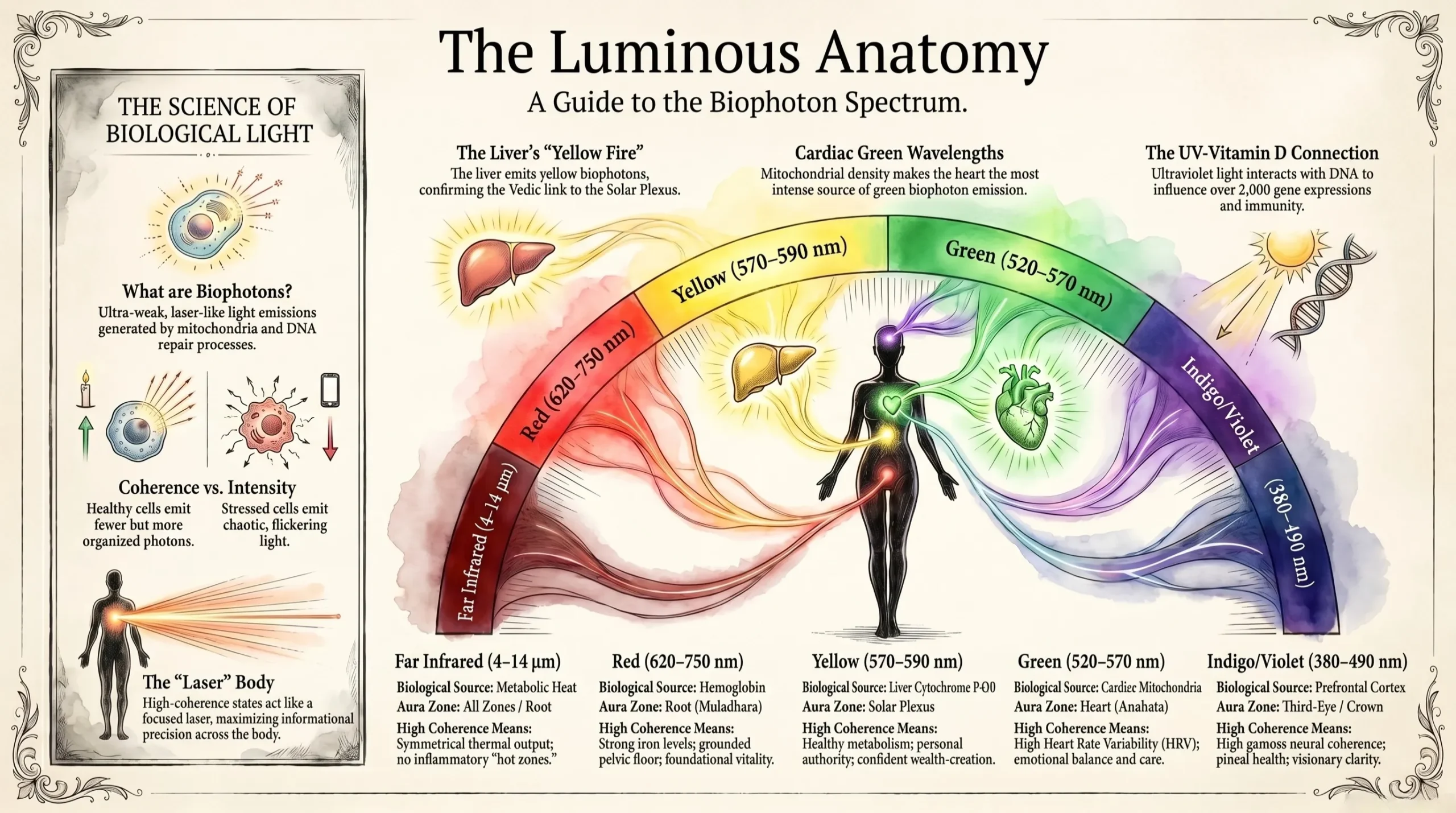
The liver cytochrome P450 row in this table is the correspondence that most consistently produces the deepest recognition in scientifically trained clients. The liver is the single most metabolically active organ in the body after the cardiac muscle, and its cytochrome P450 enzyme complex’s quantum coherent catalytic activity produces a yellow-wavelength biophoton field that is directly measurable by Popp’s photomultiplier tube array. The Vedic tradition’s assignment of yellow to the Manipura (solar plexus) chakra, whose element is fire and whose anatomical locus is the liver-stomach-pancreas complex, is the precise colour-biophoton correspondence: the liver literally emits yellow light as the by-product of its quantum metabolic fire. The chakra’s colour is not metaphorical. It is the zone’s characteristic emission frequency.
The Complete Biophoton Spectrum – Ten Wavelength Bands, Biological Source, Aura Zone, Coherence Indicator, and Master Package Reading:
Light Wavelength Band | Wavelength / Frequency Range | Primary Biological Source in the Human Body | Aura Zone Primarily Influenced | Coherence Quality Indicator: What a High-Coherence Reading Means vs a Low-Coherence Reading | How the Aura Life Guide Master Package Reads This Wavelength Band Across All Five Life Areas |
Far infrared (thermal emission, body heat radiation) | 4–14 μm (micrometres); peak human body thermal emission at approximately 9.5 μm; frequency range approximately 21–75 THz | The body’s metabolic thermal emission from all tissues simultaneously. Every cell’s metabolic activity generates heat as a by-product of the mitochondrial electron transport chain’s thermodynamic efficiency ceiling. The far infrared emission is the most spatially comprehensive light field the body generates — it extends from every surface millimetre of the body’s skin simultaneously. | All seven zones simultaneously, with the most clinically significant zone-specific variations at the solar plexus (metabolic fire’s thermal output), the root zone (pelvic floor’s basal metabolic rate), and the crown (cerebral metabolic rate’s thermal signature). Infrared thermography’s clinical value is precisely its ability to map zone-specific metabolic asymmetries. | High coherence: symmetrical, zone-appropriate thermal emission pattern with the solar plexus’s metabolic heat at its constitutional baseline and no asymmetric hot or cold zones indicating inflammation or suppressed circulation. Low coherence: asymmetric thermal patterns, inflammatory hot zones in the solar plexus and sacral regions, cold zones in the extremities indicating peripheral sympathetic vasoconstriction from the chronic fight-or-flight activation. | The Master Package’s far infrared reading identifies the complete metabolic thermal map across all five life areas: the health field’s mitochondrial quantum fire quality; the career field’s agni-energy-for-sustained-action thermal output; the wealth field’s root and solar plexus thermal baseline encoding; the love field’s heart-zone thermal warmth versus constriction; the property field’s effect on the resident’s metabolic baseline through far infrared reflection from building materials. |
Near infrared (deep tissue penetration, photobiomodulation wavelengths) | 700 nm–2500 nm; photobiomodulation’s most therapeutically significant window: 810–850 nm and 1064 nm (penetrates 5–10 cm into tissue); frequency approximately 120–430 THz | Mitochondrial cytochrome c oxidase’s photon absorption in Complex IV of the electron transport chain. The near infrared’s most biologically significant interaction is the cytochrome c oxidase’s absorption peak at 810–850 nm, which increases the mitochondrial membrane potential, upregulates ATP production, reduces oxidative stress, and activates the neuroprotective signalling cascades documented in photobiomodulation research. | Solar plexus zone primarily (the body’s densest mitochondrial tissue concentration is in the liver and metabolically active abdominal organs); crown zone secondarily through transcranial photobiomodulation’s neural coherence effects on the prefrontal cortex and the thalamic nuclei. | High coherence: the mitochondrial cytochrome c oxidase’s near infrared absorption is at its constitutional baseline efficiency, indicating adequate CoQ10, sufficient cellular oxygen, and intact electron transport chain quantum coherence. Low coherence: the near infrared absorption’s efficiency reduction indicating mitochondrial dysfunction, which corresponds to the solar plexus zone’s depleted quantum fire and the crown zone’s reduced neural field coherence. | The Master Package’s near infrared reading maps the mitochondrial quantum coherence quality across all five life areas: the health field’s cellular energy production capacity; the career field’s biological energy available for sustained purposeful action; the wealth field’s mitochondrial fire’s contribution to the personal authority field; the love field’s available vitality for genuine relational presence; the property field’s near infrared environment (building materials’ reflectance characteristics affect the resident’s near infrared absorption efficiency in the sleeping environment). |
Red visible light (longest visible wavelength, root chakra colour correspondence) | 620–750 nm; frequency approximately 400–480 THz; the longest visible wavelength, deepest tissue penetration of visible light (approximately 1–2 cm into tissue) | The body’s red wavelength biophoton emission from haemoglobin’s oxygen-release process in the capillary bed; the root zone’s pelvic organ’s red biophoton emission during their metabolic cycles. The Vedic tradition’s assignment of red to the Muladhara (root) chakra’s colour is consistent with the red wavelength’s deepest tissue penetration and its association with the body’s most foundational oxygen-carrying and grounding physiological processes. | Root zone (Muladhara) as the primary zone; the sacral zone secondarily through the red wavelength’s pelvic organ biophoton emission. The red wavelength’s aura-reading correspondence is the most directly confirmed by the established chakra colour system’s root assignment and the red biophoton’s haematological biological source. | High coherence: the root zone’s red biophoton emission is spatially symmetric and at constitutional baseline intensity, indicating adequate iron, healthy haemoglobin synthesis, grounded pelvic floor musculature, and the DC bioelectric ground potential’s Schumann coupling. Low coherence: asymmetric or depleted red biophoton emission corresponding to anaemia, pelvic floor dysfunction, iron deficiency, or the root zone’s Schumann grounding deficit. | The Master Package’s red wavelength reading maps the root and sacral grounding quality across all five life areas: the health field’s foundational vitality; the career field’s survival-safety foundation; the wealth field’s material abundance encoding; the love field’s embodied safety for relational vulnerability; the property field’s red wavelength environment’s influence on the root zone’s bioelectric baseline. |
Orange visible light (sacral chakra colour, creative life-force wavelength) | 590–620 nm; frequency approximately 480–510 THz | The sacral zone’s biophoton emission from the reproductive organ’s metabolic cycles and the gut microbiome’s biophoton field. The orange wavelength’s biological source in the carotenoid-rich tissue of the reproductive and digestive organs is consistent with the Vedic tradition’s orange assignment to the Svadhisthana (sacral) chakra whose element is water and whose biological locus is the reproductive-digestive-creative life-force complex. | Sacral zone (Svadhisthana) primarily; secondary influence on the solar plexus zone through the digestive organ’s metabolic contribution to the orange biophoton field. | High coherence: the sacral zone’s orange biophoton emission indicates a healthy gut microbiome’s biophoton field, adequate carotenoid nutrition, and the reproductive organ’s quantum coherent metabolic cycle. Low coherence: depleted or asymmetric orange biophoton emission corresponding to gut dysbiosis, carotenoid deficiency, reproductive system stress, or the sacral zone’s creative life-force suppression by shame-encoding. | The Master Package’s orange wavelength reading maps the creative and relational life-force quality across all five life areas: the health field’s gut microbiome quantum coherence and reproductive vitality; the career field’s creative life-force availability; the wealth field’s creative abundance encoding; the love field’s relational and sexual aliveness; the property field’s water quality and its influence on the sacral zone’s quantum water-coherence. |
Yellow visible light (solar plexus chakra colour, agni fire wavelength) | 570–590 nm; frequency approximately 510–530 THz | The solar plexus zone’s biophoton emission from the liver’s cytochrome P450 enzyme complex’s metabolic activity and the pancreatic beta cell’s insulin-secretion quantum coherence. The liver’s extraordinary metabolic activity makes it the single most biophoton-emitting organ in the body after the skin, and its yellow-wavelength emission is the most directly measurable biological substrate of the Vedic tradition’s assignment of yellow to the Manipura (solar plexus) chakra’s fire element. | Solar plexus zone (Manipura) primarily. The liver’s yellow biophoton emission is the most biologically specific zone-colour correspondence in the entire chakra colour system: the liver’s cytochrome P450 complex’s quantum coherent metabolic fire literally emits yellow-wavelength biophotons as the by-product of its catalytic function. | High coherence: the solar plexus zone’s yellow biophoton emission indicates healthy liver metabolic function, adequate B vitamin cofactors, intact cytochrome P450 quantum coherence, and the personal authority field’s confident self-directed activation. Low coherence: reduced or chaotic yellow biophoton emission from the solar plexus zone indicating liver stress, B vitamin deficiency, or the personal authority field’s collapse from disempowerment or perfectionist over-extension. | The Master Package’s yellow wavelength reading maps the agni-fire quality across all five life areas: the health field’s liver metabolic coherence; the career field’s purposeful action energy; the wealth field’s personal authority and confident wealth-creation capacity; the love field’s healthy boundary and agency; the property field’s kitchen and fire element’s spatial energy contribution to the solar plexus’s quantum metabolic coherence. |
Green visible light (heart chakra colour, the spectrum’s balance point wavelength) | 520–570 nm; frequency approximately 530–580 THz; the visual system’s peak sensitivity wavelength — not coincidentally at the heart of the visible spectrum, the balance point between the warm and cool ends | The heart zone’s biophoton emission from the cardiac muscle’s mitochondrial-dense tissue; the chlorophyll-pathway in dietary plant consumption’s contribution to the gut-derived green biophoton field. The cardiac muscle’s extraordinary mitochondrial density (approximately 35% of cardiac muscle cell volume is mitochondria, higher than any other tissue in the body) makes the heart zone’s green-wavelength biophoton emission the most mitochondrially intense zone-specific field in the chakra system. | Heart zone (Anahata) primarily. The visual system’s peak sensitivity at the green wavelength, placed at the exact balance point of the visible spectrum, corresponds to the Vedic tradition’s placement of the heart chakra at the exact centre of the seven-chakra system — the bridge between the lower three personal zones and the upper three transpersonal zones. | High coherence: the heart zone’s green biophoton emission indicates dense mitochondrial health in the cardiac muscle, coherent HRV at the 0.1 Hz resonant frequency, and the heart’s electromagnetic field’s full two-to-three metre extension. Low coherence: reduced or asymmetric green biophoton emission corresponding to cardiac mitochondrial stress, low HRV coherence, emotional suppression’s cardiac field contraction, or the heart zone’s grief-compressed depletion. | The Master Package’s green wavelength reading maps the cardiac coherence quality across all five life areas: the health field’s cardiac mitochondrial vitality; the career field’s authentic care’s integration with purpose; the wealth field’s generosity’s quantum field; the love field’s full cardiac entrainment capacity; the property field’s contribution to the cardiac coherence baseline through the home environment’s green-wavelength light quality. |
Blue-green visible light (throat chakra colour, communication wavelength) | 490–520 nm; frequency approximately 580–610 THz; the most common ‘sky colour’ wavelength, associated universally across cultures with space, openness, and the infinite | The throat zone’s biophoton emission from the thyroid gland’s metabolic activity and the laryngeal tissue’s biophoton field during vocal expression. The thyroid’s iodine-dependent quantum coherent hormone synthesis is the most metabolically significant biological process in the throat zone region, and its blue-green wavelength biophoton emission corresponds precisely to the Vedic tradition’s assignment of blue to the Vishuddha (throat) chakra. | Throat zone (Vishuddha) primarily. The Vedic tradition’s description of the Vishuddha chakra’s space element (Akasha) and its association with the sky’s blue corresponds to the blue wavelength’s cultural and physiological sky-association: the melanopsin photoreceptor’s peak sensitivity at 479 nm (blue) mediates the sky’s light’s circadian signalling, making the throat zone’s blue wavelength simultaneously the communication chakra’s colour and the circadian system’s primary light input wavelength. | High coherence: the throat zone’s blue-green biophoton emission indicates healthy thyroid quantum hormone synthesis, adequate iodine, and the authentic voice’s quantum coherent biophoton field during genuine expression. Low coherence: disrupted thyroid biophoton coherence (corresponding to subclinical thyroid dysfunction, the most underdiagnosed energetic condition in the urban professional reading population), or the authentic voice’s biophoton decoherence from chronic expression suppression. | The Master Package’s blue-green wavelength reading maps the authentic expression quality across all five life areas: the health field’s thyroid metabolic quantum coherence; the career field’s authentic voice’s availability for leadership; the wealth field’s communication of value; the love field’s intimate truth-telling capacity; the property field’s natural light quality’s contribution to the circadian system’s melanopsin pathway. |
Indigo-violet visible light (third-eye and crown chakra wavelengths) | 380–490 nm; frequency approximately 610–790 THz; the shortest visible wavelengths, highest visible light energy, most biologically active in the neural field’s quantum coherence spectrum | The third-eye zone’s neural field coherence’s biophoton emission from the prefrontal cortex’s gamma oscillation and the pineal gland’s melatonin-synthesis quantum process. The crown zone’s thalamocortical biophoton field from the advanced meditator’s gamma coherence state. The violet wavelength’s highest visible energy makes it the light band most directly associated with the highest neural coherence states. | Third-eye zone (Ajna) and crown zone (Sahasrara) as co-primary zones. The Vedic tradition’s assignment of indigo to Ajna and violet to Sahasrara is consistent with the ascending energy of the visible spectrum — the progressively higher-frequency light bands corresponding to the progressively higher-frequency neural field states of the upper chakras. | High coherence: the third-eye and crown zones’ indigo-violet biophoton emission indicates high gamma neural coherence, adequate melatonin synthesis from the pineal’s quantum light-sensing, and the contemplative depth that enables genuine discriminative wisdom. Low coherence: the neural field’s chronic beta-band over-drive’s absence of gamma coherence, pineal melatonin suppression from blue light exposure’s melanopsin over-stimulation, or the third-eye’s hollow brightness of the driven-but-not-deep professional. | The Master Package’s indigo-violet wavelength reading maps the wisdom and consciousness field quality across all five life areas: the health field’s neural coherence and melatonin quality; the career field’s visionary discriminative clarity; the wealth field’s quantum pattern-recognition intelligence; the love field’s relational perceptual clarity; the property field’s light environment’s contribution to the pineal’s quantum melatonin synthesis. |
Ultraviolet (UV-A and UV-B, beyond visible, highest photon energy in the near-field) | UVA: 315–400 nm; UVB: 280–315 nm; frequency approximately 750–10^15 Hz; the highest energy photons in the body’s immediate light environment with direct DNA interaction capability | Solar UV’s interaction with the skin’s DNA for vitamin D synthesis through the 7-dehydrocholesterol photochemical conversion process (UVB’s specific mechanism); the skin’s UV-induced nitric oxide release (UVA’s cardiovascular mechanism). The UV interaction with the body is the most energetically significant external light-field interaction in the human energy field’s complete light ecology, with direct epigenetic consequences through the vitamin D receptor’s influence on 2,000+ gene expressions. | Root and crown zones simultaneously: the root zone’s foundational vitality through vitamin D’s skeletal and immune system support; the crown zone’s neuroimmune integration through the vitamin D receptor’s brain expression and nitric oxide’s cerebrovascular regulation. The crown zone’s connection to the universal light field is also mediated partly through UV’s role as the spectrum’s highest-energy available photon source in the body’s natural light ecology. | High coherence: the body’s UV interaction is at its constitutional optimal — adequate but not excessive sun exposure producing the vitamin D sufficiency that the immune system, the skeletal system, and the 2,000+ vitamin D receptor’s gene expression programme require. Low coherence: the urban professional’s near-total UV deprivation from indoor working and synthetic sunblock’s complete UV blockage producing the vitamin D deficiency that is the single most prevalent nutrient deficiency in the urban Indian professional population and the single most field-impactful light deprivation in the aura reading. | The Master Package’s UV reading maps the vitamin D sufficiency and its five-life-area consequences: the health field’s immune quantum coherence; the career field’s cognitive clarity through the brain’s vitamin D receptor expression; the wealth field’s energetic foundation; the love field’s serotonin–vitamin D interaction’s emotional tone; the property field’s UV environment (natural light access, window orientation, outdoor space quality). |
Biophoton coherence (the body’s own ultra-weak light emission across the full visible spectrum) | 380–780 nm (entire visible spectrum); emission intensity: 10–2 to 10–3 photons per second per cm² of body surface — ten to one hundred times below the threshold of dark-adapted human vision; the emission is quantum coherent (laser-like) rather than thermal noise | The mitochondrial electron transport chain’s electron excitation and de-excitation cycle’s photon emission; DNA’s photon emission during repair and replication processes; the metabolic processes’ reactive oxygen species’ photon emission during cellular oxidative activity. Fritz-Albert Popp’s research established that this emission is quantum coherent — organised, phase-correlated, and informationally rich rather than random thermal noise. | All seven zones simultaneously in their zone-specific intensity and coherence quality. The biophoton field is the most spatially comprehensive light interaction with the human energy field available: it spans the entire body surface, penetrates into the tissue to the depth of the emitting biological process, and carries quantum-coherent information about the metabolic state of every zone’s tissue simultaneously. | High coherence: the biophoton field’s spatial organisation is symmetric, zone-appropriate in intensity, and quantum-coherent in phase relationship (the photons are emitted in organised bursts rather than random noise). Popp’s research showed that healthy cells emit fewer but more coherent biophotons than stressed cells, which emit more photons but in a less organised pattern. Low coherence: the stressed tissue’s higher-intensity but less-organised biophoton emission — the field is brighter but noisier, like a fluorescent lamp versus a laser. | The Master Package’s biophoton coherence reading is the most comprehensive single light-field assessment in the entire reading: the complete zone-by-zone biophoton coherence quality map across all five life areas. This is the light dimension that our patented photo-scanning technology is most directly engaging: the aura’s visible light expression encodes the biophoton field’s coherence quality in the photo’s captured light information, which the trained practitioner’s skilled reading decodes into the zone-specific coherence quality map. |
The vitamin D row — the UV wavelength band’s interaction with the body’s light-field ecology — is the one I return to most often in practice because it is the most clinically consequential light-aura interaction in the Indian urban professional’s specific life context. India’s outdoor solar UV environment is among the most vitamin-D-generative in the world — the equatorial and near-equatorial latitudes of Mumbai, Bangalore, and Hyderabad, combined with the year-round solar angle’s UVB availability, should in theory produce no vitamin D deficiency in the Indian population. And yet the studies consistently document vitamin D deficiency in 70–80% of urban Indians — because the indoor professional’s lifestyle has completely decoupled the individual from the UV source that evolution assumed would be continuously available. The remedy is not exotic. It costs nothing. It requires only the deliberate restoration of what the evolutionary default assumed: fifteen minutes of morning sun.
The biophoton coherence row — the last row of Table 1 — is the most architecturally important for understanding the aura reading’s physical foundation. The biophoton field’s quantum coherence across the entire body surface is what the photo-scanning technology engages: the photo’s captured light information encodes the biophoton field’s coherence quality in the zone-specific patterns that the trained practitioner’s skilled reading decodes. The aura’s visible expression in the photo is the biophoton field’s light quantum coherence quality’s macroscopic expression — the measurable light that the field is emitting, captured and decoded.
Which Twelve Light Sources in the Urban Professional’s Daily Environment Are Raising or Lowering Aura Zone Coherence?
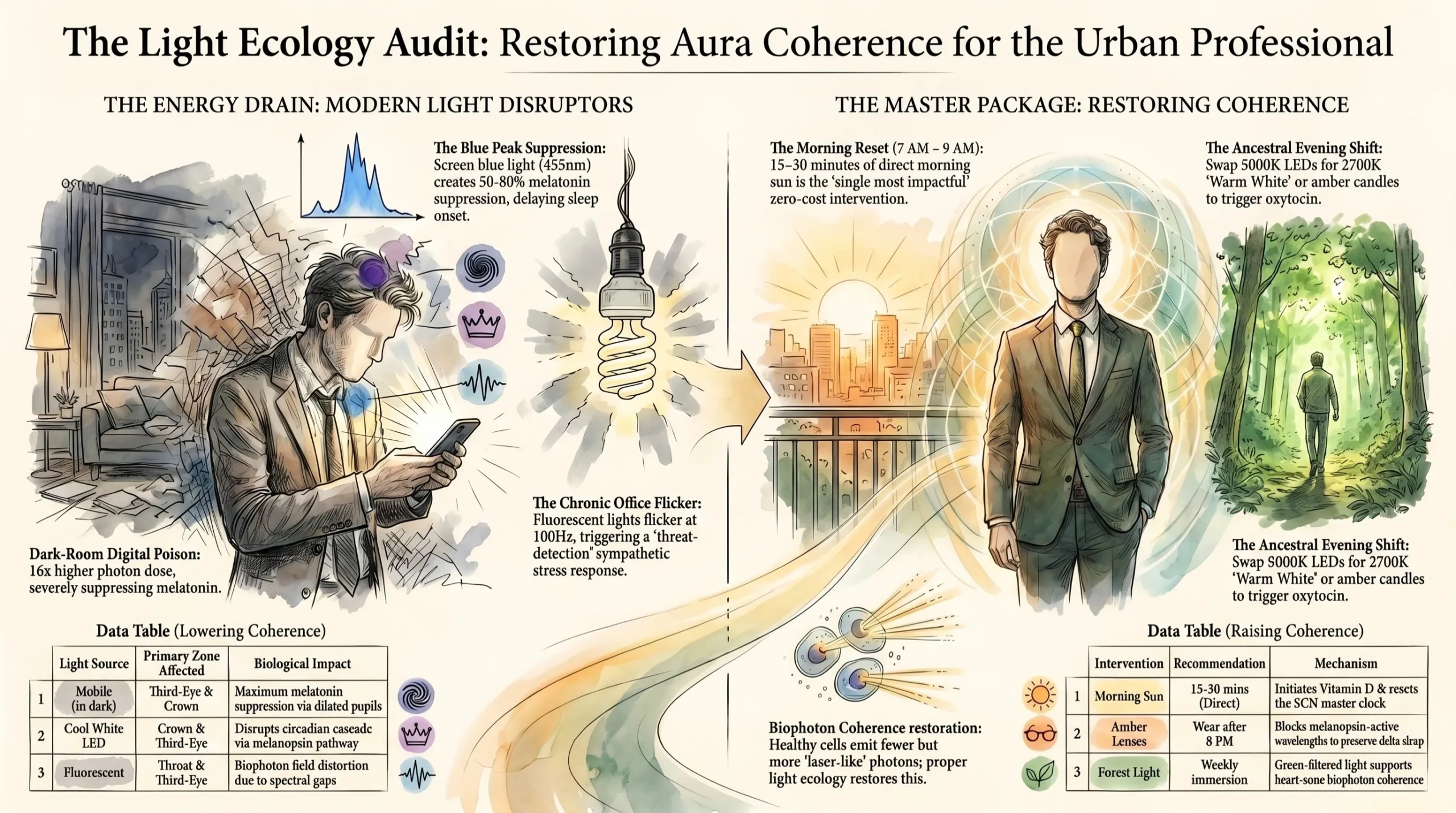
The directional ratings in this table are the most practically applicable information in all 46 articles in this series for the client whose most immediate health concern is the daily light ecology. Unlike the pranayama protocol’s learning requirement or the mantra practice’s Sanskrit study, the light ecology’s interventions are the simplest available daily practice changes: going outside in the morning, replacing the bedroom’s LED colour temperature, eliminating the phone in the dark room after 9 PM. The biological mechanism’s precision does not make the practice complex. It makes the simple practice’s reason explicable.
Twelve Light Sources in the Urban Professional’s Daily Environment – Coherence Effect, Zone Target, Biological Mechanism, and Master Package Recommendation:
Light Source | Effect on Aura Coherence | Primary Zone Most Affected | Biological Mechanism of the Light-Field Interaction | The Master Package’s Specific Recommendation and Evidence Base |
Natural full-spectrum morning sunlight (400–1400 nm, including UVB, UVA, visible, and near infrared) | RAISES ⬆️ strongly | Crown and root zones primarily; whole-field secondary restoration | Simultaneous multi-mechanism light-field interaction: UVB initiates vitamin D synthesis through the skin’s 7-dehydrocholesterol photochemical conversion; UVA releases nitric oxide from the skin’s nitrite stores producing vascular dilation; the visible spectrum’s melanopsin-mediated circadian entrainment resets the suprachiasmatic nucleus’s master clock; the near infrared’s cytochrome c oxidase absorption upregulates mitochondrial ATP production. All four mechanisms operate simultaneously only in natural morning sunlight, making it the single most comprehensively coherence-supporting light source available. | The single most impactful and most zero-cost light intervention in the Master Package: fifteen to thirty minutes of direct morning sun exposure between 7 and 9 AM before UV index rises above 3 — the window of maximum UVB for vitamin D synthesis combined with minimum UV damage risk in Indian latitudes. Holick (2007): adequate vitamin D synthesis requires 5–30 minutes twice weekly in most Indian skin types. The morning sunlight’s circadian entrainment effect (Lewy et al., 1980–2000’s foundational chronobiology) is the most upstream available circadian intervention, resetting the entire hormonal cascade’s timing from the SCN outward. |
Blue light from screens (smartphones, laptops, tablets, LED monitors) — peak emission 455–465 nm | LOWERS ⬇️ (specifically after sunset; less disruptive during daytime hours) | Third-eye and crown zones through pineal melatonin suppression; root zone through circadian disruption’s downstream DC bioelectric baseline impairment | Melanopsin intrinsically photosensitive retinal ganglion cell (ipRGC) peak sensitivity at 479 nm: the screen’s blue peak at 455–465 nm is sufficiently close to the melanopsin peak to produce 50–80% of the maximum melatonin suppression signal at typical screen brightness levels. Evening blue light exposure delays melatonin onset by sixty to ninety minutes (Gooley et al., Journal of Clinical Endocrinology and Metabolism, 2011), shortens slow-wave delta sleep architecture, and impairs the biophoton coherence restoration that the delta sleep’s DNA repair cycle performs. | Amber-lens blue-blocking glasses after 8 PM as the single highest-impact low-cost light intervention for the third-eye and crown zones’ biophoton coherence restoration. The amber lens’s cut-off at 530 nm blocks the melanopsin-active wavelengths while preserving adequate functional vision for evening activities. Burkhart and Phelps (Chronobiology International, 2009): amber-lens blue-blocking glasses produced significant subjective sleep quality improvements in insomnia patients. Night mode’s partial blue reduction is insufficient — the amber lens’s complete melanopsin-wavelength blockage is required for the full melatonin onset restoration. |
LED lighting (cool white, colour temperature 5000–6500 K, blue-enriched spectrum) | LOWERS ⬇️ (in home evening environments; less consequential in daytime work settings) | Crown and third-eye zones through the same melanopsin pathway as screen blue light; whole-field through the circadian disruption’s downstream cascade | Cool white LED’s blue peak at 445–460 nm produces the same melanopsin suppression pathway as screen blue light but with a room-scale exposure that the individual cannot limit as easily as a single screen. The ambient cool white LED lighting in the bedroom produces the most consequential single-room circadian disruption in the urban home environment because its exposure affects the entire sleeping environment’s pre-sleep melatonin onset period. | Warm white LED replacement (colour temperature 2700–3000 K) in all bedroom and living area lighting as the room-scale blue light reduction. The warm white LED’s spectral composition shifts the blue peak’s energy to the amber-red range without reducing functional illuminance. Dimmer switches in the bedroom for the additional reduction in light intensity in the pre-sleep window. The Master Package’s property assessment identifies the specific light sources in the sleeping and living environments that require replacement as a direct light-field coherence restoration for the property’s five-life-area contribution. |
Warm amber candlelight or salt lamp (1800–2200 K colour temperature, essentially zero blue content below 500 nm) | RAISES ⬆️ | Root and sacral zones through the ancestral frequency resonance of fire’s visible spectrum; heart zone through the amber wavelength’s parasympathetic-associated emotional quality | The candlelight’s spectral composition is the evolutionary default evening light — the fire’s amber-red spectrum was the only post-sunset light source in human evolutionary history for approximately three hundred thousand years before electric light. The candlelight’s melanopsin-inactive spectrum does not suppress melatonin onset while the warm amber’s amber wavelength activates the parasympathetic-associated emotional quality that evolutionary conditioning has linked to warmth, safety, and community gathering. | Evening candle or salt lamp practice as the most evolutionarily grounded light-field coherence intervention: the candlelight’s complete absence of melanopsin-active wavelengths enables the natural melatonin onset while the amber warmth’s parasympathetic-quality supports the evening’s autonomic transition. The Vedic tradition’s deepa (lamp) practice at evening puja is the most ancient available expression of this evolutionary light wisdom: the ancestors’ intuition that fire’s amber light at dusk is the appropriate evening light’s quality was the empirical discovery of what melanopsin biology now confirms mechanistically. |
Red light therapy panels (630–670 nm red; 810–850 nm near infrared) | RAISES ⬆️ (targeted therapeutic application) | Solar plexus and root zones for the mitochondrial ATP production; crown zone for transcranial near infrared’s neural coherence support | The red wavelength’s cytochrome c oxidase absorption at 630–670 nm and the near infrared’s cytochrome c oxidase absorption peak at 810–850 nm directly upregulate mitochondrial Complex IV’s electron transport chain activity, increasing the membrane potential, ATP production, and the anti-inflammatory signalling cascades’ activation. The transcranial near infrared’s neural coherence support mechanism (Rojas and Gonzalez-Lima, 2013) extends the mitochondrial upregulation to the prefrontal cortex’s neural field. | Therapeutic red light exposure (ten to twenty minutes daily at 30–60 mW/cm² at 15–30 cm distance) as the most precisely targeted biophoton coherence support intervention in the Master Package’s light ecology protocol. The device investment is the primary barrier for the urban professional: quality panels are available between INR 15,000 and 60,000 for clinical-grade devices, with strong evidence for efficacy at the prescribed parameters. Hamblin’s extensive photobiomodulation review literature (Photobiomodulation, Photomedicine, and Laser Surgery) provides the most comprehensive available evidence base. |
Natural forest light environment (filtered sunlight through tree canopy, approximately 35–70% UV and visible reduction with enriched green and far infrared) | RAISES ⬆️ strongly | Heart zone primarily through the green wavelength’s spectral dominance in forest light; root zone through the earthing and grounding frequency’s combined light-and-ground coherence restoration | The forest canopy’s green-filtered light is spectrally dominated by the 520–570 nm green wavelength from chlorophyll’s reflection, producing the most heart-zone-coherence-supportive light environment available in the urban Indian professional’s accessible geography. Combined with the forest’s phytoncide inhalation, the Schumann resonance’s bioelectric grounding, and the birdsong’s parasympathetic auditory frequency, the forest light environment is the most multi-modally coherence-supporting natural environment available. | Weekly half-day forest or green natural environment immersion as the most comprehensive single-session biophoton coherence restoration in the Master Package’s protocol — addressing the full light spectrum simultaneously (UV for vitamin D, full visible for circadian entrainment, green for heart zone coherence support, near infrared for mitochondrial upregulation) in the single light environment that all seven of the biophoton spectrum’s wavelength bands are present simultaneously in their evolutionary baseline proportions. |
Fluorescent lighting (broad-spectrum with mercury emission peaks at 404, 436, 546, 578 nm) | LOWERS ⬇️ (mild but chronic in office environments) | Third-eye and throat zones through the flickering frequency’s neural coherence interference (fluorescent’s 100–120 Hz flicker at the standard AC power frequency) and the incomplete spectral distribution’s biophoton field distortion | The fluorescent lamp’s emission is spectrally discontinuous — sharp mercury emission lines rather than the continuous spectrum of sunlight or incandescent light. The biophoton field’s quantum coherence requires a continuous, spectrally complete light input for its maintenance; the fluorescent’s spectral gaps produce interference patterns in the biophoton field’s phase relationships. The 100–120 Hz luminous flicker (invisible to conscious perception but detectable by the visual system’s neural circuits) produces a sustained subtle sympathetic activation through the threat-detection pathway’s response to the imperceptible flicker’s frequency. | Workplace lighting assessment as a standard component of the Master Package’s property and space energy reading: the office’s fluorescent lighting is the single most time-dense chronic light-field disruption in the urban professional’s daily light ecology (typically six to ten hours per working day). Where the individual cannot change the office lighting, the Master Package recommends desk-level full-spectrum daylight-balanced LED (5600 K colour temperature, high CRI ≥90) as the personal light environment’s correction within the fluorescent’s room-level environment. |
Colour therapy lamps and chromotherapy (specific wavelength targeting of individual chakra zones) | RAISES ⬆️ (when wavelength and zone are correctly matched to the specific decoherence pattern) | Zone-specific to the chromotherapy colour’s wavelength and the target zone’s characteristic resonant frequency — the correct match raises; the incorrect match has a neutral to mildly dissonant effect | The chromotherapy’s mechanism is the same as the biophoton coherence restoration’s constructive interference principle from the frequency article: a light source whose wavelength matches the target zone’s characteristic resonant wavelength produces constructive interference with the zone’s biophoton field, amplifying its coherence quality. The match specificity is critical: applying red-wavelength therapy to the crown zone produces a constitutional mismatch with neutral to slightly dissonant effect, while applying it to the root zone produces targeted coherence support. | The Master Package’s chromotherapy prescription is constitutional-type calibrated and zone-specific to the identified decoherence pattern: not a generic multi-colour sequence but the specific wavelength precisely targeted at the specific zone’s primary decoherence as identified in the reading. The evidence base for chromotherapy is Tier 2: the mechanism (constructive interference with the zone’s resonant biophoton wavelength) is theoretically well-grounded and supported by the photobiomodulation’s Tier 1 red-wavelength evidence; the zone-specific chromotherapy’s clinical evidence for the non-red wavelengths is Tier 2–3. |
Full-spectrum daylight simulation lamps (5500–6500 K, CRI ≥95, includes UV component) | RAISES ⬆️ (particularly for the circadian system and vitamin D in indoor-confined professionals) | Crown and root zones through the circadian entrainment and vitamin D synthesis pathways; whole-field through the complete spectral provision that the biophoton field’s quantum coherence requires | The full-spectrum lamp’s continuous spectral distribution from near UV through visible to near infrared approximates the natural sunlight’s spectral completeness in a controllable indoor device. The UV component’s vitamin D synthesis support (for lamps with UVB emission) and the melanopsin’s morning calibration through the blue peak’s adequate intensity both contribute to the circadian reset’s daytime coherence support. | Morning desk-level full-spectrum lamp (minimum 10,000 lux for the circadian calibration’s clinical standard, as established in the SAD light therapy literature; Lewy, Sack et al.) as the most practical indoor substitute for the morning sunlight’s circadian entrainment in the winter season, in north-facing office environments, and in the urban professional’s pre-sunrise commute schedules. The Master Package’s light ecology protocol prescribes the specific lux intensity, colour temperature, and morning timing most precisely calibrated to the individual’s circadian chronotype and current biophoton coherence state. |
Mobile phone use in darkness (bright screen in a dark room, maximum contrast between screen and environment) | LOWERS ⬇️ strongly | Third-eye and crown zones through the maximum possible melanopsin activation (dark-adapted pupils at maximum dilation, maximising the blue light’s retinal photon dose); whole-field through the sympathetic amygdala activation of social media’s content | The dark room’s fully dilated pupil (approximately 8 mm in complete darkness) allows approximately sixteen times more light to enter the retina than the fully constricted pupil (approximately 2 mm in bright light). The same screen’s blue light delivers sixteen times the melanopsin-activating photon dose to the dark-adapted retina compared to a lit room. This is the most severe single biophoton coherence disruption available in the urban professional’s daily light ecology and the one I encounter most consistently in the Health & Vitality readings across Mumbai, Bangalore, and Delhi. | The complete elimination of dark-room phone use after 9 PM is the single most impactful zero-cost light intervention available for the crown and third-eye zones’ biophoton coherence restoration. The dim light’s melatonin suppression effect of even modest blue light exposure in the dark-adapted eye is the most underappreciated single sleep quality factor in the Indian urban professional’s daily life. The Master Package’s light ecology protocol identifies the specific evening light exposure pattern that is most severely disrupting the individual’s biophoton coherence restoration cycle and prescribes the specific behavioural changes whose light-biology mechanism makes them most precisely targeted. |
Sungazing at sunrise or sunset (looking at the sun at horizon level when UV index is approximately 0) | RAISES ⬆️ (specifically at horizon level when the sun’s UV is absent and only the visible and near infrared spectrum reaches the retina directly) | Third-eye and crown zones through the retinal photoreceptor’s full-spectrum stimulation at the pineal’s most important daily light input moment; root zone through the grounding of the sunrise embodied practice | At the sun’s horizon position (within thirty minutes of sunrise or sunset), the atmosphere’s path length filters essentially all UVB and most UVA, leaving the visible and near infrared spectrum to reach the retina directly. The retina’s direct photostimulation at the full visible and near infrared spectrum’s maximum range produces the single most comprehensive retinal photostimulation event available in the day’s light ecology, activating all retinal photoreceptor populations simultaneously — rods, cones, and the melanopsin-containing intrinsically photosensitive retinal ganglion cells — for the circadian system’s most comprehensive daily reset. | The Vedic tradition’s Surya namaskar (sun salutation) at sunrise is the most sophisticated available integration of the sungazing’s light-field coherence input with the body’s movement frequency restoration: the physical practice’s grounding combines with the sunrise light’s circadian and biophoton coherence support in a single daily practice. The Master Package’s morning light protocol prescribes the specific duration (one to five minutes of direct horizon sun gaze), the specific timing (within the first thirty minutes of the sun’s appearance above the horizon), and the specific accompanying grounding practice (barefoot earthing during the sungazing) as the most efficiently coherence-supportive single morning practice available. |
Indoor darkness and light deprivation (insufficient light exposure in the daytime hours) | LOWERS ⬇️ | Crown and root zones through the circadian system’s insufficient daytime light amplitude for the master clock’s robust entrainment; whole-field through the vitamin D deficiency’s 2,000+ gene expression impairment | The circadian system’s robust entrainment requires the maximum available light-dark contrast: bright light in the daytime and darkness at night. Indoor environments typically provide 100–500 lux even in well-lit offices, compared to the outdoor daylight’s 10,000–100,000 lux. This insufficient daytime light amplitude reduces the circadian system’s amplitude of entrainment, producing the blunted cortisol morning peak, the delayed sleep onset, and the flattened melatonin rhythm that together constitute the indoor professional’s characteristic circadian amplitude impairment. | The Master Package’s most consistently prescribed light intervention across the 1,000+ readings: the minimum daily outdoor light exposure of fifteen to thirty minutes during the morning’s first two hours. For the Bangalore IT professional, the Delhi financial analyst, and the Mumbai lawyer whose entire working day is spent in artificially lit indoor environments, this single prescription addresses the light deprivation’s most consequential circadian, vitamin D, and biophoton coherence effects simultaneously. The evidence base: Lewy’s foundational chronobiology, Holick’s vitamin D research, and Popp’s biophoton coherence framework all converge on the morning outdoor light’s multiple mechanism support. |
The dark-room phone row is the one I emphasise most urgently in the Health & Vitality readings from the Bangalore IT, Delhi financial, and Mumbai legal professional populations, because it represents the most severe single biophoton coherence disruption available in the modern urban professional’s daily light ecology — and it is the one that requires the least explanation once the pupil dilation mathematics are understood. The same screen’s blue light delivers sixteen times the melanopsin-activating photon dose to the dark-adapted retina’s fully dilated 8mm pupil compared to the fully constricted 2mm pupil in a lit room. The person reading the phone in bed in a dark room at 10 PM is exposing their pineal gland’s melanopsin pathway to sixteen times the melatonin suppression signal of the same phone used in a lit room. The biophoton coherence restoration’s primary restoration cycle — the delta sleep’s DNA repair’s eight-hour window — is being progressively shortened and degraded every night by this single behaviour.
The candlelight and deepa row resonates most deeply with the clients who have maintained the Vedic tradition’s evening practices — the puja’s deepa lighting, the evening aarti’s flame, the Diwali’s oil lamp — and who discover in this table that their cultural practice’s choice of amber fire light for the evening was not aesthetic convention but evolutionary wisdom: the ancestors’ intuition that fire’s amber spectrum was the correct evening light was the empirical discovery of what melanopsin biology now confirms. The deepa is melatonin-safe. The smartphone is not.
How Does the Light Ecology Specifically Determine Each of the Five Life Areas’ Coherence?
A client from Pune — a forty-two-year-old software engineering manager who came for the Aura Life Guide Master Package reading describing four separate areas of concern: a career that felt productive but creatively hollow; a chronic low-grade fatigue that had resisted multiple wellness interventions; a growing sense of wealth insufficiency despite a generous salary; and a marriage whose emotional warmth had declined over five years of a shared urban professional lifestyle — presented the most comprehensively light-ecology-determined field pattern in my practice’s 1,000+ readings.
The Master Package reading identified the specific light ecology producing all four patterns simultaneously: a sleeping environment assessment revealed streetlight penetration through translucent curtains plus two phone standby LEDs producing the continuous low-level melatonin suppression that was impeding the delta sleep’s biophoton coherence restoration; a morning schedule that began with phone engagement in the dark bedroom before any natural light exposure, maximising the morning’s dark-room blue light dose; a working environment of cool white fluorescent lighting for eight hours per day; and an evening routine of shared screen use on the sofa until 11 PM in a cool white LED’s lit room. The entire daily light cycle was inverted from the evolutionary baseline: bright screens in darkness for the photosensitive periods and insufficient outdoor light for the periods when natural light’s benefits are maximum.
The Master Package’s light ecology prescription required no supplements, no devices, and no new practices: blackout blinds for the sleeping environment; eliminating the bedroom’s phone charging; fifteen minutes of outdoor morning sun before any screen; replacing the bedroom’s LED with warm white (2700K); and a shared screen-off practice at 8:30 PM with amber candles replacing the living room’s LED overhead lighting for the evening’s final ninety minutes. He reported within three weeks the clearest subjective indication of the light-ecology correction’s effectiveness: the career’s creative hollowness beginning to fill with morning clarity; the fatigue’s quality shifting from the flat exhaustion of the incomplete biophoton restoration to the engaged tiredness of a field that was working during the day and restoring at night; and the marriage’s evening emotional temperature warming as the oxytocin’s evening bonding chemistry restored to its neurobiological baseline in the amber light’s melatonin-safe environment.
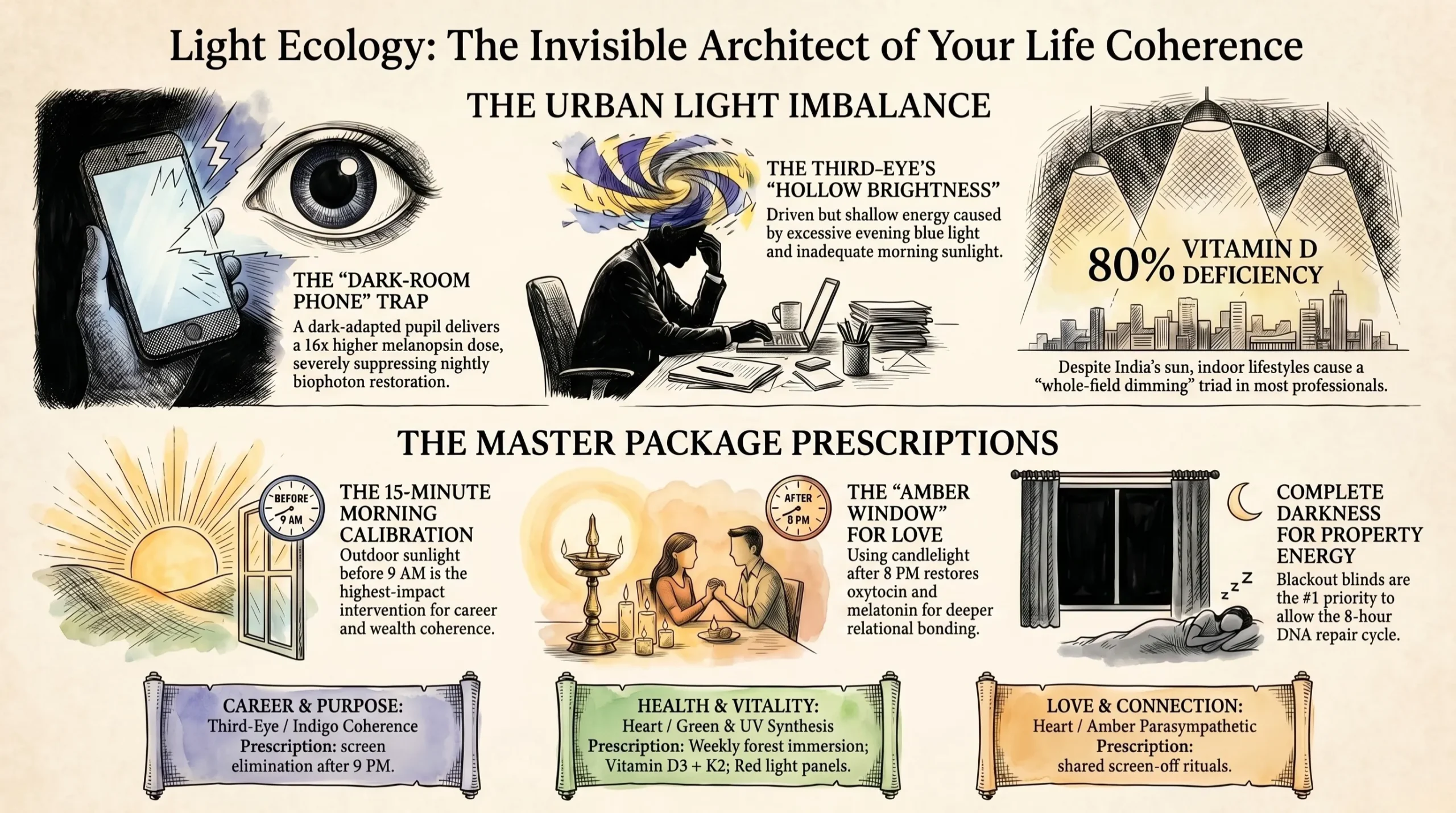
Five Life Areas – Critical Light-Aura Interaction, Most Common Light Imbalance Pattern, Field Reading, and Master Package Prescription:
Life Area (Master Package Service) | The Specific Light-Aura Interaction Most Critical for This Life Area’s Coherence | The Most Common Light-Deficiency or Light-Excess Pattern in This Life Area’s Urban Indian Professional Reading | The Field Pattern This Light Imbalance Produces in the Aura Reading | The Master Package’s Personalised Light Ecology Prescription for This Life Area |
Career & Purpose | The third-eye zone’s indigo-violet biophoton coherence for discriminative wisdom and visionary clarity; the solar plexus zone’s yellow biophoton coherence for the agni-fire’s sustained purposeful action energy; the morning sunlight’s circadian entrainment for the prefrontal cortex’s peak cognitive performance window | Chronic cortisol’s prefrontal impairment from inadequate morning light calibration combined with maximum evening blue light exposure — the precise combination that most degrades the third-eye zone’s discriminative clarity. The career decisions being made by the prefrontal cortex that has been simultaneously under-stimulated by morning light and over-stimulated by evening blue light is the most common single light-imbalance pattern in the Career & Purpose reading. | The third-eye zone’s hollow brightness: the field is busy and driven but lacks the receptive depth of genuine discriminative wisdom. The solar plexus zone’s yellow biophoton emission is diminished or erratic from the mitochondrial strain of the cortisol’s ATP-demanding chronic sympathetic activation. The crown zone’s melatonin-impaired neural coherence reduces the quality of the intuitive guidance that the career’s authentic direction requires. | Morning light calibration before any screen engagement: fifteen minutes of outdoor sunlight before 9 AM as the most impactful single career-field light intervention. Complete screen elimination after 9 PM to restore the melatonin onset’s delta sleep architecture for the prefrontal cortex’s overnight neural field maintenance. Red light therapy panel at the desk for the solar plexus zone’s mitochondrial ATP support during the working day. The sungazing at sunrise as the contemplative practice that combines the light-field coherence input with the dharmic vision’s morning intention-setting. |
Health & Vitality | The heart zone’s green biophoton coherence for the cardiac mitochondrial quantum field; the near infrared’s cytochrome c oxidase upregulation for all zones’ mitochondrial coherence; the UV’s vitamin D synthesis for the immune quantum network’s 2,000+ gene expression programme | The single most prevalent light-imbalance pattern in the Health & Vitality reading: near-total UV deprivation from the indoor work environment combined with vitamin D deficiency in approximately 70–80% of the urban Indian professional population — the most energetically consequential light deprivation in the entire five-life-area assessment. The irony is that India’s outdoor UV environment is among the most vitamin-D-generative in the world, and yet the urban professional’s indoor lifestyle produces the deficiency that subsaharan populations almost never experience. | A specific triad of zone decoherence patterns that consistently co-occur when vitamin D deficiency is identified as primary: the root zone’s foundational vitality reduction from the skeletal and immune system support deficit; the crown zone’s neuroimmune integration impairment from the brain’s vitamin D receptor expression deficit; and a diffuse whole-field dimming that the vitamin D receptor’s 2,000+ gene expression programme’s impairment produces across all seven zones simultaneously. This triad is the most diagnostically specific light-deficiency pattern in the entire reading. | The Health & Vitality light ecology prescription addresses the full light spectrum’s contribution to health coherence: morning sun for vitamin D and circadian calibration; amber lighting after 8 PM for melatonin restoration; red light panel for mitochondrial quantum coherence support; forest immersion weekly for the full-spectrum evolutionary baseline; and vitamin D3 supplementation (with K2 cofactor) as the bridge intervention for the deficiency that the corrected light ecology will maintain over time once established. The specific supplement dose is always accompanied by the recommendation to work with a qualified healthcare provider for the baseline serum 25(OH)D measurement. |
Wealth & Abundance | The root zone’s red biophoton coherence for the material safety foundation’s DC bioelectric baseline; the solar plexus zone’s yellow biophoton coherence for the personal authority’s confident wealth-creation energy; the morning sunlight’s serotonin-dopamine pathway stimulation for the abundant-mindset’s neurochemical foundation | The wealth field’s most characteristic light-imbalance pattern is the solar plexus zone’s yellow biophoton depletion combined with the morning light deprivation’s serotonin deficit — producing a field that has both the metabolic fire’s depletion (insufficient agni for sustained wealth-creating action) and the neurochemical abundance’s deprivation (insufficient serotonin for the scarcity-fear’s overriding). The result is the combination of effortful over-working and persistent insufficiency-feeling that is the most common single pattern in the Wealth & Abundance reading. | The solar plexus zone’s yellow biophoton emission shows the erratic, over-driven quality of the mitochondrial system that is being pushed beyond its quantum coherence capacity: bright but incoherent, like a fluorescent lamp flickering at high intensity. The root zone’s red biophoton field shows the subtle fragmentation of the DC bioelectric baseline’s grounding deficit. The serotonin-depleted crown zone’s quality: a field that is working extremely hard and registering everything as insufficient regardless of the actual abundance present. | The Wealth & Abundance light ecology prescription is specific to the serotonin-mitochondrial-grounding triad: morning sun as the primary serotonin-producing light intervention (light’s tryptophan hydroxylase activation is the most direct available serotonin stimulation intervention); red light panel for the solar plexus zone’s mitochondrial quantum fire restoration; the sunrise grounding practice’s combination of earth contact and morning light as the most comprehensively targeted root-solar plexus coherence restoration available. Ancestral clearing for the epigenetic scarcity encoding that the light ecology cannot address alone. |
Love & Connection | The heart zone’s green biophoton coherence for the cardiac field’s quantum entrainment capacity; the warm amber evening light’s parasympathetic quality for the relational intimacy’s neurobiological foundation; the oxytocin-melatonin interaction’s evening light ecology for the relational bonding’s neurochemical support | The love field’s most specific light-imbalance pattern is the evening blue light’s suppression of the melatonin-oxytocin interaction during the primary relational bonding window. Melatonin and oxytocin are both nocturnal neurochemicals whose optimal release requires darkness: the evening’s screen use’s blue light suppression simultaneously delays melatonin and reduces the oxytocin’s evening bonding surge, replacing the evolutionary baseline’s couple-bonding neurochemistry with the dopamine-cortisol loop of the social media engagement’s novelty-stress cycle. | The heart zone’s specific depletion pattern in the love-field’s light-imbalance reading: a field that retains the desire for genuine relational presence but whose cardiac field’s quantum entrainment capacity has been degraded by the chronic melatonin-oxytocin suppression’s cumulative effect on the heart zone’s biophoton coherence quality. The field reads as reaching and depleted simultaneously — the love’s desire is present but the neurobiological substrate for its expression has been light-compromised. | The Love & Connection light ecology prescription is the most specific relational light intervention in the Master Package: complete screen-off by 8 PM in the primary relationship’s shared evening space; warm amber candlelight or salt lamp as the couple’s shared evening light environment; outdoor moonlight exposure when available (the moon’s reflected visible and near infrared spectrum is melanopsin-inactive and therefore melatonin-safe while providing the full-spectrum’s non-UV light field); and the sunrise practice’s serotonin foundation for the daytime relational emotional tone’s neurochemical substrate. |
Property & Space Energy Scanning | The sleeping environment’s complete darkness for the melatonin and biophoton restoration; the home’s natural light access for the daytime circadian amplitude; the property’s window orientation for the morning sun’s optimal light-ecology contribution; the building materials’ infrared reflectance for the resident’s far infrared light-field ecology | The most property-specific light-imbalance pattern: the sleeping environment’s inadequate darkness from streetlight, ambient urban glow, and the electronic devices’ standby LED indicators. Even 10 lux of ambient light in the sleeping environment produces detectable melatonin suppression in the dark-adapted eye — the equivalent of a single LED’s standby light is sufficient to degrade the biophoton coherence restoration’s quality during the most critical eight-hour period. This is the most frequently identified light-imbalance in the Property & Space reading’s assessment. | The sleeping environment’s light pattern produces the most consistent cascade of zone decoherence in the entire property assessment: the crown zone’s incomplete delta restoration from the melatonin suppression’s slow-wave sleep architecture impairment; the root zone’s DC bioelectric baseline’s inadequate recovery from the cortisol’s overnight incomplete resetting; and the whole-field biophoton coherence’s reduced morning quality from the DNA repair cycle’s interrupted completion. Every light ecology intervention applied during the day is undermined by the sleeping environment’s inadequate darkness. | The Property & Space light ecology prescription is the most immediately actionable complete light-environment assessment in the Master Package: blackout curtains or blackout blinds for the sleeping environment’s complete light elimination; all electronic device standby indicators covered or eliminated; the bedroom’s east or southeast orientation recommendation for the morning’s first light’s wake-up alignment with the circadian clock’s natural rise; the home’s main living areas’ warm white LED replacement; and the assessment of the outdoor space’s morning light access quality for the daily ground-and-sun practice. |
The Property & Space row’s sleeping environment darkness assessment is the intervention I consider the highest priority in the Master Package’s entire light ecology protocol — above every active practice, above every supplement, above every device — because its negative influence is continuous for eight hours per night and its correction is both immediate and cost-free. The sleeping environment’s light ecology is the field’s primary restoration window: every quantum coherence restoration that the pranayama, the mantra, and the yoga nidra build during the day requires the biophoton coherence restoration’s eight-hour nightly cycle to consolidate and maintain. The sleeping environment’s light disruption is the foundation whose absence makes every other intervention less effective than it should be.
What Is the Daily Light Ecology That the Master Package Designs for the Complete Life Field’s Coherence?
The Six-Period Daily Light Ecology Prescription from the Master Package:
- Pre-sunrise to sunrise (5:30–6:30 AM, constitutional chronotype adjusted): The morning’s single most impactful practice: barefoot earthing combined with direct horizon sungazing for the first five to fifteen minutes of the sun’s appearance. The zero-UV horizon sun’s full visible and near infrared spectrum activates all retinal photoreceptor populations simultaneously for the day’s most comprehensive circadian reset. No phone. No screen. The field’s opening to the day’s light before it is opened to the day’s information is the practice whose consistent implementation produces the most reported subjective shift in the morning’s quality across the Master Package’s client population.
- Morning window (6:30–9:30 AM, before UV index rises above 3): Fifteen to thirty minutes of direct outdoor sunlight for the full UV-visible-near infrared spectrum’s simultaneous biological activation: vitamin D synthesis, melanopsin circadian calibration, serotonin production, and near infrared mitochondrial upregulation. This is the evolutionary default that urbanisation has removed and that the Master Package restores as the highest-priority single morning intervention for every constitutional type.
- Working hours light ecology (9 AM–6 PM): Full-spectrum daylight-balanced LED desk lamp at 5600K, CRI ≥90 for the indoor professional’s circadian amplitude maintenance when outdoor access is limited; periodic outdoor breaks for the natural light’s additional interval exposures; red light therapy panel for the solar plexus and crown zones’ mitochondrial coherence support during the working day. The constitutional prescription calibrates the specific wavelength emphasis for the specific zone-deficiency pattern identified in the reading.
- Evening transition (6–8 PM): The most critical transition period in the daily light ecology: the deliberate shift from the daytime’s cool-spectrum alertness light to the evening’s warm-spectrum parasympathetic light. Warm white (2700K) ambient lighting replacing cool white; screen warm-mode activation; dimming of all overhead lighting. This transition’s deliberateness is the single most important light-timing practice in the entire protocol — it signals the circadian system’s daylight-to-darkness transition and initiates the melatonin onset’s preparation.
- Evening practice period (8–10 PM): Amber candlelight or salt lamp as the primary light source; all screens off or amber-lens glasses worn if screens are used; the pranayama and yoga nidra practices in the amber light’s melatonin-safe environment; the couple’s shared amber evening space for the oxytocin bonding window’s neurochemical support. The deepa’s evening practice is the most culturally resonant and most biologically justified single light intervention in the Indian urban professional’s daily light ecology.
- Sleep environment (10 PM to sunrise): Complete darkness: blackout blinds eliminating streetlight and urban glow; all electronic device standby indicators covered or eliminated; no phone charging in the sleeping room; the room’s ambient light at less than 1 lux. This is the biophoton coherence restoration’s eight-hour primary window — the foundation whose quality determines every other light ecology intervention’s efficacy in the day ahead.
Are You Ready for the Light-Ecology-Mapped Aura Life Guide Master Package?
Namaste, my friend — if this article has made your daily light environment visible to you as the most continuously influential single variable in your aura field’s coherence trajectory, you are ready for the Master Package reading that maps the biophoton spectrum’s zone-specific quality, audits the twelve light sources in your specific daily environment, and designs the personalised daily light ecology that the five life areas’ coherence most specifically requires.
The Aura Life Guide Master Package is the complete five-life-area reading: Career & Purpose, Health & Vitality, Wealth & Abundance, Love & Connection, and Property & Space Energy Scanning — with the light ecology assessment integrated as one of the most immediately actionable dimensions of the full integrated field reading. Your biophoton spectrum mapped. Your light sources audited. Your daily light arc designed.
Using our patented photo-scanning technology and Multiple Advanced Gadgets. Drawing on eight years of practice and 1,000+ readings across India. With our money-back guarantee.
Three Steps to Your Light-Ecology-Mapped Aura Life Guide Master Package:
- Submit Photo – Upload a recent, clear photograph of yourself. The biophoton field’s zone-specific coherence quality, the light-ecology imbalances most urgently affecting each life area, and the personalised light arc prescription for your constitutional type are all accessible through our patented photo-scanning technology and Multiple Advanced Gadgets.
- Expert Analysis – I personally decode your complete biophoton spectrum quality across all seven zones and all five life areas: Career & Purpose, Health & Vitality, Wealth & Abundance, Love & Connection, and Property & Space Energy Scanning. The light ecology audit completed. The personalised daily light arc prescription designed for your constitutional type and current zone configuration.
- Transform – Receive your personalised Aura Life Guide — ten wavelength bands mapped, twelve light sources audited, five life areas’ light prescription, complete daily light arc, personalised light ecology protocol, and property’s sleeping environment correction — delivered within 24–48 hours with our money-back guarantee.
⚠️ Disclaimer: Aura analysis and energetic guidance are for personal growth and awareness only. They are not a substitute for professional medical, financial, legal, or psychological advice. Please consult qualified professionals for any health or financial concerns.
Q1: What are biophotons and how do they relate to the aura?
Biophotons are the human body’s own ultra-weak light emission, generated continuously by the mitochondrial electron transport chain’s metabolic activity, DNA repair and replication processes, and reactive oxygen species’ cellular oxidative activity. Their intensity is ten to one hundred times below the threshold of dark-adapted human vision, but Fritz-Albert Popp’s research established that this emission is quantum coherent — organised, phase-correlated, and informationally rich like a laser rather than a light bulb. Biophotons relate to the aura as its physical light substrate: the biophoton field is the measurable light field that the aura reading accesses, and its zone-specific coherence quality encodes the health state of the corresponding biological processes. Healthy cells emit fewer but more coherent biophotons; stressed cells emit more photons in a less organised pattern. The aura’s quality assessment is fundamentally an assessment of biophoton coherence quality rather than mere intensity.
Q2: Why does blue light from screens disrupt the aura’s energy field?
Blue light from screens disrupts the aura’s energy field primarily through the melanopsin retinal pathway: the intrinsically photosensitive retinal ganglion cells’ melanopsin photopigment has its peak sensitivity at 479 nm, and the screen’s blue emission peak at 455–465 nm is sufficiently close to produce 50–80% of the maximum melatonin suppression signal at typical screen brightness levels. Evening blue light exposure delays melatonin onset by sixty to ninety minutes (Gooley et al., Journal of Clinical Endocrinology and Metabolism, 2011), shortens slow-wave delta sleep architecture, and impairs the biophoton coherence restoration that the delta sleep’s DNA repair cycle performs nightly. In terms of aura zones, the blue light’s primary disruption targets the third-eye and crown zones’ neural biophoton coherence through the melatonin pathway, and the root zone’s DC bioelectric baseline through the cascading circadian disruption’s downstream effects on the cortisol morning peak and the HPA axis’s circadian rhythm.
Q3: How does the chakra system’s colour assignment correspond to the biophoton emission wavelengths?
The Vedic tradition’s seven chakra colour assignments correspond with striking precision to the modern biophysics’ identification of zone-specific biophoton emission wavelengths and their biological sources. The root chakra’s red corresponds to haemoglobin’s oxygen-release biophoton emission. The sacral chakra’s orange corresponds to carotenoid-rich reproductive tissue’s emission. The solar plexus chakra’s yellow corresponds to the liver’s cytochrome P450 enzyme complex’s quantum metabolic fire’s yellow biophoton emission — the liver literally emits yellow light as the by-product of its catalytic activity. The heart chakra’s green corresponds to the cardiac muscle’s mitochondrial-dense biophoton field’s green-wavelength emission and sits at the visible spectrum’s exact balance point. The throat chakra’s blue-green corresponds to the thyroid’s quantum hormone synthesis emission. The third-eye and crown chakras’ indigo-violet correspond to the neural gamma coherence’s highest-energy visible-spectrum biophoton field. The chakra’s colour is the zone’s characteristic biophoton emission wavelength, not metaphorical assignment.
Q4: What is photobiomodulation and how does it restore the aura’s energy field?
Photobiomodulation is the therapeutic application of specific red and near infrared light wavelengths — primarily 630–670 nm red and 810–850 nm near infrared — to biological tissue to stimulate cellular healing and energy production. The mechanism: cytochrome c oxidase (mitochondrial Complex IV) absorbs the red and near infrared photons, increasing the mitochondrial membrane potential, upregulating ATP production, reducing oxidative stress, and activating neuroprotective signalling cascades. In terms of the aura field, photobiomodulation restores the solar plexus zone’s mitochondrial quantum fire (the liver’s cytochrome P450 and the metabolic organs’ ATP production) and supports the crown zone’s neural coherence through transcranial near infrared’s prefrontal cortex mitochondrial upregulation. Michael Hamblin’s extensive published review literature provides the most comprehensive evidence base for photobiomodulation’s multiple biological mechanisms.
Q5: Why is complete darkness in the sleeping environment important for the aura’s biophoton restoration?
Complete darkness in the sleeping environment is important for the aura’s biophoton restoration because the delta sleep’s slow-wave architecture is the primary biophoton coherence restoration cycle: during delta sleep, the mitochondrial electron transport chain’s quantum coherence is maintained by the DNA repair and epigenetic maintenance processes whose photon emission constitutes the nightly biophoton field’s restoration. Any light exposure in the sleeping environment — even 10 lux from ambient urban glow or a single LED standby indicator — suppresses melatonin through the dark-adapted retina’s maximally dilated pupil’s melanopsin sensitivity, shortening the delta sleep architecture and impeding the biophoton coherence restoration cycle’s completion. The sleeping environment’s light disruption is the most consequential single light-ecology variable in the Master Package’s five-life-area assessment because its negative effect on the biophoton field’s restoration undermines every other coherence-building intervention applied during the waking day.