How Do Frequencies Influence Aura Patterns? 10 Bands • 12 Sources • 4 Doshas | Aura Photo Science India
Namaste, I’m Mukesh Shah. There is a sentence I have been saying in my practice for eight years that I want to begin this article with, because it is the sentence that most completely captures what I have learned about frequency and the aura field: the aura is not static. It is a living frequency environment that changes in real time in response to every frequency source in the individual’s life — from the Earth they sleep on to the music they play on their morning commute to the voice of the person they speak with in their first meeting of the day.
Most people who first encounter the aura concept think of it as something fixed — a stable energy signature that the practitioner reads and reports. And there is a constitutional dimension that is genuinely stable: the dosha-based field type, the dharmic signature, the ancestral patterns, the causal body’s samskara configuration. These change slowly, over years and decades of practice and life experience. But the field’s moment-to-moment frequency state is far more dynamic than the constitutional layer’s relative stability would suggest. In the course of a single day, the urban professional’s aura field traverses a frequency landscape that their grandparents never encountered: the blue-screened commute’s beta-sustaining stimulation, the open-plan office’s ambient noise interference, the Wi-Fi and mobile network’s non-native electromagnetic frequencies, the deadline pressure’s cortisol-driven sympathetic activation, and the evening’s Netflix’s alpha-theta suppression. Each of these is a frequency influence on the aura pattern. Each is doing something specific to specific zones.
In my analysis of over 1,000 Health & Vitality readings across Mumbai, Delhi, Bangalore, Pune, Ahmedabad, and Hyderabad, the most consistently impactful single change I prescribe is not a supplement or a meditation practice but a frequency environment audit: an honest assessment of the frequency sources the individual is spending their most time in, which of those sources are raising zone coherence and which are lowering it, and what specific changes to the frequency environment produce the most immediate and most sustained improvement in the field’s overall coherence quality. The frequency environment audit is the most practically actionable contribution the aura reading makes to the client’s daily life — because it identifies specific, manageable changes to the frequency landscape the client is already living in, rather than requiring the addition of new practices to an already full life.
This article maps the frequency-aura relationship comprehensively: the complete biological frequency spectrum from the Schumann resonance through the brain’s gamma waves; twelve frequency sources in the urban professional’s daily life and their specific zone coherence effects; the constitutional field type’s specific frequency prescriptions and the sources each type must avoid; and the practical daily frequency ecology that the Health & Vitality reading designs for each client’s specific constitutional pattern and life context.
What Is a Frequency and How Does It Directly Change an Aura Zone’s Pattern?
The cymatic analogy from the previous article in this series provides the most visually accessible model: Hans Jenny’s sand-plate experiments showed that specific frequencies produce specific geometric patterns in vibrating media, and that introducing a second frequency either amplifies the first’s pattern (constructive interference) or disrupts it into disorganised chaos (destructive interference). The aura zone’s pattern behaves according to the same resonance physics principle. Each zone has a characteristic resonant frequency — the frequency at which its biophoton field, its DC bioelectric current, and its cardiac or neural field coherence all operate optimally. Introduce a frequency source that matches the zone’s resonant frequency and you get constructive interference: the zone’s pattern becomes more organised, more coherent, more luminous in the reading. Introduce a dissonant frequency and you get the standing wave interference block that the previous article described: the zone’s pattern becomes chaotic, fragmented, and decoherent.
This is why the specific frequency source matters more than the generic category of ‘good’ or ‘bad’ vibration that wellness culture tends to use. A Tibetan singing bowl tuned to the heart zone’s characteristic frequency is a specific cardiac field intervention with a specific constructive interference mechanism. A singing bowl tuned to a different zone’s frequency played at the heart zone’s location will produce a different effect. The frequency is the medicine. Getting the frequency right is what distinguishes a clinically effective sound therapy prescription from a generically pleasant relaxation experience.
What Are the Ten Frequency Bands in the Body’s Complete Biological Spectrum and How Does Each Shape the Aura?
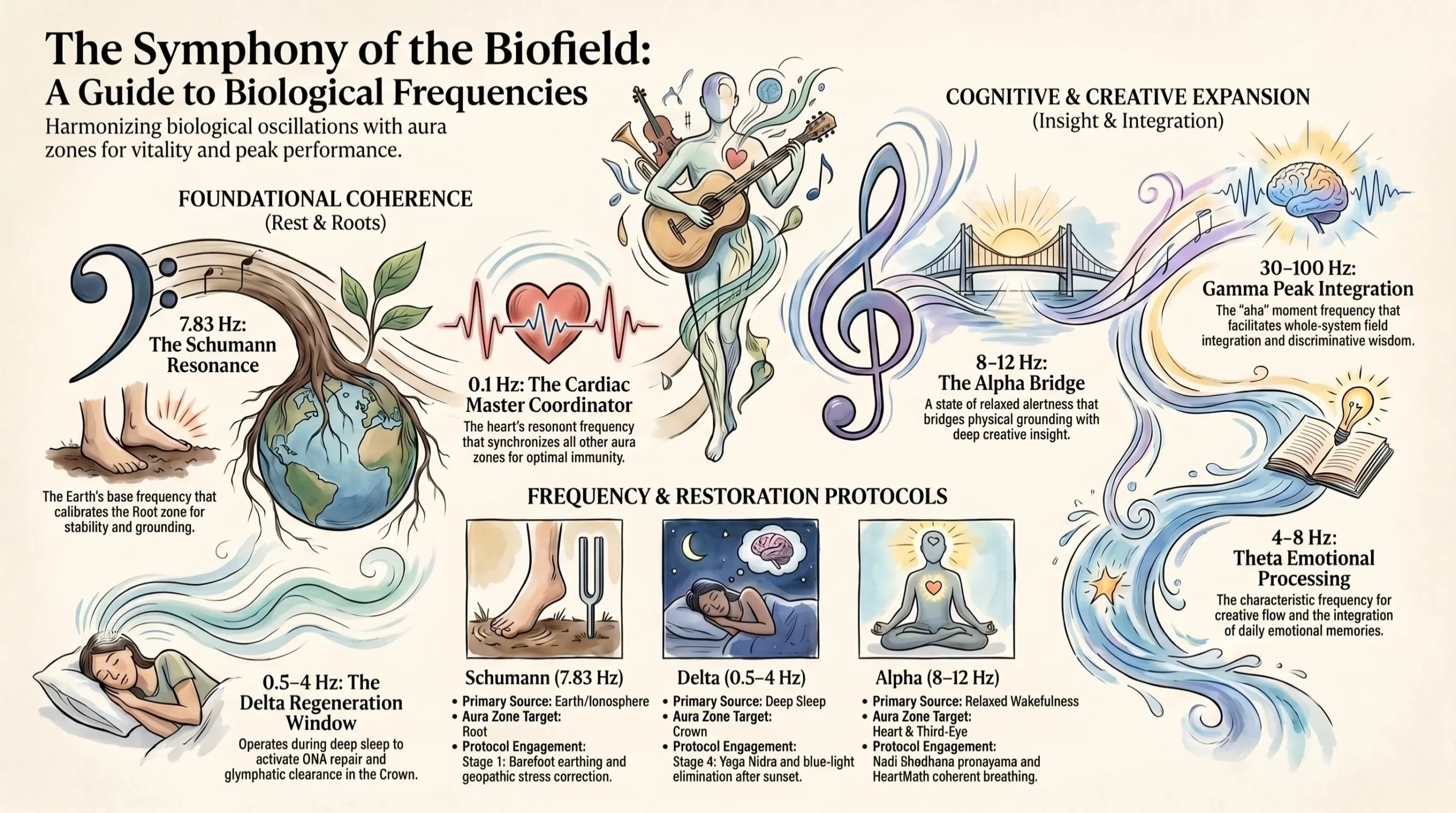
The range of frequencies relevant to the aura field spans more than twelve orders of magnitude — from the Schumann resonance’s 7.83 Hz at the low end to the biophoton field’s 10¹⁴ Hz visible light frequencies at the high end. This enormous span reflects the fact that the aura is not a single-frequency phenomenon but a complex multi-frequency architecture in which each frequency band performs a specific biological and field function. The delta sleep’s 0.5–4 Hz and the biophoton’s 10¹⁴ Hz are not interchangeable — the delta band does the nightly epigenetic maintenance work that the biophoton band’s quantum coherence organisation requires as its operating substrate. The full spectrum’s integrity is a prerequisite for each band’s optimal function.
The Complete Biological Frequency Spectrum – Each Band’s Source, Aura Zone Target, Health State, and Protocol Engagement:
Frequency Band | Frequency Range (Hz) | Primary Biological Source | Aura Zone Most Influenced | Health State When This Frequency Dominates | How the Health & Vitality Protocol Engages This Band |
Schumann resonance (Earth’s base frequency) | 7.83 Hz (fundamental); harmonics at 14.3, 20.8, 27.3, 33.8 Hz | Electromagnetic resonance between the Earth’s surface and the ionosphere, driven by global lightning activity. Acts as the evolutionary calibration frequency for all life on Earth, including the human biofield’s root zone baseline. | Root zone (Muladhara): the body’s DC bioelectric reference potential is evolutionarily calibrated to the 7.83 Hz Schumann fundamental. The root zone’s coherence degrades when the individual is chronically insulated from this frequency through urban architecture, rubber-soled footwear, and elevated sleeping environments. | Grounded, secure, elementally connected. The Vedic description of Prithvi tattva’s quality in the field: heavy, stable, nourishing, present. Autonomic nervous system at resting baseline. Inflammatory cytokines at lowest available daily level. Cortisol at natural circadian morning peak rather than chronic elevation. | Stage 1 earthing protocol: bare-foot contact with natural ground restores the body’s bioelectric coupling to the Schumann fundamental. Sleeping environment correction: relocating the bed away from geopathic stress zones where the local field’s frequency deviates from the Schumann baseline. The most upstream available frequency restoration intervention in the entire five-stage protocol. |
Delta waves (deep sleep regeneration) | 0.5–4 Hz | Thalamocortical oscillators during slow-wave sleep; the deepest available neural frequency state. Also present in the ventral-dorsal vagal blend of deep yoga nidra practice. The nightly epigenetic maintenance cycle’s operative frequency. | Crown zone (Sahasrara) and the causal body layer: the deepest available field restoration occurs in the delta state. The nightly DNA methylation maintenance, the OGG1 DNA repair activation, and the glymphatic clearance cycle all operate in the delta frequency window. | Deep regenerative restoration. The cellular biology is in its highest available repair mode: DNMT-mediated epigenetic maintenance, immune memory consolidation, growth hormone secretion, and neural synaptic pruning for cognitive clarity. The aura’s total field coherence is deepest and most internally organised in the delta state. | Stage 1 sleep optimisation for sufficient slow-wave delta architecture; Stage 4 yoga nidra’s delta state access through the ventral-dorsal vagal blend; blue light elimination after sunset for melatonin onset that enables the delta transition; the progressive muscle relaxation entry sequence for clients whose chronic sympathetic dominance prevents direct delta access. |
Theta waves (creative insight, emotional processing) | 4–8 Hz | Hippocampal theta rhythm during memory consolidation and emotional integration; the hypnagogic state’s characteristic frequency; deep meditation’s first inner threshold. The sankalpa’s embedding frequency in yoga nidra practice. | Third-eye zone (Ajna) and the mental body layer: creative synthesis, intuitive pattern recognition, and the inner guidance that the Vedic tradition names as Prajna (wisdom-knowing). Emotional memory integration through the hippocampal theta rhythm’s processing of the day’s emotional field. | Creative flow, intuitive clarity, emotional processing completeness. The meditator’s first inner landscape: the imagery, the insight, and the felt-sense knowing that arises between waking and sleep. The artist’s creative state, the yogi’s contemplative absorption, and the therapist’s most receptive listening mode all operate in the theta band. | Stage 4 yoga nidra’s theta phase access; the Nadi Shodhana pranayama’s interhemispheric synchronisation that facilitates the theta state’s hippocampal coherence; the evening emotional journalling practice that initiates the theta state’s emotional integration process before sleep; the creative visualisation dimension of the Stage 4 yoga nidra sequence. |
Alpha waves (relaxed alert coherence) | 8–12 Hz | Posterior cortical alpha rhythm during eyes-closed relaxed wakefulness; the parasympathetic nervous system’s wakeful coherent resting state. The resonant frequency overlap between the upper Schumann harmonics and the lower alpha band is not coincidental — it suggests evolutionary calibration. | Third-eye zone and heart zone: alpha coherence is the bridge frequency between the body’s grounding (Schumann) and the mind’s creative depth (theta). The heart zone’s HRV coherence in the ventral vagal baseline state produces cardiac field oscillations in the alpha-adjacent range. | Relaxed alert presence: the state of the practitioner who is simultaneously grounded and aware, neither driven nor drowsy. The Vedic description of Sattvic quality in the wakeful mind: clear, luminous, balanced between activity and stillness. Immune regulation at its optimal daytime level. | Nadi Shodhana pranayama’s alpha coherence facilitation; HeartMath coherent breathing at 0.1 Hz producing cardiac field oscillations that entrain the brain’s alpha rhythm through the vagal-cortical coherence pathway; Stage 4’s open-awareness meditation (the relaxed focused awareness that sustains alpha coherence during active waking states). |
Beta waves (focused cognitive activity) | 12–30 Hz | Frontal and parietal cortex during active cognitive processing, problem-solving, and task-focused attention. High-beta (20–30 Hz) corresponds to the anxious rumination state; low-beta (12–15 Hz) corresponds to the sensorimotor rhythm’s calm focused attention. | Third-eye and throat zones: the cognitive engagement of the prefrontal cortex drives the throat zone’s expression field. Low-beta’s calm focused engagement is associated with throat zone clarity and coherent communication. High-beta’s anxious rumination is associated with the throat zone’s tension pattern and the third-eye zone’s driven contraction. | Two distinct health states: low-beta’s calm engagement is productive and sustainable; high-beta’s anxious rumination depletes the prefrontal cortex’s executive function, elevates cortisol, and produces the driven third-eye zone’s constriction pattern. The urban professional’s default cognitive state is most commonly chronic high-beta — the nervous system’s Rajasic overdrive. | The protocol’s goal is not to eliminate beta but to shift from high-beta’s anxious rumination to low-beta’s calm engagement: Bhramari humming for the shift from high-beta to alpha-theta; Nadi Shodhana for the interhemispheric synchronisation that reduces the high-beta’s asymmetric lateralisation; Stage 3’s emotional clearing for the anxiety content that drives the chronic high-beta. |
Gamma waves (peak cognitive coherence and consciousness integration) | 30–100 Hz (most relevant: 40 Hz) | Thalamocortical gamma oscillations during peak attentional binding, conscious awareness integration, and the ‘aha’ insight state. The 40 Hz gamma coherence is the neural correlate of unified conscious experience. In advanced meditators (Matthieu Ricard’s FMRIB data), sustained gamma coherence during compassion meditation reaches unprecedented amplitudes not seen in non-meditators. | Crown and third-eye zones simultaneously: the gamma band’s thalamocortical binding of information across the entire cortex corresponds to the crown zone’s whole-system field integration function and the third-eye zone’s discriminative wisdom (Viveka). The Vedic tradition’s description of Samadhi’s neural correlate. | Peak conscious integration: the state of the practitioner whose sustained attention has achieved the thalamocortical binding’s highest available coherence. Not a common daily state for most people but an accessible occasional state that expands with sustained contemplative practice. The ‘flow state’ in secular terms; the Dhyana approaching Samadhi in Vedic terms. | Stage 5’s advanced contemplative practices for the sustained gamma coherence that only develops across years of committed practice; the Tratak (steady gazing) practice as the most accessible single-pointed attention gateway to momentary gamma coherence; the kirtan and mantra’s emotional devotional field as the bhakti pathway to gamma coherence without requiring the formal meditative achievement. |
Cardiac field frequency (HRV coherence oscillations) | 0.04–0.4 Hz (coherent peak: 0.1 Hz, approximately 6 breaths per minute) | The heart’s autonomic nervous system’s modulation of the sinoatrial node’s firing rhythm, producing the cardiac field’s beat-to-beat frequency variation (HRV). The 0.1 Hz resonant frequency is the baroreflex’s natural oscillation period — the body’s primary autonomic coherence frequency. | Heart zone (Anahata) as the primary zone; downstream influence on all zones through the vagal coordination network. The heart zone’s HRV coherence state is the single most important frequency parameter in the entire aura field because the vagal network’s organ-wide influence makes the cardiac frequency’s coherence state the field’s primary inter-zone coherence coordinator. | Ventral vagal safe-and-social baseline at the coherent 0.1 Hz peak: immune regulation is optimal (elevated IgA), cognitive performance is at its flexible best, emotional regulation is robust, and the social engagement system’s prosodic voice and facial expressiveness are fully accessible. The Sattvic field quality’s cardiac frequency signature. | HeartMath coherent breathing at exactly the resonant frequency of 0.1 Hz (4–6 breaths per minute) as the most directly targeted single frequency restoration intervention in the entire protocol; Bhramari humming for the vagal tone’s upregulation that maintains the 0.1 Hz coherence between formal practice sessions; the morning HRV measurement as the field’s daily frequency calibration check. |
Biophoton coherence frequency (cellular light emission) | 380–780 nm (visible light spectrum); coherence organisation at biologically relevant frequencies from single Hz to kHz range | Mitochondrial electron transport chain’s photon emission during oxidative phosphorylation; DNA’s photon emission during repair and replication. Fritz-Albert Popp’s research established that the emission is quantum coherent — not random thermal noise but a laser-like organised field that carries biological information. | All seven zones simultaneously: the biophoton coherence frequency pattern is the most spatially comprehensive frequency influence on the aura field. Each zone’s biophoton coherence quality encodes the zone’s tissue’s cellular energy state. Zone decoherence in the biophoton reading corresponds to the reduced quantum coherence efficiency in the zone’s cellular energy processes. | High biophoton coherence: the cellular biology is operating at its quantum efficiency maximum, with the mitochondrial electron transport chain’s proton tunnelling steps maintaining their quantum coherence and the DNA repair and replication processes emitting the precisely organised photon field that coherent biological function requires. The pre-symptomatic window’s earliest available indicator. | Stage 2’s CoQ10, PQQ, and alpha-lipoic acid for the mitochondrial electron transport chain’s quantum coherence maintenance; the constitutional pranayama for the cellular oxygen availability that enables the mitochondrial chain’s coherent operation; the circadian rhythm’s nightly biophoton coherence restoration through delta sleep’s DNA repair cycle. |
Infrasound and low-frequency vibration (environmental frequencies) | Below 20 Hz (inaudible to human hearing); building resonances typically 0.5–10 Hz; industrial infrasound sources | Industrial machinery, traffic infrastructure, HVAC systems in commercial buildings, and geological infrasound sources. The urban professional’s workplace and residential environment is typically saturated with infrasound that the conscious hearing cannot detect but the autonomic nervous system responds to through the vagal afferent pathway’s pressure-sensing mechanoreceptors. | Root and sacral zones primarily: infrasound’s frequencies overlap with the Schumann resonance band and can produce constructive or destructive interference with the root zone’s DC bioelectric baseline. Chronic infrasound exposure in the 4–8 Hz range can disrupt the Schumann coupling and produce the root zone’s standing wave interference block described in the previous article’s physics framework. | Chronic low-level infrasound exposure is associated with elevated cortisol, disturbed sleep, increased anxiety, and the non-specific fatigue and malaise that the person experiencing it cannot attribute to any identifiable cause. The Vedic tradition’s description of environmental prana disturbance corresponds to this infrasound interference with the root and sacral zones’ frequency environment. | Stage 1’s environmental frequency assessment: sleeping environment infrasound mapping for the most consequential chronic frequency exposure period; workplace environmental assessment; the earthing protocol’s Schumann frequency restoration that counteracts infrasound interference by strengthening the root zone’s coupling to the Schumann fundamental. |
Non-native electromagnetic frequencies (modern technology’s field environment) | 50/60 Hz power frequency; Wi-Fi 2.4/5 GHz; mobile networks 700 MHz–3.5 GHz; Bluetooth 2.4 GHz | The built environment’s artificial electromagnetic field, generated by power systems, wireless communication infrastructure, and personal electronic devices. These frequencies are entirely absent from the evolutionary environment in which the human biofield’s frequency calibration developed over millions of years. | Multiple zones simultaneously, with the most acute effects on the root zone’s Schumann coupling (50/60 Hz interference with the 7.83 Hz fundamental), the heart zone’s HRV coherence (power frequency field’s interference with the 0.1 Hz cardiac resonance), and the third-eye zone’s neural field (microwave frequencies’ thermal and non-thermal effects on the prefrontal cortex’s neural field coherence). | The biofield’s frequency environment in the modern urban professional’s life is the most evolutionarily unprecedented frequency exposure in human history. The BioInitiative Report’s synthesis of over 1,800 peer-reviewed studies identifies multiple biological effects of non-native EMF across the frequency spectrum — including HRV reduction, melatonin suppression, and inflammatory cytokine elevation at exposure levels below current safety guidelines. | Stage 1’s non-native EMF reduction protocol: wireless device distance and timing management in the sleeping environment (minimum six feet from sleeping body); router placement outside the bedroom; earthing as the bioelectric ground that normalises the body’s bioelectric potential against the 50/60 Hz power frequency field’s influence; forest and natural environment time for the frequency environment’s evolutionary baseline restoration. |
The cardiac HRV coherence frequency row deserves special emphasis because it is the most clinically central frequency parameter in the entire system. The 0.1 Hz cardiac resonant frequency is not one of ten equally important frequencies — it is the primary coherence coordinator for the entire zone network’s frequency architecture. Through the vagal network’s organ-wide influence, the cardiac field’s coherence state at 0.1 Hz sets the frequency baseline for every other zone’s operating state. When the heart zone’s HRV coherence is high, the downstream effect on all other zones is a general elevation of coherence quality. When it is low, the downstream effect is a general reduction. The cardiac frequency is, in this sense, the aura field’s master frequency — the one whose restoration produces the most broadly distributed benefit across the entire zone network.
The non-native EMF row is the one that generates the most discomfort in my practice, because the frequency sources it describes are also the sources of the professional tools, communication devices, and entertainment platforms that the urban professional’s entire lifestyle is built around. I am not prescribing the elimination of technology. I am prescribing the awareness of technology’s specific frequency effects on the aura field, and the specific management protocols that maintain the field’s coherence within a technological lifestyle. The specific interventions — wireless device distance management in the sleeping environment, router placement outside the bedroom, daily earthing as the bioelectric ground that counteracts the 50/60 Hz power frequency’s interference — are manageable within the urban professional’s existing life structure.
Which Twelve Frequency Sources in the Urban Professional’s Daily Life Are Raising or Lowering Aura Zone Coherence?
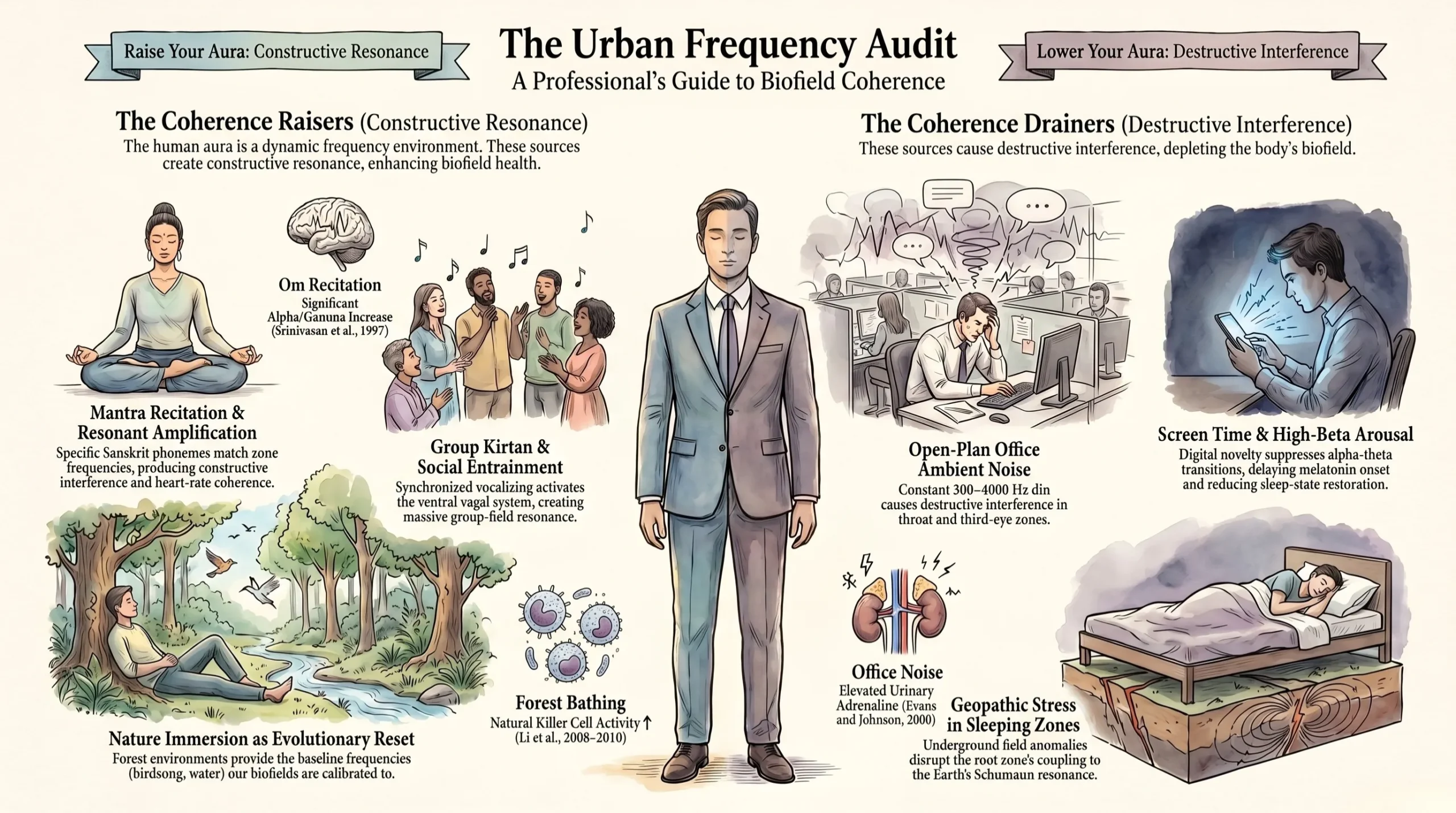
The twelve sources in this table were chosen because they represent the most common and most impactful frequency influences in the specific life context of the urban Indian professional — not because they are the only frequency sources in that life. The selection reflects eight years of Health & Vitality readings across Mumbai, Delhi, Bangalore, Pune, Ahmedabad, and Hyderabad: these are the twelve that come up most consistently across the most clients, have the most substantial supporting evidence, and offer the most practically manageable protocol responses within the urban professional’s existing life structure.
Twelve Frequency Sources in the Urban Professional’s Daily Life – Coherence Effect, Zone Target, Mechanism, and Protocol Response:
Frequency Source | Effect on Zone Coherence | Primary Zone Affected | The Physical Mechanism | The Protocol Response and Evidence |
Mantra recitation (specific Sanskrit phonemes at prescribed frequencies) | RAISES ⬆️ | Zone-specific: each bija mantra targets its corresponding chakra’s characteristic resonant frequency | The Sanskrit phoneme’s acoustic frequency matches the zone’s characteristic biophoton emission frequency, producing resonant amplification (constructive interference) of the zone’s standing wave pattern. The vagal branch’s laryngeal stimulation by the voiced mantra adds a simultaneous parasympathetic field restoration effect. | The mantra’s zone-coherence effect is the most extensively tradition-tested frequency intervention in the Health & Vitality protocol. Srinivasan et al. (Ether and Veda, 1997): Om recitation EEG study showing significant alpha and gamma coherence increase. The HeartMath research’s confirmation that specific tonal patterns produce HRV coherence elevation validates the cardiac frequency dimension. The five-thousand-year Vedic mantra science’s clinical observational base is the longest-running frequency therapy evidence programme in human history. |
Singing and group kirtan (devotional group vocal resonance) | RAISES ⬆️ | Heart and throat zones primarily; group field resonance amplification elevates all zones through the social engagement system’s ventral vagal activation | Group vocal resonance produces the largest available single-session HRV coherence elevation through the simultaneous activation of three frequency mechanisms: the vagal laryngeal stimulation (same as mantra), the social engagement system’s ventral vagal activation through prosodic group voice, and the entrainment of multiple cardiac fields to a shared coherent frequency through the group’s synchronised oscillation. | Vickhoff et al. (Frontiers in Psychology, 2013): choir singing synchronises singers’ heart rates through the shared respiratory frequency’s baroreflex entrainment. Porges’ Polyvagal Theory: the prosodic voice’s middle-ear ossicle stimulation directly activates the ventral vagal social engagement system. The Vedic kirtan tradition’s group coherence effect is the most accessible available large-group field elevation practice — available at any mandir, any satsang, and increasingly in corporate wellness settings in Bangalore and Mumbai. |
Tibetan singing bowl and gong sound healing | RAISES ⬆️ (when bowls are tuned to zone-specific frequencies) | Zone-specific to the bowl’s tuning; multi-zone when multiple bowls span the complete chakra frequency range | The bowl’s sustained harmonic overtone series creates a standing wave field in the room that the body’s biofield entrains to through the auditory nerve’s cortical projection and the body’s resonant response to the bowl’s acoustic field. The overtone series’ higher harmonics stimulate gamma coherence; the fundamental’s lower frequencies stimulate theta and alpha states. | Goldsby et al. (Journal of Evidence-Based Complementary and Alternative Medicine, 2017): Tibetan singing bowl meditation produces significant reductions in tension, anxiety, and depressed mood with significant pain reduction. The mechanism’s acoustic resonance component is supported by the cymatics literature’s standing wave geometric pattern restoration. The bowl’s tuning to the zone-specific frequency is the most important clinical variable: a bowl tuned to the heart zone’s frequency is a specific cardiac field intervention, not a generic relaxation tool. |
Open-plan office ambient noise (constant mid-frequency din) | LOWERS ⬇️ | Throat and third-eye zones: the constant mid-frequency noise’s destructive interference with the zone’s characteristic resonant frequencies | Chronic ambient noise at 300–4000 Hz (human speech’s primary frequency range) produces sustained sympathetic activation through the amygdala’s threat-detection response to uncontrolled auditory input. The result is persistent beta-wave arousal without the focused task engagement that makes productive beta beneficial, creating the depleting high-beta rumination state that the urban professional’s most common cognitive frequency profile represents. | Evans and Johnson (Journal of Applied Psychology, 2000): open-plan office noise produces elevated urinary adrenaline (sympathetic activation marker) and reduced task motivation compared to quiet conditions. The standing wave interference block in the throat zone produced by chronic ambient noise is the most commonly identified throat zone energy block in the Health & Vitality readings from clients in Bangalore’s and Mumbai’s open-plan technology and financial sector workplaces. The protocol response: natural soundscapes (birdsong, flowing water, forest) as the evolutionary default frequency environment’s restoration during breaks. |
Classical Indian music (Raga system aligned to specific times of day) | RAISES ⬆️ (most powerfully when played at the prescribed time of day) | Zone-specific to the raga’s prescribed function; the time-of-day alignment amplifies the effect through the circadian frequency’s resonance | The Raga system’s most sophisticated feature is its time alignment: each raga’s specific frequency pattern is tuned to the body’s circadian frequency state at the prescribed time of day, producing resonant amplification rather than interference. The morning ragas’ ascending frequency patterns align with the cortisol morning peak’s sympathetic activation; the evening ragas’ descending patterns align with the parasympathetic onset’s frequency state. | The Raga system is the world’s most sophisticated clinical frequency prescription system for the aura field’s circadian frequency management: 72 parent scales, each with specific time-of-day, season-of-year, and constitutional-type prescriptions that collectively constitute a comprehensive frequency ecology management protocol. Balwant Singh (Journal of Ethnopharmacology, 2002): preliminary evidence for Raga-specific physiological responses. The circadian frequency alignment is the Raga system’s most important and most underappreciated clinical dimension — the same raga played at the wrong time of day produces a weaker or even dissonant effect. |
Screen time and digital content consumption (visual and auditory high-frequency stimulation) | LOWERS ⬇️ (specifically: raises high-beta and suppresses alpha-theta-delta) | Third-eye and crown zones primarily; secondary suppression of the heart zone’s HRV coherence through the chronic sympathetic activation | The constant visual and auditory novelty of digital content consumption drives sustained beta-wave engagement through the dopaminergic reward system’s activation, while simultaneously suppressing the alpha-theta transition that the nervous system requires for the biophoton field’s nightly restoration cycle. The blue light component’s melatonin suppression adds the circadian disruption’s delta sleep reduction to the immediate beta-elevation effect. | The aggregate frequency effect of three hours of evening screen time — the urban Indian professional’s median evening screen exposure — is: alpha-theta transition suppression, delta sleep architecture reduction, melatonin onset delay of ninety minutes, morning biophoton coherence reduction from the insufficient delta restoration, and cumulative HRV coherence deficit from the HPA axis’s disrupted circadian cortisol rhythm. Stage 1’s blue light elimination protocol after 8 PM is the most impactful single frequency intervention available for this pattern. The protocol costs nothing and requires no practitioner. |
Nature immersion and forest environments (natural frequency environment) | RAISES ⬆️ | Root and sacral zones primarily; whole-field restoration through the natural frequency environment’s evolutionary calibration effect | Forest environments provide the evolutionary default frequency environment to which the human biofield’s frequency calibration system is tuned: Schumann resonance coupling (no electrical insulation from the Earth), natural infrasound from wind and water at biologically coherent frequencies, acoustic frequencies in the 1–8 kHz range from birdsong and water that produce parasympathetic nervous system activation, and the phytoncide volatile organic compounds’ immune-modulating effect through olfactory nerve activation. | Li et al. (multiple publications in the International Journal of Immunopathology and Pharmacology, 2008–2010): forest bathing (Shinrin-yoku) produces significant natural killer cell activity elevation lasting up to thirty days after a three-day forest immersion. The mechanism includes phytoncide inhalation’s direct NK cell upregulation, the natural frequency environment’s cortisol and adrenaline reduction, and the Schumann resonance coupling’s inflammatory cytokine normalisation. The frequency argument for regular forest immersion is, in my assessment, one of the most practically actionable single frequency interventions available to the urban professional in Mumbai or Bangalore — accessible at Sanjay Gandhi National Park, Cubbon Park, or any natural area within a reasonable commute. |
Heavy metal and aggressive music with dissonant frequencies | LOWERS ⬇️ (for most constitutional field types; individual variation exists) | Heart and solar plexus zones: the dissonant frequency patterns’ destructive interference with the heart zone’s characteristic resonant frequency | Dissonant intervals (tritones, augmented fourths, minor seconds) produce destructive interference in the auditory cortex’s frequency processing and activates the amygdala’s threat-detection response through the auditory nerve’s direct projection to the amygdala without prefrontal cortex mediation. The result is sympathetic activation, cortisol elevation, and heart zone HRV coherence reduction. | Khalfa et al. (Annals of the New York Academy of Sciences, 2003): dissonant music produces elevated cortisol compared to consonant music in the same subjects. The constitutional field type variable is important here: the Pitta-dominant field type’s existing solar plexus over-brightness is amplified by dissonant frequencies; the Vata-dominant field type’s existing root zone fragmentation is worsened. The protocol response is constitutional: not a blanket prohibition on any music genre but a specific assessment of which frequency environments each constitutional field type is most vulnerable to and most restored by. |
Pranayama (breath as direct frequency modulator of the cardiac and neural fields) | RAISES ⬆️ (specific to the pranayama’s frequency prescription) | Zone-specific to the pranayama’s target: Nadi Shodhana for third-eye and heart; Bhramari for throat and heart; Kapalabhati for root and solar plexus; slow resonant breathing for heart as primary | Breath is the body’s most accessible voluntary frequency modulator: the respiratory rate directly determines the baroreflex’s vagal activation frequency, the cardiac field’s HRV coherence frequency, and the brain’s entrained oscillation through the respiratory-cardiac-neural coherence cascade. Breathing at the resonant frequency of 0.1 Hz maximally drives the entire cascade’s coherence to its highest available state within a single session. | The pranayama-frequency connection is the most directly actionable finding in this article’s entire framework: the breath’s respiratory rate is the body’s most accessible single voluntary control over the biofield’s primary frequency parameters. Brown and Gerbarg’s comprehensive pranayama review (World Journal of Psychiatry, 2016), the HeartMath’s resonant frequency breathing research, and the Telles group’s thirty years of pranayama physiological measurement all converge on the same practical conclusion: controlling the breath’s frequency is controlling the aura field’s primary coherence-determining frequency parameter. |
Sleep-disrupting alarm clocks (abrupt arousal from delta-theta states) | LOWERS ⬇️ | Crown and third-eye zones: the abrupt frequency shift from delta (0.5–4 Hz) to beta (12–30 Hz) in under five seconds, compared to the natural dawn’s gradual light-induced frequency transition over thirty to sixty minutes | The natural dawn awakening is a gradual frequency transition from delta through theta to alpha to beta, mediated by the gradual increase in light intensity’s cortisol morning peak activation. The alarm clock’s abrupt arousal bypasses this transition entirely, producing a sympathetic shock response (cortisol spike, adrenaline release) that disrupts the natural morning frequency calibration and sets the day’s autonomic baseline at a stressed rather than grounded state. | Walker (Why We Sleep, 2017): the abrupt alarm awakening produces a cardiovascular stress response whose cumulative daily repetition constitutes a significant chronic cardiovascular load. The protocol response: dawn simulation alarm clocks (gradually increasing light over thirty minutes mimicking natural sunrise) as the most directly frequency-aligned alarm technology; waking without alarm by maintaining consistent sleep and wake times that align the body’s natural circadian frequency with the desired waking time; and the five-minute pre-rising Shavasana as the transitional frequency bridge from delta-theta to alpha before full beta engagement. |
Satsang and conscious community (collective field resonance) | RAISES ⬆️ | Heart and crown zones: the collective ventral vagal field activation through shared intentional frequency | Satsang’s frequency mechanism is the most sophisticated available group field intervention: the combination of mantra’s direct frequency stimulation, kirtan’s respiratory entrainment, the teacher’s high-HRV coherence field’s entrainment of participants’ cardiac fields, and the shared intentional presence’s collective ventral vagal activation all operate simultaneously. The Polyvagal Theory’s social engagement system’s frequency mechanism — prosodic voice activating the middle-ear ossicles’ neural pathway to the vagal dorsal motor nucleus — is the most precisely characterised of the multiple frequency mechanisms operating in satsang. | The HeartMath research’s cardiac field entrainment documentation provides the neuroscientific basis for the traditional assertion that proximity to an elevated field elevates one’s own field. McCraty et al.’s finding that coherent cardiac fields produce measurable HRV synchronisation in nearby individuals means that satsang’s frequency effect is not metaphorical but measurably real: the teacher’s high-HRV coherence state produces cardiac field oscillations that entrain participants’ baroreflex resonant frequency toward the teacher’s own coherence baseline. The baraka of the Sufi tradition, the teacher’s shakti in the Vedic tradition, and the congregation’s ‘spirit’ in the Christian tradition are all culturally specific descriptions of the same cardiac field entrainment mechanism. |
Geopathic stress zones (underground water streams, geological fault lines) | LOWERS ⬇️ | Root zone primarily; whole-field disruption in severe cases through the Schumann coupling’s interference | Underground water streams and geological fault lines generate electromagnetic field disturbances whose frequencies deviate from the Schumann resonance baseline, producing destructive interference with the root zone’s DC bioelectric grounding potential. The sleeping environment is the most consequential geopathic stress exposure because of its sustained nightly duration during the field’s primary restoration cycle. | Rambouillet (Ernst Hartmann’s Geopathic Stress research, 1950s onward) and the broader geopathic stress literature document correlations between sleeping environment field anomalies and chronic health complaints that do not respond to conventional treatment. The most systematic modern review (Perry, 2003: Journal of Alternative and Complementary Medicine) acknowledges the evidence’s methodological limitations while identifying the sleeping environment’s electromagnetic field as a plausible contributor to chronic unexplained health conditions. Stage 1’s geopathic stress assessment is the Health & Vitality reading’s most consistently impactful single recommendation for clients with chronic fatigue, sleep disruption, and systemic immune compromise that has not responded to other interventions. |
The satsang row is the one I return to most often when clients ask which single frequency change produces the most sustained improvement. The HeartMath cardiac field entrainment research — that a coherent cardiac field produces measurable HRV synchronisation in nearby individuals — makes the traditional assertion that proximity to an elevated field elevates one’s own field a neuroscientifically confirmed statement rather than a devotional metaphor. This means that the company one keeps is not merely an ethical consideration or a motivational strategy. It is a specific, real-time frequency influence on the cardiac field’s coherence baseline. The elevated teacher’s high-HRV coherence field is measurably entraining the student’s baroreflex resonant frequency toward the teacher’s own coherence state during satsang. This is baraka, shakti, and cardiac field entrainment simultaneously — all three descriptions of the same physical mechanism.
How Does the Constitutional Field Type Determine Which Frequencies Heal and Which Deplete?
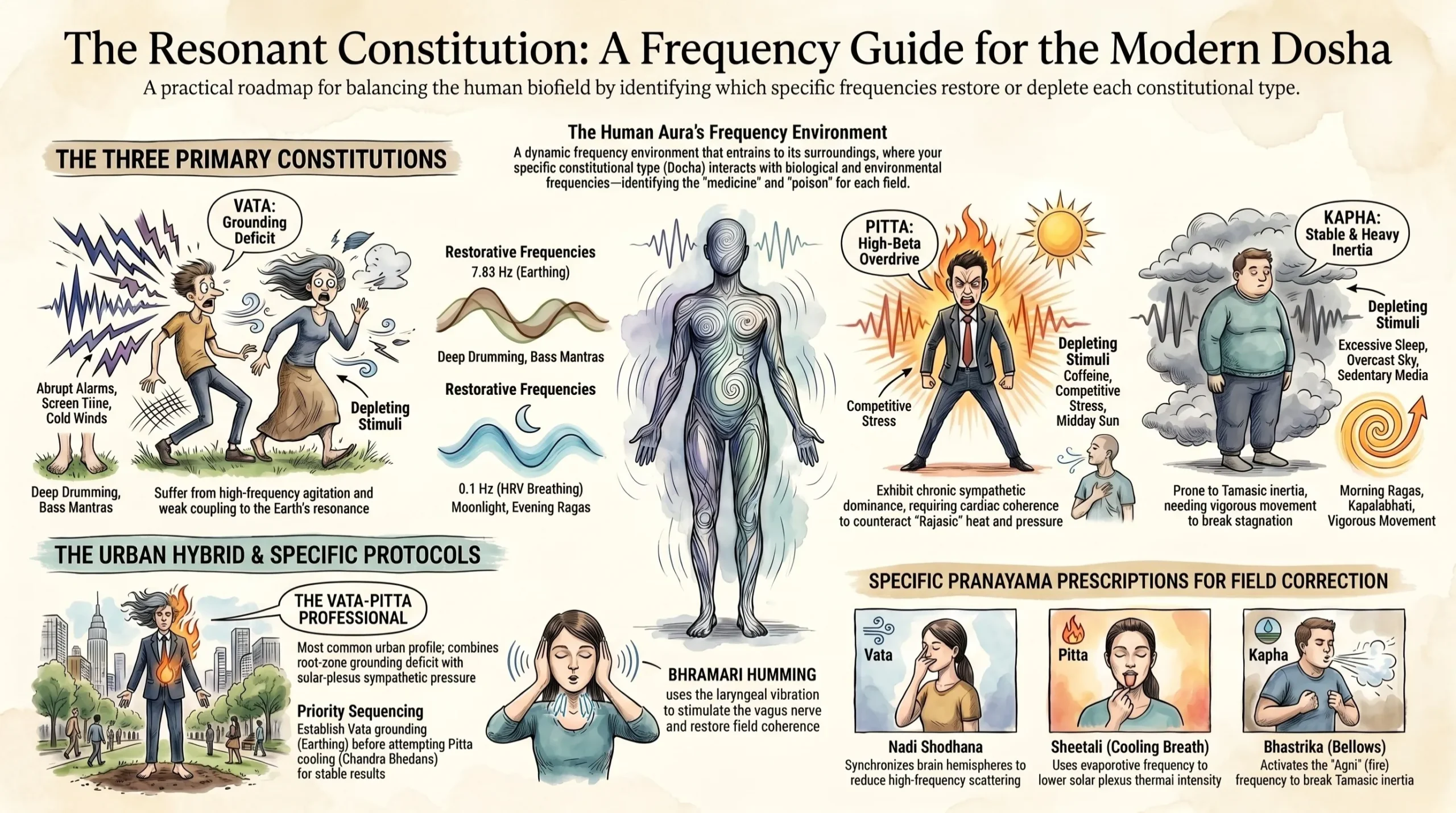
The constitutional variability of frequency response is the most practically important finding in this article’s framework, because it explains why generic frequency prescriptions — ‘everyone should meditate to 528 Hz solfeggio frequencies’ or ‘binaural beats at 40 Hz produce gamma coherence for everyone’ — are at best incomplete and at worst counterproductive. The Vata field’s root zone grounding deficit is not addressed by the 40 Hz gamma coherence target — it requires the 7.83 Hz Schumann grounding first. The Kapha field’s inertia-frequency imbalance is not addressed by the slow, cooling frequency prescriptions that are appropriate for the Pitta. The frequency prescription’s constitutional calibration is what distinguishes the Health & Vitality reading’s specific individual prescription from the generic wellness culture’s one-frequency-suits-all approach.
Constitutional Field Type Frequency Prescriptions – Characteristic Imbalance, Restorative Sources, Depleting Sources, and Specific Protocol:
Constitutional Field Type (Dosha Dominant) | Characteristic Frequency Imbalance Pattern | Frequency Sources Most Restorative for This Type | Frequency Sources Most Depleting for This Type | Specific Protocol Frequency Prescriptions with Rationale |
Vata dominant (Air and Space element: mobile, variable, light, quick) | The Vata field’s characteristic frequency imbalance is chronic high-frequency agitation without grounding: the root and sacral zones’ Schumann coupling is weakest in this constitutional type, making it most vulnerable to the root zone’s DC bioelectric grounding deficit. The aura reads as a field that vibrates at the top and flickers at the edges — alive and responsive but without the earth connection that stable coherence requires. The Vata field’s nervous system equivalent is polyvagal dysregulation with a tendency toward anxiety, insomnia, and the creative-scattered high-beta pattern. | Deep, slow, grounding frequencies: the Schumann resonance’s 7.83 Hz through earthing; low-frequency mantra (Sa, La, Ha at the lower range of the bass voice); forest immersion for the natural infrasound’s grounding frequency and the earth-contact’s Schumann coupling; the delta sleep architecture’s restoration through consistent sleep timing; the Kapha-season and winter foods’ heavier, warmer quality as a dietary frequency anchor; deep rhythmic drumming’s low-frequency oscillation as the most immediate available grounding frequency experience. | High-frequency irregular stimulation: alarm clocks’ abrupt delta-to-beta frequency shock; open-plan office ambient noise’s unpredictable auditory input; screen time’s beta-sustaining novelty stimulation; air travel’s combined altitude, dehydration, and pressurisation frequency disruption; cold, windy, dry environments whose elemental frequency resonates with the Vata field’s existing agitation; excessive evening social stimulation that prevents the nervous system’s frequency transition to theta-delta. | Primary pranayama prescription: Bhramari humming (grounding through the laryngeal vibration’s sustained low-frequency tone) and Nadi Shodhana (the bilateral frequency balancing that reduces the Vata’s characteristic right-hemisphere high-frequency dominance through interhemispheric synchronisation). Primary mantra prescription: Om (the full harmonic series from bass fundamental to upper overtones restores the complete frequency architecture from root to crown) and So-Hum (the breath’s natural frequency at the resonant breathing rate’s 0.1 Hz). Avoid: Kapalabhati (amplifies the existing high-frequency agitation). Sleep protocol priority: fixed sleep timing is the single most impactful Vata frequency intervention. |
Pitta dominant (Fire and Water element: sharp, hot, intense, focused) | The Pitta field’s characteristic frequency imbalance is chronic high-beta driven intensity without parasympathetic recovery: the solar plexus and heart zones are over-driven at the high-beta and sympathetic activation frequencies, producing the heat-bright-driven field quality that the Vedic tradition identifies as Rajasic excess. The aura reads as a field that is extremely coherent and bright in the central zones but with a quality of pressure, heat, and compulsive forward direction that becomes decoherent when it cannot achieve its goals. The Pitta field’s nervous system equivalent is chronic sympathetic dominance with a tendency toward inflammation, perfectionism, and the driven executive’s cardiovascular risk profile. | Cool, slow, parasympathetic-activating frequencies: evening ragas’ descending frequency patterns (particularly Bhairav, Yaman, and Darbari Kanada at their prescribed times); the cardiac HRV coherence breathing’s 0.1 Hz resonant frequency as the antidote to the Pitta field’s sympathetic over-drive; moonlight’s infrared spectrum’s cooling frequency quality; water environments’ natural frequency (the ocean’s 0.1 Hz infrasonic pulse is an extraordinary natural 0.1 Hz HRV coherence entrainment source); forest immersion’s parasympathetic frequency restoration. | Competitive and performance-pressured frequency environments: dissonant music’s sympathetic amplification of the already over-driven solar plexus; screen-based news and social comparison content’s dopamine-cortisol frequency loop; excessive caffeine’s sympathetic upregulation of an already sympathetically dominant field; hot, midday sun exposure that resonates with the Pitta’s fire element’s existing excess; intense competitive exercise at peak heat of day. | Primary pranayama prescription: Chandra Bhedana (left nostril breathing that activates the right hemisphere’s parasympathetic association — the specific interhemispheric frequency correction for the Pitta’s right-hemisphere sympathetic dominance) and Sheetali (cooling breath’s evaporative frequency effect on the solar plexus’ over-bright heat). Primary mantra prescription: the soothing mid-range tones of the Durga mantra and the softening heart-zone frequency of the specific raga prescribed at the evening time. Heart zone priority: the Pitta field’s heart zone emotional body clearing (Stage 3) is the most important single frequency intervention because the suppressed frustration and perfectionist pressure are the primary sources of the cardiac field’s incoherence. |
Kapha dominant (Earth and Water element: stable, slow, heavy, enduring) | The Kapha field’s characteristic frequency imbalance is insufficient frequency stimulation rather than excessive: the root and sacral zones are deeply grounded but the upper zones’ frequencies are under-activated, producing the Tamasic quality of inertia, heaviness, and resistance to the frequency shifts that the system’s vitality requires. The aura reads as a well-grounded, coherent field that lacks the dynamic frequency variability (HRV coherence) that vital health requires. The Kapha field’s nervous system equivalent is low HRV with dorsal vagal tendencies — not the acute freeze but the chronic under-stimulation that produces the weight gain, sleep excess, and motivational inertia of Kapha imbalance. | Activating, warming, frequency-elevating sources: morning ragas’ ascending frequency patterns (Bhairav, Bairagi, and Bhupali at dawn); Kapalabhati’s sympathetic activation frequency for the appropriate Kapha morning practice; vigorous aerobic exercise’s BDNF-elevating and frequency-activating effect; spicy, warm, light foods’ agni-stimulating frequency resonance; the Kapha-reducing season (spring’s warming frequency environment); social engagement with energising community as the ventral vagal frequency activation that the Kapha field most needs. | Heavy, slow, further-sedating frequency environments: excessive sleep beyond eight hours (which deepens the already-excessive Tamasic delta state without producing additional restoration); cold, damp environments; overcast, low-light frequency environments that suppress the sympathetic frequency activation the Kapha field requires for balance; slow, heavy, minor-key music that resonates with the already-excessive Kapha inertia; prolonged sedentary media consumption. | Primary pranayama prescription: Kapalabhati (the specific sympathetic frequency activation from dorsal-Tamasic inertia toward the ventral-Sattvic baseline — the exact frequency correction the Kapha field requires) and Bhastrika (bellows breath for the Kapha field’s full frequency activation when Kapalabhati alone is insufficient for the pronounced Tamasic depression). Primary mantra prescription: the solar plexus zone’s Ram mantra at a vigorous, rhythmically dynamic frequency to activate the Manipura’s agni from its Kapha suppression. Morning protocol priority: the Kapha field’s single most impactful frequency intervention is waking before or at sunrise and immediately performing Kapalabhati and vigorous physical movement before the day’s Tamasic momentum can establish itself. |
Dual Vata-Pitta (the most common urban professional constitutional pattern in India) | The Vata-Pitta combination produces the most characteristically urban-professional frequency imbalance in my practice across 1,000+ readings from Mumbai, Delhi, and Bangalore: the root zone’s Vata grounding deficit combines with the solar plexus and heart zones’ Pitta sympathetic over-drive, producing a field that is simultaneously ungrounded at the bottom and over-pressured in the middle. The nervous system equivalent is chronic sympathetic dominance combined with polyvagal dysregulation — the most common and most depleting combination in the urban Indian professional’s frequency ecology. | Grounding-with-cooling frequencies simultaneously: the ocean’s natural frequency environment is the ideal restoration environment for this combination (Schumann coupling for the Vata grounding, water’s cooling resonance for the Pitta heat, the ocean’s 0.1 Hz infrasonic pulse for the HRV coherence restoration). Evening ragas at sunset for the Pitta cooling. Bhramari humming for the simultaneous vagal grounding (Vata) and sympathetic downregulation (Pitta). | The specific combination that most commonly produces acute field decoherence in this constitutional type: high-stakes deadline pressure (Pitta’s over-drive) while simultaneously sleep-deprived (Vata’s root grounding depleted by delta deficit) in an open-plan noisy environment (ambient frequency interference with both the root zone’s Schumann coupling and the solar plexus’s frequency coherence). This combination describes a typical Monday morning in Mumbai’s financial district. | The Vata-Pitta dual protocol sequencing is the most important clinical variable: the Vata grounding intervention (earthing, Bhramari, consistent sleep timing) must be established before the Pitta’s sympathetic downregulation practices (cardiac coherence breathing, Chandra Bhedana) can achieve their maximum effect — because the ungrounded Vata field cannot maintain the 0.1 Hz cardiac coherence state if the root zone’s Schumann coupling is simultaneously disrupted. Stage 1’s sleeping environment correction is the single most impactful frequency intervention for this combination: it addresses the Vata’s grounding deficit and the Pitta’s HPA circadian disruption simultaneously. |
A client from Bangalore — a thirty-eight-year-old senior software architect with a classic Vata-Pitta constitutional pattern confirmed in both the aura reading and his own Ayurvedic practitioner’s assessment — had tried two years of generic wellness practices before the Health & Vitality reading: daily meditation, weekly yoga, and a clean diet. He described his experience as ‘the practices are working but not enough.’ The reading identified the specific frequency mismatch: his meditation practice was a silent breath-awareness practice, which for his constitutional type’s Vata grounding deficit was not providing the sonic frequency support that Vata needs — the Bhramari humming’s vibration and the mantra’s acoustic frequency are not interchangeable with silent breath-awareness for a Vata-dominant field’s root zone grounding requirement.
The protocol modification was specific and minimal: replace the silent meditation with Bhramari humming for the first ten minutes, followed by Om and So-Hum mantra for fifteen minutes. Add earthing for fifteen minutes each morning before the session. Shift the evening yoga from a vigorous Vinyasa class (which was amplifying the Pitta’s sympathetic activation rather than reducing it) to a Yin yoga practice whose long-held poses’ parasympathetic frequency is constitutionally appropriate for the Pitta’s cooling requirement. He reported the difference within two weeks as qualitatively different from the previous two years of practice: the grounding feeling he had been approaching but never quite reaching in the silent practice was now reliably present from the first morning session.
What Is the Practical Daily Frequency Ecology That the Health and Vitality Reading Designs?
The practical question I am most often asked at this point in the reading is: ‘how much of this can I actually implement given my working schedule?’ It is a legitimate question, and the answer is more encouraging than the table’s comprehensiveness might suggest. The daily frequency ecology does not require a monastic schedule. It requires the strategic insertion of specific frequency interventions at the specific circadian moments where their benefit is highest and their cost in time is lowest.
The Five Highest-Impact Frequency Interventions That Fit Any Schedule:
- Morning earthing (15 minutes, no cost, no equipment): Bare-foot contact with natural ground immediately after waking, before any digital engagement. Restores the Schumann coupling, normalises the bioelectric reference potential, initiates the circadian frequency transition at the body’s evolutionary baseline frequency rather than at the alarm clock’s sympathetic shock. For the Mumbai or Bangalore professional, the housing complex’s garden, the beach (for coastal cities), or any patch of natural ground qualifies. This is the single most impactful frequency intervention per unit time in the entire protocol for the Vata-Pitta constitutional pattern.
- Constitutional pranayama (15–20 minutes, no cost, no equipment): The specific pranayama sequence prescribed for the constitutional type, performed before the day’s first digital engagement. For Vata-Pitta: ten minutes of Bhramari followed by ten minutes of Nadi Shodhana. For Pitta: fifteen minutes of Chandra Bhedana followed by five minutes of cardiac coherence breathing. For Kapha: fifteen minutes of Kapalabhati followed by ten minutes of Bhramari. The pranayama is the body’s most accessible voluntary frequency modulator — its constitutional calibration makes it the most specifically targeted available frequency intervention for the individual’s specific imbalance pattern.
- Midday cardiac coherence reset (5 minutes, HeartMath Inner Balance device optional): Five minutes of slow paced breathing at the resonant frequency of 0.1 Hz at the midday transition point. This is the field’s primary inter-zone coherence restoration practice — five minutes at the resonant frequency produces measurable HRV coherence elevation that persists for several hours. For the Pitta-dominant professional whose morning work session has been driving the sympathetic’s high-beta activation, this five-minute midday reset is the most immediately impactful frequency intervention for the afternoon’s quality.
- Blue light elimination after 8 PM (no cost, no equipment, requires only intention): The single most impactful Stage 1 frequency intervention for the urban professional’s delta sleep architecture. Blue light’s suppression of the pineal’s melatonin onset delays the delta frequency’s arrival by sixty to ninety minutes, reduces slow-wave delta duration, and impairs the nightly biophoton coherence restoration, epigenetic maintenance, and glymphatic clearance that the delta frequency’s biology requires. Blue light glasses after 8 PM, night mode settings on all screens, and warm amber lighting in the evening environment together constitute the most accessible available delta frequency protection.
- Weekly forest or natural environment immersion (half-day, widely accessible): The evolutionary default frequency environment’s full restoration: Schumann coupling without electrical insulation, natural infrasound’s biologically coherent frequencies, birdsong and water’s parasympathetic frequency activation, phytoncide’s immune-modulating olfactory frequency, and the natural light spectrum’s circadian frequency calibration. Li et al.’s research confirms that the NK cell elevation persists for thirty days after a three-day forest immersion — meaning a weekly half-day in Cubbon Park in Bangalore, Sanjay Gandhi National Park in Mumbai, or any natural area of similar quality provides a sustained frequency ecology restoration that accumulates across weeks and months of consistent practice.
Are You Ready for a Frequency-Calibrated Health and Vitality Reading?
Namaste, my friend — if this article has shifted your understanding of the aura field from a static energy signature to a dynamic, continuously frequency-responsive living system, you are ready to engage with the Health & Vitality reading’s most practical dimension: the specific daily frequency ecology designed for your constitutional field type, your current zone’s coherence state, and the specific frequency sources your life context most urgently requires you to increase or reduce.
The reading identifies your constitutional field type’s characteristic frequency imbalance, maps the specific frequency sources in your life context that are most impacting your zone’s coherence, and prescribes the specific daily frequency sequence most precisely calibrated to your field’s current state and your constitutional type’s specific resonant requirements. Not a generic wellness frequency guide. A field-specific, constitutional-type-calibrated, circadian-frequency-sequenced daily ecology.
Using our patented photo-scanning technology and Multiple Advanced Gadgets. Drawing on eight years of practice and 1,000+ readings across India. With our money-back guarantee.
Three Steps to Your Frequency-Calibrated Health and Vitality Reading:
- Submit Photo – Upload a recent, clear photograph of yourself. Your constitutional field type, its characteristic frequency imbalance pattern, and the specific zone coherence states that need frequency restoration are all accessible through our patented photo-scanning technology and Multiple Advanced Gadgets.
- Expert Analysis – I personally decode your complete Health & Vitality aura field’s frequency architecture, identifying your constitutional type’s specific imbalance, mapping the twelve frequency sources’ effects on your zone network, and prescribing the five high-impact daily frequency interventions most aligned with your specific pattern.
- Transform – Receive your personalised Health & Vitality Aura Guide — full biological frequency spectrum assessment, twelve frequency source audit for your specific life context, constitutional frequency prescription, five daily interventions, and circadian frequency sequence — delivered within 24–48 hours with our money-back guarantee.
⚠️ Disclaimer: Aura analysis and energetic guidance are for personal growth and awareness only. They are not a substitute for professional medical, financial, legal, or psychological advice. Please consult qualified professionals for any health or financial concerns.
Q1: How do frequencies change aura patterns?
Frequencies change aura patterns through the physical principle of resonance and entrainment. Each aura zone has a characteristic resonant frequency at which its biophoton field, DC bioelectric current, and cardiac or neural field coherence all operate optimally. When a matching frequency source is introduced — through mantra, pranayama, music, or natural environment — constructive interference amplifies the zone’s coherent pattern. When a dissonant frequency is introduced — through chronic ambient noise, non-native EMF, or geopathic stress — destructive interference fragments the zone’s pattern. The body’s biofield is continuously entraining to the dominant frequencies in its environment without conscious awareness, making the daily frequency ecology the most continuously influential health variable in the aura field’s pattern.
Q2: What is the Schumann resonance and why does it matter for aura health?
The Schumann resonance is the electromagnetic resonance frequency between the Earth’s surface and the ionosphere, driven by global lightning activity, with a fundamental frequency of 7.83 Hz and harmonics at 14.3, 20.8, 27.3, and 33.8 Hz. It matters for aura health because it is the evolutionary calibration frequency for all life on Earth: the human biofield’s root zone DC bioelectric reference potential is calibrated to the 7.83 Hz fundamental. When the urban professional is chronically insulated from the Earth’s surface by rubber-soled shoes, elevated floors, and high-rise living — and particularly when sleeping in geopathic stress zones where the local field deviates from the Schumann baseline — the root zone’s frequency coupling degrades, producing the bioelectric grounding deficit that affects all other zones through the field’s inter-zone coherence network.
Q3: How does pranayama modulate aura frequency?
Pranayama is the body’s most accessible voluntary frequency modulator because the respiratory rate directly determines three critical frequency parameters: the baroreflex’s vagal activation frequency, the cardiac field’s HRV coherence frequency, and the brain’s entrained neural oscillation through the respiratory-cardiac-neural coherence cascade. Breathing at the resonant frequency of 0.1 Hz (approximately 6 breaths per minute) maximally drives the baroreflex’s vagal activation, producing the highest available HRV coherence state within a single session. Bhramari humming adds direct laryngeal vagal branch stimulation at the humming’s acoustic frequency. Nadi Shodhana’s alternating nostril breathing produces interhemispheric synchronisation through asymmetric olfactory bulb stimulation. Each pranayama targets specific frequency bands and specific zones, making the constitutional prescription’s specific practice selection the most clinically important frequency decision in the Health & Vitality protocol.
Q4: How does the constitutional dosha type affect which frequencies are healing versus depleting?
The constitutional dosha type determines the specific frequency sources that raise versus lower zone coherence because each dosha has a characteristic frequency imbalance: Vata-dominant fields (Air and Space element) suffer chronic high-frequency agitation without grounding and are most restored by slow, earthed, deep frequencies (Schumann earthing, Bhramari humming, deep mantra) and most depleted by high-frequency irregular stimulation (alarm clocks, open-plan noise, screen novelty). Pitta-dominant fields (Fire and Water element) suffer chronic high-beta sympathetic over-drive and are most restored by cooling, parasympathetic, descending-pattern frequencies (evening ragas, Chandra Bhedana, cardiac coherence breathing) and most depleted by dissonant, competitive frequency environments. Kapha-dominant fields (Earth and Water element) suffer insufficient frequency stimulation and are most restored by activating, warming frequencies (morning ragas, Kapalabhati, vigorous movement) and most depleted by slow, heavy, further-sedating frequency sources.
Q5: Why is the Raga system particularly effective for aura frequency management?
The Indian classical Raga system is the world’s most sophisticated circadian frequency prescription system for aura field management because its most clinically important feature is its time-of-day alignment: each raga’s specific frequency pattern is tuned to the body’s circadian frequency state at its prescribed time of day, producing constructive interference (resonant amplification) rather than dissonant interference. The morning ragas’ ascending frequency patterns align with the cortisol morning peak’s sympathetic activation frequency; the evening ragas’ descending patterns align with the parasympathetic onset. This circadian frequency alignment means the same raga produces different effects at different times of day — the wrong time produces a weaker or dissonant effect. With 72 parent scales, seasonal prescriptions, and constitutional-type calibrations, the Raga system constitutes a comprehensive daily frequency ecology management protocol available entirely free through any classical Indian music streaming platform.