Why Integrate Aura with Psychology? 10 Frameworks • 8 Conditions • 7-Zone Map | Aura Photo Science India
Namaste, I’m Mukesh Shah. Every week in my practice — across more than 1,000 Health & Vitality readings in Mumbai, Delhi, Bangalore, Pune, Ahmedabad, and Hyderabad — I sit with clients who have already tried psychology. They have had years of CBT. They have read Bessel van der Kolk and understood intellectually that the body keeps the score. They have done months of Jungian shadow work or somatic experiencing or IFS sessions. And they arrive at the Health & Vitality reading not because the psychology has failed them — it has genuinely helped — but because something that the psychological work has reached toward but not quite touched remains untouched. A pattern that keeps returning despite the insight. A heaviness that lifts during sessions and returns between them. An achievement of understanding that does not produce the change in how the body feels that the understanding should produce.
This article is for those clients, and for the psychologically sophisticated reader who wants to understand precisely what the aura reading adds to the psychological frameworks they already respect and work with. I want to be honest about this from the beginning: I am not claiming that the aura reading replaces psychology. I am claiming something more specific, and I believe more useful: that the aura reading and psychology are complementary intelligences that address the same human experience from different perspectives, and that the integration of the two produces outcomes that neither achieves alone.
Psychology’s extraordinary contribution to human self-understanding over the last century cannot be overstated. The Jungian shadow concept, the attachment theory’s relational pattern map, the somatic psychology’s confirmation that the body carries what the mind cannot hold, the interpersonal neurobiology’s neural integration framework — these are among the most practically consequential insights in any intellectual tradition I have encountered. They have given millions of people the language and the process to understand their own inner experience with a precision that was not available to previous generations.
What psychology does not provide — what it cannot provide from within its own disciplinary framework — is the pre-cognitive, pre-verbal field-level access to the pattern’s encoding in the body-field before the client has the capacity or willingness to name it. The aura reading’s zone assessment identifies what the field is carrying before the analytical mind has organised it into a narrative. This pre-verbal field access is not superior to the psychological framework’s cognitive and emotional depth — it is prior to it. And priority matters clinically: the field map that the reading provides before the therapeutic work begins gives the subsequent psychological work a spatial starting point that makes it more precisely targeted, more efficiently sequenced, and more physiologically supported than it would be without the field-level foundation.
In my analysis of over 1,000 auras across eight years of practice, the most consistently reported experience of the clients who have worked with both psychology and the aura reading is not that one replaced the other but that the reading made the psychological work’s effects more permanent. The insight that had been achieved in therapy began to stick in the body. The pattern that had been understood cognitively began to change at the field level. The gap between intellectual understanding and embodied transformation began to close. This article is my attempt to explain precisely why that happens.
What Is the Fundamental Difference Between What Psychology Addresses and What the Aura Reading Accesses?
The most useful analogy I have found for explaining this distinction is musical. The psychologist is working with the score that the musician is playing. With skill and patience, the therapist can help the musician change specific passages, correct technical errors, interpret the notation differently, and develop a more conscious and reflective relationship with the score’s content. This is extraordinarily valuable work. The aura reading is working with something prior to the score: the musician’s own body-field, whose physical state, tension patterns, breath quality, and postural organisation are determining the quality and authenticity of the playing before the first note is consciously intended. No amount of score analysis changes the musician’s body-field’s contribution to the playing. The body-field work does not replace the score analysis — but without it, the score analysis’ best insights cannot be fully embodied.
Van der Kolk’s most important single insight in The Body Keeps the Score is the one that most directly addresses this distinction: that cognitive therapeutic approaches alone cannot access the trauma’s somatic encoding, because the somatic encoding is not linguistic and therefore cannot be reorganised through language. The aura reading extends this insight one level further: the somatic encoding is not only muscular and postural but field-level — the pattern exists in the body-field’s coherence quality before it manifests in the muscle tension and the HRV pattern that the somatic psychology identifies. The field-level access is the layer prior to the somatic layer that van der Kolk reaches.
Key Quantum Principles Behind the Human Aura:
What Do Ten Major Psychological Frameworks Correspond to in the Aura Zone Reading?
Your aura is not fixed or permanent. It shifts continuously based on your thoughts, emotions, health, life events, and energetic environment. When I analyse a client’s aura photograph, I am reading their energetic frequency map — a quantum snapshot of where they are right now, and where their energy is blocked or flowing freely.
Ten Psychological Frameworks and Their Aura Zone Correspondences – Core Concept, Zone Location, What the Reading Adds, and Clinical Application:
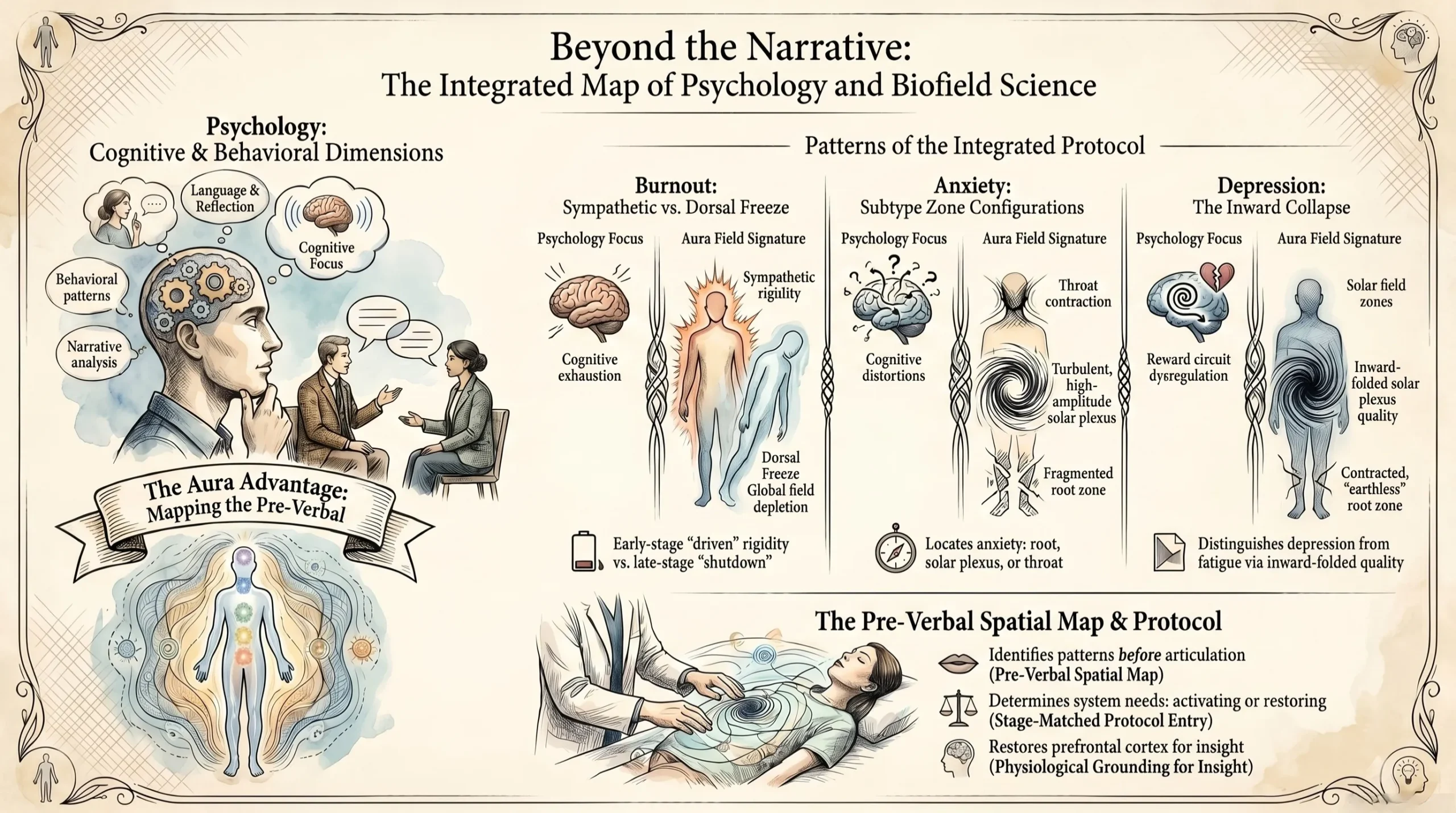
Psychological Framework | The Core Concept That Corresponds to an Aura Zone Reading | The Specific Aura Zone Where This Concept Is Most Visibly Encoded | What the Psychology Framework Cannot Access That the Reading Adds | How the Health & Vitality Reading Uses This Convergence Clinically |
Jungian analytical psychology — shadow, individuation, the collective unconscious | The shadow complex’s field signature: the disowned, suppressed, or unconscious psychological content that the ego has rejected from its self-concept. Jung’s shadow concept is the most precisely articulated Western psychological description of the samskara’s field encoding — the unconscious pattern whose energy is not absent from the field but present in a decoherent, non-integrated form. | The lower zones (root and sacral) for the shadow’s instinctual and relational suppressed content; the heart zone for the shadow’s emotional body’s grief, shame, and unexpressed love; the solar plexus for the shadow’s suppressed power and agency; the throat zone for the shadow’s unspoken authentic expression. The individuation process’s integration of the shadow corresponds exactly to the aura reading’s zone coherence restoration through Stage 3’s emotional and ancestral clearing. | The Jungian framework maps the psychological structure of what is suppressed but does not provide a pre-verbal, pre-cognitive access route to the shadow’s encoding in the physical field. The aura reading’s zone assessment identifies the shadow complex’s location in the field before the client has named it, articulated it, or achieved the cognitive recognition that Jung’s talking therapy requires. The field’s pre-verbal shadow encoding is accessible to the reading before it is accessible to the analytical mind. | Stage 3’s emotional body clearing is the Health & Vitality reading’s shadow integration protocol: the somatic practices that access the field’s encoded shadow content through the body’s pre-verbal intelligence rather than through the analytical mind’s narrative processing. The reading identifies which zones carry the shadow’s primary field encoding and which clearing sequence is most precisely calibrated to the client’s specific shadow configuration — the field-level shadow map that the Jungian analyst builds over months or years of analytical sessions, accessible in a single reading. |
Somatic psychology — body-based trauma storage, Peter Levine’s Somatic Experiencing, Bessel van der Kolk’s body-keeps-the-score framework | The body’s tissue-level storage of unprocessed traumatic experience as chronic muscular tension, postural patterns, and autonomic nervous system dysregulation. Van der Kolk’s central thesis — that trauma is stored in the body, not the mind, and that cognitive therapeutic approaches alone cannot access it — is the Western somatic psychology’s confirmation of what the Vedic tradition has always maintained: the sthula sharira (physical body) carries the samskara’s most dense and most physically consequential encoding. | Root and sacral zones for the developmental and relational trauma’s foundational physical encoding; the solar plexus for the power-over trauma’s compressed agency; the heart zone for the attachment trauma’s chronic contraction; the throat for the silenced truth’s suppression pattern. Peter Levine’s description of the incomplete freeze response’s stored activation energy in the body corresponds to the root zone’s fragmented coherence in the Health & Vitality reading’s trauma pattern. | Somatic psychology identifies that trauma is stored in the body and provides body-based therapeutic approaches to access it. It does not provide a spatial field map of where specifically in the body-field each trauma category is stored before the client has disclosed the trauma’s existence. The aura reading’s zone-specific trauma pattern identification gives the Health & Vitality protocol a spatial field map of the trauma’s primary encoding locations before the somatic therapeutic work begins. | The Health & Vitality reading’s Stage 3 somatic emotional clearing is the most directly somatic-psychology-aligned dimension of the five-stage protocol: the specific asana and pranayama sequence for each zone’s trauma pattern, the mantra’s vibrational access to the pre-verbal encoding, and the yoga nidra’s theta-state processing of the somatic memory content all operate through the body’s pre-cognitive intelligence that somatic psychology identifies as the trauma’s primary processing pathway. |
Attachment theory — Bowlby, Ainsworth, the four attachment styles (secure, anxious-preoccupied, dismissive-avoidant, fearful-avoidant) | The internal working model’s field encoding: the relational field pattern that the early attachment experience has installed as the individual’s default relational field template. Bowlby’s internal working model is the psychological description of what the aura reading identifies as the heart zone’s relational field pattern — the template whose quality determines the heart zone’s default opening or closing posture in relational contexts. | Heart zone (Anahata) as the primary encoding location for the attachment pattern’s field template; the throat zone for the communication style’s attachment-pattern-determined expression; the root zone for the secure base’s presence or absence in the field’s foundational layer. The anxious-preoccupied attachment style’s heart zone reads as over-reaching and depleted; the dismissive-avoidant’s reads as armoured and withheld; the fearful-avoidant’s reads as both reaching and armoured simultaneously — the most painful and most complex single zone pattern in the reading. | Attachment theory maps the four relational pattern templates with psychological precision but cannot identify which of the attachment styles is active in a given moment without the client’s self-report and reflective capacity. The aura reading’s heart zone field pattern is visible and distinguishable regardless of the client’s reflective capacity or willingness to self-disclose — the field carries the attachment history before the mind is ready to name it. | The Love & Connection reading’s heart zone clearing is the most directly attachment-theory-grounded service in the practice. For the Health & Vitality reading, the attachment pattern’s heart zone encoding is addressed through Stage 3’s heart zone emotional clearing with specific focus on the early relational field’s contribution to the cardiac electromagnetic field’s chronic constriction — the most cardiovascularly consequential single psychological dimension of the Health & Vitality field. |
Positive psychology — Seligman’s PERMA model (Positive emotions, Engagement, Relationships, Meaning, Achievement) | The PERMA model’s five flourishing dimensions map precisely onto five zone-quality indicators in the aura field: Positive emotions correspond to the heart zone’s coherent openness; Engagement to the solar plexus zone’s purposeful activation; Relationships to the heart and throat zones’ relational coherence; Meaning to the third-eye zone’s visionary clarity; Achievement to the solar plexus zone’s confident assertive quality. The PERMA profile is, in field terms, the reading of the five specific zone qualities that together constitute the flourishing aura. | Heart zone for Positive emotions and Relationships; solar plexus for Engagement and Achievement; third-eye for Meaning. The PERMA-flourishing aura field’s overall quality is what the Vedic tradition describes as the Sattvic field’s fully expressed form: all five PERMA dimensions simultaneously present as coherent, well-organised, dynamically alive zone qualities. | The PERMA model maps the five dimensions of psychological flourishing but is exclusively self-report based — it measures what the client believes about their flourishing rather than the field’s actual coherence quality across the five dimensions. The aura reading identifies the field-level PERMA profile independently of the client’s self-assessment, revealing the discrepancy between the intellectually affirmed flourishing and the field’s actual coherence state — particularly valuable for the high-functioning professional who scores well on PERMA self-report while the field is depleted. | The Health & Vitality reading’s stage-by-stage protocol systematically builds each PERMA dimension’s field-level coherence: Stage 1 builds the Engagement foundation through circadian restoration; Stage 2 builds the Achievement dimension through mitochondrial vitality; Stage 3 builds the Positive emotions and Relationships dimensions through emotional body clearing; Stage 4 builds the Meaning dimension through the third-eye zone’s contemplative depth; Stage 5 integrates all five into the Sattvic flourishing field’s full expression. |
Cognitive behavioural psychology — Beck’s cognitive triad, automatic negative thoughts (ANTs), core beliefs | The core belief’s field encoding: the deepest-layer cognitive schema that Beck identifies as the organising architecture beneath the automatic thought and the dysfunctional assumption. Beck’s core belief — the ‘I am worthless,’ ‘I am unlovable,’ ‘the world is dangerous’ — is the psychological description of the Vedic tradition’s ahamkara (false self-identity) whose field encoding the aura reading identifies in the causal body’s layer before the client has articulated the core belief cognitively. | The causal body layer (the reading’s deepest assessable field layer) for the core belief’s most deeply encoded field pattern; the third-eye zone for the cognitive schema’s ongoing information-processing distortion; the heart zone for the core belief about lovability’s cardiac field consequence; the root zone for the core belief about safety’s foundational field consequence. | CBT identifies and directly challenges the core belief through cognitive restructuring — a cognitive approach that is highly effective for the belief’s cognitive expression but less effective for its pre-cognitive, somatic, and field-level encoding. The aura reading’s causal body layer assessment identifies the core belief’s field encoding at the level where the CBT’s cognitive restructuring has not yet reached — the field pattern beneath the thought pattern that is generating the thought. | The Stage 5 causal body clearing’s samskara dissolution practices address the CBT’s core belief at its most foundational available encoding level: not through cognitive challenge (which reshapes the thought) but through the mantra, yoga nidra sankalpa, and ancestral clearing practices that address the field pattern from which the thought is being generated. The CBT and the Stage 5 clearing are complementary rather than competitive: the CBT restructures the cognitive expression while the Stage 5 addresses the field-level source. |
Depth psychology and psychosynthesis — Assagioli’s subpersonalities, the higher self, will | Assagioli’s subpersonality concept — that the psyche contains multiple semi-autonomous psychological part-selves, each with its own needs, beliefs, and field expression — corresponds directly to the aura reading’s zone-level assessment of the field’s internal plurality: the zones that are coherent and well-integrated (the subpersonalities that have been consciously developed) versus the zones that are decoherent, suppressed, or underdeveloped (the subpersonalities that have been marginalised from the self-concept). | All seven zones as the reading’s subpersonality field map: each zone’s coherence quality encodes the degree to which the corresponding psychological dimension (survival intelligence, relational intelligence, power intelligence, love intelligence, authentic expression, visionary intelligence, universal intelligence) has been consciously developed and integrated. The subpersonality conflict — the solar plexus’s ambition versus the heart zone’s relational need, for instance — reads as a specific inter-zone coherence tension in the field. | Psychosynthesis identifies the subpersonality configuration through therapeutic dialogue and imagery work — approaches that depend on the client’s capacity for reflective self-observation. The aura reading’s seven-zone field map provides the subpersonality configuration’s field-level layout before the client has achieved the reflective self-observation that psychosynthesis requires, giving the therapeutic work a precise spatial starting point. | The Health & Vitality reading’s zone-specific protocol prescription is, in Assagioli’s language, the field-level subpersonality development and integration programme: each stage’s practices develop specific psychological intelligences (Stage 1 the survival intelligence, Stage 2 the vitality intelligence, Stage 3 the emotional intelligence, Stage 4 the contemplative intelligence, Stage 5 the transpersonal intelligence) through the body-field’s direct access rather than the reflective mind’s indirect approach. |
Transpersonal psychology — Maslow’s self-actualisation and peak experiences, Grof’s holotropic states | Maslow’s hierarchy’s self-actualisation level and the peak experience concept correspond to the aura field’s crown and third-eye zones’ fully coherent expression: the peak experience is, in field terms, a temporary access to the neuroimmune coherence state whose field signature is the luminous, expansive, inter-zone continuously coherent aura that the Health & Vitality protocol’s five-stage sequence builds toward as its aspirational ceiling. Maslow’s self-actualising person’s characteristics are, in aggregate, the psychological description of the Sattvic field’s fully expressed zone quality. | Crown zone (Sahasrara) for the peak experience’s universal field connection; third-eye zone for the Being-cognition’s visionary clarity; heart zone for the unitive experience’s love dimension; the whole-field coherence quality that Maslow described as the Being-values’ luminous presence. Grof’s holotropic states’ transpersonal field expansions correspond to the crown zone’s access to field states beyond the individual body’s boundaries. | Transpersonal psychology identifies the peak experience’s psychological content and the self-actualisation trajectory’s developmental stages but does not provide a practical, daily-life protocol for cultivating the field conditions that the peak experience requires. The aura reading’s five-stage protocol is the practical field-preparation programme for the peak experience’s reliable cultivation — moving from the peak experience’s occasional involuntary occurrence to its increasingly reliable voluntary access. | The Health & Vitality reading’s Stage 4 and Stage 5 practices are the most directly transpersonal-psychology-aligned dimensions of the protocol: the yoga nidra’s ventral-dorsal blend state’s crown zone access, the deep meditation’s gamma coherence, and the Stage 5’s consciousness practices that Maslow would have recognised as the practical technology for self-actualisation’s field cultivation. |
Existential psychology — Frankl’s logotherapy, the will to meaning, ultimate concerns | Frankl’s logotherapy’s core insight — that the primary human motivation is not pleasure (Freud) or power (Adler) but meaning — corresponds to the third-eye zone’s visionary clarity and the throat zone’s authentic expression as the two zones whose decoherence most consistently corresponds to the existential vacuum that logotherapy addresses. The meaning deficit’s field signature is the third-eye zone’s directed brightness without receptive depth — the driven person who is achieving but not flourishing. | Third-eye zone (Ajna) as the meaning-finding intelligence’s field node; the throat zone’s authentic expression as the meaning’s outward embodiment; the crown zone’s universal field connection as the ultimate meaning source that Frankl’s logotherapy points toward without naming as a field phenomenon. The existential vacuum’s field signature — a third-eye zone that is bright but inwardly hollow — is among the most commonly identified patterns in the Career & Purpose reading’s urban professional client population. | Existential psychology identifies the meaning deficit and the meaning-finding process but works exclusively at the cognitive-narrative level: the client’s reflective construction of meaning through reframing. The aura reading identifies the existential vacuum’s field-level signature — the hollow third-eye zone’s specific quality — before the client has articulated the meaning deficit, providing the pre-cognitive field-level confirmation of what the existential work is addressing. | Stage 4’s yoga nidra sankalpa (the intention embedded during the theta state’s neuroplasticity window) is the most directly logotherapy-aligned practice in the protocol: it is the field-level equivalent of Frankl’s meaning-finding — the embedding of a consciously chosen ultimate value at the level of the field’s deepest accessible encoding rather than merely the cognitive mind’s affirmation. The Health & Vitality reading’s third-eye zone restoration is the field preparation for this logotherapeutic embedding to have maximum depth and durability. |
Developmental psychology — Erikson’s eight stages, adult development stages, Kegan’s orders of mind | Erikson’s eight psychosocial developmental stages — each defined by a specific psychological tension whose resolution produces a specific psychological strength — correspond to the aura field’s eight-layer structure: each developmental stage’s unresolved tension leaves a specific field encoding in the corresponding zone’s layer. The developmental arrests (Erikson’s psychosocial crises that were not adequately resolved) are visible in the aura field as specific zone decoherence patterns whose quality encodes the developmental stage at which the arrest occurred. | Root zone for the Trust vs Mistrust stage’s resolution or arrest; sacral zone for Autonomy vs Shame; solar plexus for Initiative vs Guilt and Industry vs Inferiority; heart zone for Intimacy vs Isolation; throat zone for Identity vs Role Confusion’s authentic expression; third-eye for Generativity vs Stagnation’s visionary depth; crown zone for Ego Integrity vs Despair’s life-meaning integration. The developmental arrest’s specific zone location in the reading provides the most precise available spatial map of the psychosocial developmental history. | Developmental psychology identifies the developmental stage sequence and the specific tension at each stage but requires the client’s biographical history to identify which stages were inadequately resolved. The aura reading’s zone-specific developmental arrest pattern is visible in the field independently of the biographical narrative — the zone quality encodes the developmental history at the field level before the client has disclosed or even consciously recognised the unresolved developmental tension. | The Health & Vitality reading’s zone-specific protocol addresses the developmental arrests directly through the corresponding stage’s practices: Stage 1’s environmental safety for the Trust stage’s root zone foundation; Stage 3’s somatic clearing for the Shame and Guilt stages’ sacral and solar plexus field encoding; Stage 4’s generativity practices for the Generativity stage’s third-eye zone development. The developmental field map is the Health & Vitality reading’s most precisely sequenced clinical contribution. |
Interpersonal neurobiology — Daniel Siegel’s mindsight, integration as the foundation of mental health | Siegel’s central concept of neural integration — that mental health is the differentiated parts of the nervous system’s coordinated linkage into a flexible, adaptive, coherent, energised, and stable (FACES) whole — is the most direct Western neuroscience equivalent of the aura reading’s inter-zone coherence continuity assessment. Siegel’s FACES acronym is the psychological description of what the Health & Vitality reading identifies as the Sattvic coherent field’s quality: flexible, adaptive, coherent, energised, and stable. | The inter-zone coherence continuity across all seven zones as the FACES integration’s field-level expression: the smooth, continuous, well-organised field network whose zones are both individually coherent (differentiated) and continuously connected (linked) is Siegel’s integration expressed as a complete field pattern. The chaos-rigidity spectrum — Siegel’s two poles of dysregulation — corresponds to the aura reading’s distinction between the chaotic decoherence of the anxiety pattern and the rigid decoherence of the freeze pattern. | Interpersonal neurobiology’s integration framework provides the most neuroscientifically rigorous available description of the healthy mind’s qualities but operates at the level of neural circuits and interpersonal relationships. The aura reading’s seven-zone integration assessment extends this framework to the biofield’s spatial architecture — identifying which specific zones are failing to differentiate or to link, and in which direction (toward chaos or rigidity) each zone’s dysregulation is expressed. | Siegel’s FACES acronym is the target state that every stage of the Health & Vitality protocol is building toward: Stage 1’s circadian stability builds Stable; Stage 2’s vitality builds Energised; Stage 3’s emotional clearing builds Adaptive (reducing the rigidity of suppressed emotional content); Stage 4’s contemplative depth builds Coherent and Flexible; Stage 5’s causal body clearing builds the complete FACES integration’s full field expression. The FACES state and the Sattvic coherent field are the same destination described from two disciplinary perspectives. |
The interpersonal neurobiology row is the one I return to most often when working with psychologically sophisticated clients, because Siegel’s FACES framework provides the most precise available Western scientific language for what the Health & Vitality reading is building toward: a nervous system whose differentiated parts are coordinated into flexible, adaptive, coherent, energised, and stable integration. The FACES state and the Sattvic coherent field are the same destination described from neuroscience and from the Vedic tradition respectively. Demonstrating that convergence to a client who is familiar with Siegel’s framework typically produces the most immediate recognition of why the aura reading’s five-stage protocol is structured as it is — because each stage is building a specific dimension of the FACES integration’s field-level expression.
The Jungian shadow row is the one that most consistently produces the ‘this is exactly what I have been trying to articulate’ response from clients who have done Jungian work. The shadow concept’s field-level expression — the pattern in the zone that carries the disowned psychological content’s energy before the ego has integrated it — is the most direct available description of what the zone decoherence pattern actually carries. The shadow is not absent from the field when it has been repressed; it is present in a decoherent, non-integrated form. The integration is not the removal of the decoherent pattern but its reorganisation into coherent zone expression — the Jungian integration process expressed in field-level language.
How Does the Aura Reading Add Precision to the Assessment of Eight Common Psychological Conditions?
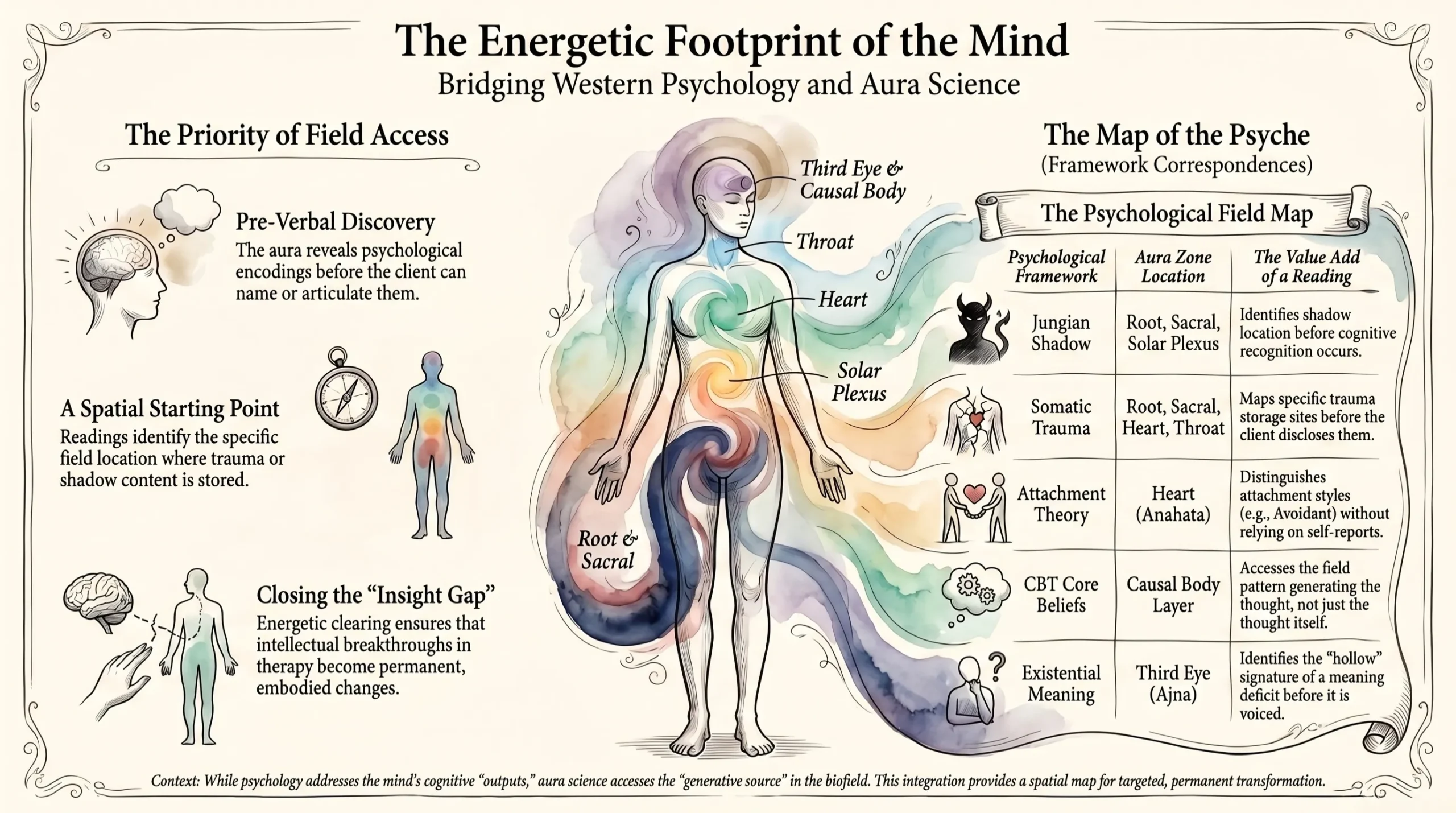
I want to name the most important clinical principle that unifies the eight conditions’ table: the aura reading’s contribution is not a replacement for the psychological assessment’s cognitive and relational depth. It is a prior layer of spatial, pre-verbal, field-level information that makes the psychological work more precisely targeted. The reading is the map; the psychological work is the journey. The map does not replace the journey’s necessity. But a journey without a map is significantly less efficient than one with.
Eight Psychological Conditions – What Psychology Provides, What the Reading Adds, Zone Pattern, and Integrated Protocol:
| Psychological Condition | What Psychology Identifies and Addresses | What the Aura Zone Reading Adds That Psychology Does Not Provide | The Field Pattern the Reading Identifies | The Integrated Health & Vitality Protocol Response |
| Chronic stress and professional burnout | Psychology identifies the cognitive, behavioural, and emotional dimensions of burnout (Maslach’s three-component model: emotional exhaustion, depersonalisation, reduced personal accomplishment) and addresses them through CBT, stress management techniques, boundary-setting, and lifestyle adjustment. The psychological framework is most effective at the cognitive and behavioural levels of the burnout presentation. | The reading identifies which specific zones are carrying the burnout’s primary field encoding and at which stage of the burnout progression (sympathetic dominance → early burnout → dorsal freeze transition) the field currently sits. This stage identification determines the protocol’s entry point — the wrong stage’s intervention applied to the wrong field state produces further depletion rather than restoration, a clinical distinction that the psychological framework’s symptom assessment does not provide. | Early burnout: root and solar plexus zones over-bright and rigid; heart zone beginning to constrict. The driven solar plexus’s compulsive over-extension. Late burnout: global field depletion with all zones dim and contracted — the dorsal vagal freeze signature. The transition point between these two states is the most urgent intervention window in the reading. | Stage-matched protocol entry: early burnout receives Stage 1-2’s circadian and HPA restoration before Stage 3’s emotional clearing; late burnout’s freeze restoration sequence begins with gentle somatic movement, Bhramari, and social engagement system activation before any intensifying pranayama. The psychological framework’s cognitive and behavioural work is most effective when sequenced after the field’s physiological restoration rather than concurrently — because the cognitive capacity for the psychological work’s reflection requires the prefrontal cortex’s restoration that Stages 1-2 provide. |
| Anxiety disorders (generalised anxiety, performance anxiety, social anxiety) | Psychology identifies the cognitive distortions (catastrophising, overestimation of threat, intolerance of uncertainty) and the behavioural avoidance patterns that maintain the anxiety cycle. CBT’s cognitive restructuring and exposure therapy, ACT’s defusion and psychological flexibility, and somatic therapies address the anxiety’s cognitive, behavioural, and somatic dimensions. | The reading identifies the specific zone configuration of the anxiety pattern — whether it is primarily a root zone fragmentation (existential safety deficit), a solar plexus turbulence (performance threat perception), a heart zone constriction (relational safety deficit), or a throat zone contraction (authentic expression suppression) — before the client has identified which specific dimension of their anxiety is primary. Different anxiety subtypes produce different zone configurations requiring different protocol entries. | The fragmented root zone with turbulent solar plexus and constricted throat zone. The crown and third-eye zones show the tight, vigilant monitoring quality of the amygdala’s hyperactivated threat detection. The heart zone cycles between reaching and armoured in the social anxiety subtype. The overall field has the characteristic quality of a system waiting for a threat it cannot locate. | The zone-specific anxiety protocol: root zone fragmentation → earthing, Bhramari, and the grounding sequence; solar plexus turbulence → cardiac coherence breathing’s 0.1 Hz resonance and the solar plexus zone’s Ram mantra; throat constriction → Bhramari humming and Stage 3’s authentic expression clearing. The psychological framework’s cognitive and behavioural work is most effective when the zone-specific field restoration has reduced the amygdala’s chronic activation threshold so that the cognitive restructuring’s prefrontal cortex engagement can proceed without the hyperactivated threat detection’s interference. |
| Depression and anhedonia | Psychology identifies the cognitive triad (negative view of self, world, and future), the behavioural withdrawal, and the anhedonia’s reward circuit dysregulation. Behavioural activation’s evidence base is strong for mild-to-moderate depression; CBT and interpersonal therapy’s cognitive and relational dimensions; antidepressant support when indicated. The psychological framework is most effective at the cognitive, behavioural, and relational levels. | The reading identifies the specific zone configuration of the depression pattern and, crucially, whether the pattern is in its sympathetic depletion phase (reduced but still externally oriented zones) or its dorsal freeze phase (fully contracted, inwardly collapsed zones). This distinction determines whether the protocol’s entry should be activating (Kapalabhati, vigorous movement, Bhastrika for the freeze-phase’s sympathetic mobilisation) or restoring (Bhramari, yoga nidra, gentle movement for the depletion-phase’s parasympathetic support). | The solar plexus zone’s inward collapse — distinct from the mere depletion of fatigue — is the most specific single zone indicator of the depression pattern. The heart zone’s emotional body withdrawal. The root and sacral zones’ contracted earthlessness. The crown zone’s dim disconnection from the universal field. The dorsal freeze quality’s cold, heavy, globally contracted field impression. | The depression protocol’s activation-before-refinement sequence mirrors the Vedic tradition’s Tamas-clearing prescription: Stage 2’s morning Kapalabhati and vigorous aerobic movement as the sympathetic mobilisation that lifts the dorsal freeze; mandatory daily sunlight as the chronobiological HPA restoration; the bhakti dimension’s devotional field activation as the ventral vagal’s social engagement restoration; Stage 3’s grief clearing for the solar plexus’s inward-collapsed emotional body content. Psychological therapy sequenced after this foundation enables the cognitive and relational work to proceed with the field’s necessary physiological energy available. |
| Trauma and post-traumatic stress | Psychology’s trauma frameworks — EMDR, somatic experiencing, IFS (Internal Family Systems), and narrative therapy — address the trauma’s cognitive processing, somatic storage, and identity reconstruction dimensions with varying but often strong evidence bases. The trauma framework’s most important advances (Levine’s somatic experiencing, van der Kolk’s body-centred approach) have moved the field toward the body’s pre-cognitive processing — toward, though not yet at, the field-level encoding that the aura reading accesses. | The reading identifies the spatial field map of the trauma’s primary encoding locations before the therapeutic process begins, providing the practitioner and the client with a field-level understanding of where the body is carrying the trauma’s energy most densely and which clearing sequence is most precisely calibrated to the specific trauma’s zone configuration. For developmental trauma (complex PTSD), the multi-zone encoding’s specific configuration guides the sequencing of the therapeutic approaches. | Complex PTSD’s multi-zone encoding: root zone’s safety deficit fragmentation; sacral zone’s relational and sexual trauma compression; solar plexus’s agency violation’s collapsed compression; heart zone’s attachment trauma’s armoured contraction; throat zone’s silenced truth’s suppression. Single-incident trauma: specific zone encoding corresponding to the trauma’s primary threat type. The ancestral layer’s transgenerational trauma field: patterns in the reading that correspond to Yehuda’s epigenetic transmission research. | The trauma protocol’s most important clinical principle is the reading’s stage identification: the therapeutic approaches that are effective for stabilised trauma (Stage 3’s deeper clearing) are contraindicated for the unstabilised field (Stage 1’s safety foundation must precede all deeper work). The Zone 1 safety restoration (sleeping environment, Schumann grounding, vagal tone baseline) is the aura reading’s equivalent of van der Kolk’s therapeutic window concept: no effective trauma processing occurs outside the window of tolerable activation that the physiological safety foundation enables. Referral to trauma-specialised psychological therapy is always included as the most important concurrent recommendation for complex PTSD presentations. |
| Grief and unprocessed loss | Psychology’s grief frameworks — Kübler-Ross’s stages, Worden’s tasks of mourning, the dual process model — identify the grief process’s psychological dimensions and provide language and structure for the mourning process. The psychological framework addresses grief’s cognitive-narrative, emotional, and relational dimensions effectively when the grief is consciously acknowledged and actively processed. | The reading identifies grief that has not been consciously acknowledged or processed — the suppressed grief that has been compressed into specific zones without the individual’s awareness that they are carrying it. The most common presentation in the Health & Vitality reading is the heart zone’s compressed grief field from losses that were never fully mourned: the parent who died while the professional was managing the funeral logistics; the relationship whose ending was handled by moving straight into the next; the career opportunity that was sacrificed for duty and never grieved. | The heart zone’s specific compressed grief pattern: a zone that has a thick, heavy, dense quality distinct from the simple constriction of chronic sympathetic suppression — the grief is present in the field as a dense accumulated weight rather than an active emotional experience. The throat zone’s silence around the grief’s expression. The sacral zone’s shutdown in the cases where the grief involves relational loss. The root zone’s disruption when the grief involves a foundational loss of safety or belonging. | Stage 3’s heart zone grief clearing: the specific practice sequence most precisely calibrated to the compressed grief’s field encoding — not the grief processing’s cognitive-narrative (which the psychological framework provides) but the field’s pre-cognitive emotional body’s physical release through the somatic practices that access the grief’s body-level encoding. The yoga nidra’s theta state provides the emotional processing depth that the body’s pre-cognitive intelligence requires for the grief’s field-level integration. The Bhramari’s vagal activation’s oxytocin release provides the neurobiological comfort that the grieving heart zone needs. |
| Identity confusion and self-esteem deficits | Psychology addresses identity confusion through narrative therapy’s authoring of alternative life stories, CBT’s core belief restructuring, and the developmental psychology’s understanding of identity’s formation through the Eriksonian stages. Self-esteem’s CBT and ACT approaches address the cognitive and evaluative dimensions of self-worth with evidence-based effectiveness. | The reading identifies the specific zone configuration of the identity confusion — whether it is primarily an ungrounded root zone (no stable base of being from which the identity can be defined), a solar plexus identity collapse (no clear sense of one’s own power and agency), a throat zone authenticity gap (performing an identity that does not match the field’s actual signature), or a third-eye vision deficit (no clarity about the direction the authentic self is moving toward). Each identity pattern requires a different protocol entry. | The most specific single zone indicator for identity confusion in the urban professional population: the throat zone’s authenticity gap — the mismatch between the professional persona’s performed frequency and the underlying field’s actual signature. The field reads as two contradictory layers: the outer professional identity’s surface brightness and the inner authentic field’s suppressed but clearly present alternative frequency. This is the most common single pattern in the Career & Purpose reading and the third most common in the Health & Vitality reading. | The throat zone authenticity gap protocol: Stage 3’s authentic expression clearing for the suppressed identity’s field-level emergence; the Vishuddha zone’s Ham mantra for the throat’s resonant frequency restoration; the Career & Purpose reading’s dharmic signature assessment as the field-level alternative to the narrative therapy’s story authoring. The dharmic signature’s zone location — identified in the reading as the zone with the highest available coherence when the client is in their most naturally aligned state — provides the identity-formation’s field-level anchor that the narrative therapy’s story authoring approximates at the cognitive level. |
| Relational and interpersonal difficulties | Psychology’s interpersonal frameworks — attachment theory’s relational pattern mapping, IFS’s parts work in relational contexts, emotionally focused couples therapy, and the interpersonal neurobiology’s dyadic regulation framework — address the relational difficulty’s cognitive, attachment, and communication dimensions. The interpersonal framework is most effective when both parties are engaged and reflectively capable. | The reading identifies the specific field-level mechanism of the relational difficulty — whether it is the heart zone’s attachment pattern’s template mismatch, the throat zone’s authentic communication’s suppression, the solar plexus’s boundary and agency confusion, or the field’s overall energetic depletion that leaves nothing available for the relational investment that healthy relating requires. The reading also identifies the individual’s own field contribution to the relational pattern without requiring the partner’s assessment. | The relational field pattern most commonly identified in the Health & Vitality reading’s urban professional clients: the field whose total energetic depletion from the chronic sympathetic dominance has reduced the available field investment for the primary relationship to a level below what the relationship’s maintenance requires. The heart zone is present but depleted — not armoured or grief-compressed, simply empty of the available field energy that genuine relational presence requires. The most common relational complaint from spouses and partners: ‘they are physically present but energetically absent.’ | The Health & Vitality protocol’s relational field restoration is primarily through Stage 1-2’s vitality restoration: restoring the energetic resource that the relationship’s field investment requires before addressing the relational pattern’s psychological dimensions. The Love & Connection reading’s heart zone clearing is the most directly relational service in the practice; for the Health & Vitality reading, the relational field restoration is primarily through the restoration of the energetic capacity for genuine relational presence that the burnout’s depletion has removed. |
| Spiritual emergency and awakening experiences | Transpersonal psychology’s frameworks — Grof’s spiritual emergency model, Wilber’s integral framework’s pre/trans distinction, and the clinical guidelines for supporting spiritual emergence — address the spiritual experience’s psychological integration and the distinguishing of genuine transpersonal states from psychotic episodes. This is the most underdeveloped area of mainstream psychology’s clinical repertoire. | The reading distinguishes between the spiritual emergence’s field signature (a genuine expansion of the crown and third-eye zones’ coherence quality that is well-integrated with the lower zones’ grounding) and the spiritual bypass’s field signature (bright upper zones combined with depleted, ungrounded lower zones — the elevation without foundation pattern). This distinction is the most clinically consequential contribution the aura reading makes to the spiritual emergency’s assessment. | Genuine spiritual emergence: the complete field’s coherent expansion, with all seven zones elevated simultaneously and the lower zones’ grounding foundation strong. Spiritual bypass: brilliant crown and third-eye with collapsed, fragmented, or dissociated lower zones. Kundalini activation without adequate grounding: root and sacral zones showing specific activation patterns that, without the earthing and stabilisation protocol, can produce the disorientation and destabilisation that the spiritual emergency’s presenting symptoms describe. | The grounding-before-elevation protocol: Stage 1’s Schumann earthing and root zone stabilisation is the most urgent intervention for the spiritual emergency’s destabilised presentation before any upper-zone practices are prescribed. The psychological support for cognitive integration of the spiritual experience’s content is the most important concurrent referral: the aura reading’s field stabilisation and the transpersonal therapist’s cognitive integration work are the complementary responses to the spiritual emergency’s two dimensions. |
What Is the Seven-Zone Psychological Map That the Reading Provides for Each Life Area?
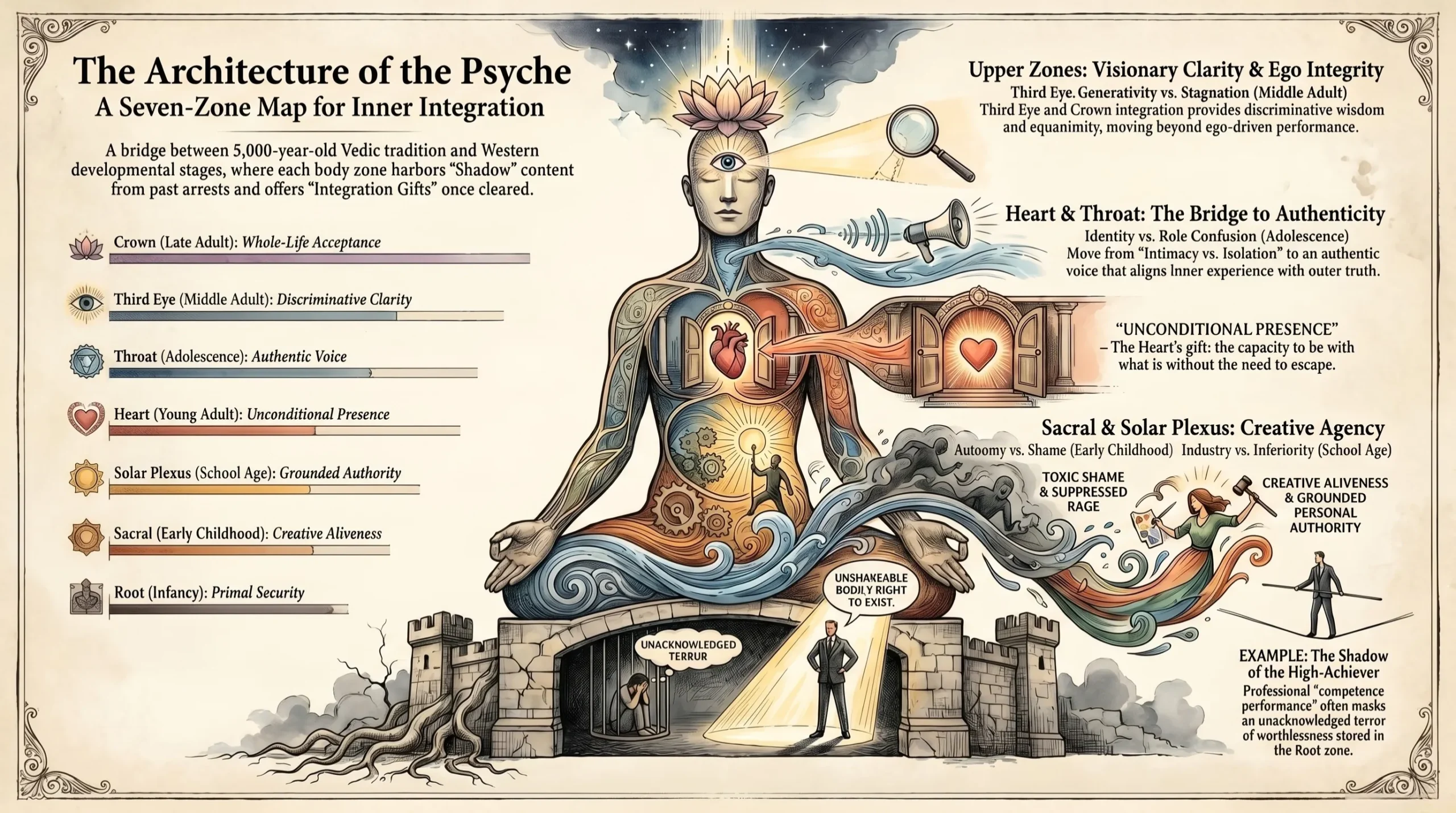
I want to introduce this table with a specific observation from practice: the zone psychological map is the single most practically useful framework I have found for explaining to a client why they are experiencing what they are experiencing without the need for a diagnostic label. The diagnostic label’s limitation — generalised anxiety disorder, dysthymia, adjustment disorder — is that it describes the pattern’s category without identifying its specific location in the individual’s field. The zone psychological map locates the pattern with spatial precision: not ‘anxiety’ as a generalised category but the specific configuration of root zone fragmentation combined with solar plexus turbulence combined with throat zone constriction that is this individual’s specific anxiety pattern, requiring this individual’s specific zone-targeted protocol.
The Seven-Zone Psychological Map – Psychological Content, Developmental Stage, Shadow Content, Integration Gift, and Protocol Intervention:
Zone | Vedic Name | Primary Psychological Content Encoded Here | Developmental Stage Correspondence (Erikson) | The Shadow Content Most Commonly Found Here | The Psychological Integration Gift When This Zone Is Cleared | The Health & Vitality Protocol’s Psychological Intervention |
Root | Muladhara | Survival intelligence, basic safety and trust, the body’s right to exist, the ancestral inheritance’s foundational layer, the earth belonging sense, the constitutional vitality that all other psychological functioning requires as its biological substrate | Trust vs Mistrust (Erikson Stage 1: infancy). The resolution’s quality determines the root zone’s foundational coherence: adequate early trust produces the stable, well-grounded root zone; the trust deficit produces the fragmented, anxious root zone whose Schumann coupling is weakest | The feared worthlessness that drives the achievement compulsion; the unacknowledged terror beneath the high-functioning professional’s competence performance; the tribal shame that the socially mobile individual has buried; the ancestral survival fear that the epigenetic transmission has carried forward | Primal security: the felt-sense bodily knowing that the self has the right to exist, to occupy space, and to receive care from the world — not as an intellectually affirmed belief but as a physiologically grounded state. The root zone’s integration gift is the unshakeable baseline that all higher-zone flourishing requires | Stage 1’s earthing protocol for the bioelectric grounding; the ancestral clearing for the epigenetically transmitted survival fear; Stage 3’s somatic work with the body’s fundamental safety signals |
Sacral | Svadhisthana | Relational and creative intelligence, emotional fluidity, pleasure and sensory aliveness, the capacity for intimacy without merger, the creative impulse’s life-force expression, the healthy shame’s relational boundary function before it becomes toxic shame’s self-condemnation | Autonomy vs Shame and Doubt (Erikson Stage 2: early childhood). The healthy autonomy’s will and boundary-setting versus the shame’s collapse of self-directed agency. Initiative vs Guilt (Erikson Stage 3: preschool) contributes the creative initiative’s inhibition pattern | The repressed creative longing that the ‘responsible adult’ identity has suppressed; the toxic shame that was installed by early shaming of the child’s natural expressiveness; the sexual shame and creative inhibition that Indian cultural and familial conditioning has most commonly encoded here; the grief about the unlived life | Creative aliveness: the spontaneous, embodied pleasure in the sensory world and the creative impulse’s unself-conscious expression. The sacral zone’s integration gift is the capacity to be fully alive in the body without the shame’s inhibition — the foundation for genuine intimacy, creative productivity, and embodied joy | The Apana Vayu pranayama for the downward-moving prana’s release; Stage 3’s shame-clearing somatic work; the specific sacral zone mantra (Vam) for the creative life-force’s field restoration |
Solar Plexus | Manipura | Power and agency intelligence, the healthy will’s self-directed purposeful action, personal authority and self-responsibility, the capacity to metabolise experience (the digestive fire’s psychological equivalent), the boundary between self and other at the level of will rather than emotion | Industry vs Inferiority (Erikson Stage 4: school age). The competence-building versus the inadequacy’s internalisation. Identity vs Role Confusion (Erikson Stage 5: adolescence) contributes the personal authority’s development versus the conformity’s identity displacement | The suppressed rage of the disempowered individual; the perfectionist’s driven over-extension that compensates for the underlying inadequacy belief; the authority-resentment that the professional’s socially performed deference conceals; the power-over wound of having been controlled, dominated, or violated in the agency dimension | Grounded personal authority: the psychological capacity to act from genuine self-directed agency rather than from the fear of inadequacy’s compensatory over-extension or the disempowerment’s passive compliance. The solar plexus zone’s integration gift is the clean, purposeful, self-responsible power that neither overreaches nor underasserts | Stage 3’s solar plexus rage-and-suppressed-power clearing; Kapalabhati for the agni’s activation; the Ram mantra’s solar plexus zone resonant frequency; the professional boundary-setting practice’s field reinforcement |
Heart | Anahata | Love and compassion intelligence, the capacity for genuine relational presence, grief’s integration and the loss’s metabolisation, the self-compassion that is the foundation for sustainable compassion toward others, the bridge between the lower zones’ personal psychology and the upper zones’ transpersonal dimensions | Intimacy vs Isolation (Erikson Stage 6: young adulthood). The capacity for genuine intimacy’s vulnerability versus the isolation’s self-protective withdrawal. Generativity vs Stagnation (Erikson Stage 7) contributes the loving contribution’s expansive giving versus the contracted self-absorption | The ungrieved losses accumulated across the lifespan; the self-condemnation that mirrors the inner critic’s harshest voice; the unexpressed love for those who have died or departed; the capacity for love that was learned as conditional in the family-of-origin and is now enacted conditionally toward the self | Unconditional presence: the capacity to be with what is — in oneself and in others — without the need to fix, improve, or escape it. The heart zone’s integration gift is the self-compassionate ground from which genuine compassion toward others becomes sustainably available, rather than the depleting performance of compassion that has no self-compassionate foundation | Stage 3’s heart zone grief and compassion clearing; the cardiac HRV coherence training for the electromagnetic field restoration; Bhramari for the vagal oxytocin release; loving-kindness meditation (Metta) for the self-compassion’s field cultivation |
Throat | Vishuddha | Authentic expression intelligence, the alignment between inner experience and outer communication, the truth-telling capacity that integrity requires, the creative voice’s authentic frequency, the listening intelligence that authentic communication includes, the boundary between the private self and the public persona | Identity vs Role Confusion (Erikson Stage 5: adolescence). The authentic identity’s emergence versus the role’s social performance. The throat zone carries the Identity stage’s most directly expressive dimension: the capacity to say who one is, what one values, and what one needs without the social performance’s substitution | The unsaid truth that has been swallowed for social safety; the authentic voice that has been silenced by the family’s or culture’s demand for conformity; the creative voice’s suppression in the professional who was told their creative aspirations were not practical; the anger that has been expressed as throat tension rather than spoken boundary | Authentic voice: the capacity to speak from the inner knowing with clarity, warmth, and courage — the congruence between what is felt and what is said that the Vedic tradition identifies as Satya (truthfulness) as a pratical lived quality. The throat zone’s integration gift is the freedom that comes from speaking truthfully, and the relational depth that authentic communication makes available | Bhramari humming for the laryngeal vagal stimulation and the throat zone’s resonant field restoration; Stage 3’s authentic expression clearing; the Ham mantra’s throat zone frequency; the journalling practice’s pre-verbal to verbal bridge for the suppressed content’s gradual articulation |
Third Eye | Ajna | Discriminative wisdom intelligence (Viveka), the capacity to perceive clearly without the ego’s distorting filters, the visionary dimension that sees the larger pattern beyond the immediate context, the intuitive knowing that arises from integrated intelligence rather than accumulated data, the witness consciousness that can observe the mind’s patterns without being captured by them | Generativity vs Stagnation (Erikson Stage 7: middle adulthood). The visionary contribution to the next generation versus the stagnation’s contracted self-focus. The third-eye zone’s wisdom is most fully developed in the individual who has moved beyond the ego’s self-referential focus to the generative vision’s larger contribution | The disowned intuitive knowing that the rational professional has suppressed because it could not be analytically justified; the suppressed spiritual longing in the materialist who has dismissed it as intellectually embarrassing; the visionary capacity that has been redirected from genuine guidance into compulsive cognitive control; the inner critic’s occupation of the space that the witness consciousness should inhabit | Discriminative clarity: the capacity to see what is actually present — in oneself, in relationships, and in situations — without the defensive distortions of the ego’s protective mythology. The third-eye zone’s integration gift is the trusted inner knowing that makes decisive action possible without the chronic second-guessing that is the unintegrated third-eye’s most common presenting symptom | Stage 1’s circadian correction for the pineal melatonin’s third-eye zone restoration; Nadi Shodhana for the interhemispheric synchronisation; Stage 4’s open-awareness meditation for the witness consciousness’ development; the Ajna zone’s Om mantra |
Crown | Sahasrara | Transpersonal intelligence, the capacity for genuine humility that arises from the direct experience of the self’s relationship to the universal field, the Ego Integrity that Erikson’s final stage names as the acceptance of the life’s full arc without the despair’s regret or the denial’s distortion, the spiritual intelligence that all major psychological frameworks from Maslow’s self-actualisation through Jung’s individuation to Frankl’s ultimate meaning point toward as the human development’s ceiling | Ego Integrity vs Despair (Erikson Stage 8: late adulthood). The acceptance of the complete life’s meaning versus the despair’s regret. The crown zone’s full psychological integration requires all seven lower zones’ progressive development — the crown zone cannot integrate what the lower zones have not processed | The spiritual pride that masquerades as enlightenment; the spiritual bypass’s upper-zone brightness that is achieved by abandoning the lower zones’ shadow work rather than completing it; the nihilistic despair beneath the intellectually sophisticated atheism; the fear of death that drives the achievement compulsion’s unconscious search for immortality through legacy | Ego Integrity: the whole-life acceptance that comes from having done the lower zones’ shadow work, processed the middle zones’ relational and expressive dimensions, and opened to the upper zones’ transpersonal depth. The crown zone’s integration gift is the unshakeable equanimity that comes from the direct experience of the self’s relationship to something larger than the individual biography | Stage 4-5’s contemplative and consciousness practices; yoga nidra’s delta state’s crown zone restoration; the GDV camera’s total field coherence confirmation; the samskara dissolution practices that address the causal body’s most deeply encoded material |
The heart zone row’s integration gift — unconditional presence — is the one that most consistently produces the deepest recognition in clients who have done the most psychological work. The CBT client who has spent three years restructuring their self-critical core beliefs, the Jungian client who has completed two years of shadow integration, and the somatic therapy client who has spent eighteen months processing their attachment trauma all describe the same aspiration in different language: the capacity to be with what is in oneself and in others without the need to fix, improve, or escape it. The heart zone’s integration gift is the field-level expression of that capacity — and the aura reading’s specific contribution to its cultivation is the direct, pre-cognitive field access to the compressed grief, the conditional love template, and the unexpressed love for those who have departed that is maintaining the cardiac field’s constriction beneath the cognitive understanding that has been achieved.
The crown zone row’s shadow content — particularly the spiritual pride that masquerades as enlightenment and the spiritual bypass’s upper-zone brightness — is the one that requires the most sensitive clinical handling, because the clients most vulnerable to this pattern are those with the most developed spiritual and psychological sophistication. The reading’s most important contribution for this profile is the honest assessment of the lower zones’ grounding quality: the brilliant crown zone that is sitting on top of an uncleared root zone’s survival terror, an uncleared sacral zone’s creative and relational suppression, and an unprocessed solar plexus’s power wound is not the integration’s ceiling — it is the bypass’s characteristic signature. The crown zone’s genuine integration gift requires all seven lower zones’ progressive development as its foundation.
What Does the Integrated Aura-Psychology Approach Produce That Neither Achieves Alone?
The most important single thing the integration produces is the closing of the gap between cognitive understanding and embodied transformation — the gap that the Hyderabad consultant described as the most frustrating single experience of his three years of excellent CBT. Psychology provides the understanding; the field work provides the embodiment. Understanding without embodiment is the most commonly reported outcome of psychological work that has been conducted without the field-level physiological restoration sequence. Embodiment without understanding is the most commonly reported outcome of somatic work that has been conducted without the psychological framework’s cognitive depth. The integration produces the compound: understanding that is simultaneously embodied because the field’s physiological restoration has given the nervous system the coherence required to hold the insight in the body rather than merely in the mind.
Five Specific Clinical Outcomes That the Integration Achieves:
- The pattern’s permanence: The psychological insight’s tendency to produce understanding that returns to baseline without the field work’s physiological anchoring is the most commonly reported limitation of cognitive therapy alone. When the field-level physiological restoration (Stages 1-2) precedes the psychological work’s cognitive-emotional dimension (Stage 3 and beyond), the insight that is achieved is embedded in a field that has the coherence quality to sustain it between sessions. The insight sticks because the field it is embedded in has the structural integrity to hold it.
- The body’s participation: Van der Kolk’s most important clinical finding is that the body’s participation in the therapeutic process — not merely the body’s description by the cognitive mind but the body’s own pre-cognitive processing of the stored material — is what produces the embodied change that cognitive therapeutic approaches cannot achieve alone. The aura reading’s zone assessment and the Stage 3 somatic clearing’s body-first practices give the body’s participation in the therapeutic process its most precise available spatial starting point.
- The pre-disclosure map: The most practically valuable contribution the reading makes to psychological work is the field-level information that is available before the client has the safety, the reflective capacity, or the conscious awareness to disclose the pattern’s existence. For trauma presentations, for the deeply defended shadow configurations, and for the developmental arrests that are pre-verbal in origin, the field map’s pre-disclosure availability is the difference between a therapeutic process that begins at the edge of the defended territory and one that begins with the spatial layout of the territory already known.
- The sequential clarity: The most common source of inefficiency in psychological work is the lack of a principled sequencing framework — the absence of a clinical rationale for addressing dimension A before dimension B. The Health & Vitality reading’s five-stage sequence provides the most precise available sequencing rationale: Stage 1’s physiological safety before Stage 3’s emotional clearing; Stage 3’s somatic-emotional work before Stage 4’s contemplative depth; the lower zones’ grounding before the upper zones’ opening. The sequence is grounded in the nervous system’s hierarchy (polyvagal theory’s safety-before-mobilisation-before-social principle) and in the developmental psychology’s stage-dependent development. It is not arbitrary.
- The daily practice’s physiological support: The most significant structural difference between the aura reading’s protocol and most psychological frameworks is the daily practice’s physiological maintenance between sessions. The psychological session’s insights fade between appointments when there is no daily practice that maintains and extends the session’s work at the field level. The Health & Vitality reading’s daily protocol — the constitutional pranayama, the earthing, the mantra, the yoga nidra, the cardiac coherence breathing — is the daily physiological maintenance of the field restoration that the reading initiates and the psychological work deepens.
Are You Ready for the Psychologically Integrated Health and Vitality Reading?
Namaste, my friend — if this article has named the specific gap you have been experiencing between the psychological understanding you have achieved and the embodied transformation you have been seeking, you are ready for the Health & Vitality reading’s most integrative contribution: the field-level map of what your body is carrying at the pre-cognitive level, the physiological restoration sequence that gives the psychological work’s insights the biological capacity to become embodied rather than merely understood, and the seven-zone psychological map of the inner geography that your therapeutic work has been navigating.
Using our patented photo-scanning technology and Multiple Advanced Gadgets. Drawing on eight years of practice and 1,000+ readings across India. With our money-back guarantee.
Three Steps to Your Psychologically Integrated Health and Vitality Reading:
- Submit Photo – Upload a recent, clear photograph of yourself. The seven zones’ psychological content, the developmental arrest patterns, the shadow configurations, and the specific psychological frameworks most relevant to your current field state are all accessible through our patented photo-scanning technology and Multiple Advanced Gadgets.
- Expert Analysis – I personally decode your complete Health & Vitality aura field’s psychological map: which zones carry which psychological dimensions, which shadow content is most urgently calling for integration, which psychological conditions are reflected in the field pattern, and which five-stage protocol sequence is most precisely calibrated to your specific psychological field’s current configuration.
- Transform – Receive your personalised Health & Vitality Aura Guide — seven-zone psychological map, shadow configuration assessment, developmental arrest locations, integration gift sequence, psychologically sequenced five-stage protocol, and daily practice for embodied transformation — delivered within 24–48 hours with our money-back guarantee.
⚠️ Disclaimer: Aura analysis and energetic guidance are for personal growth and awareness only. They are not a substitute for professional medical, financial, legal, or psychological advice. Please consult qualified professionals for any health or financial concerns.
Q1: What does the aura reading add to psychological therapy that psychology cannot provide?
The aura reading provides pre-cognitive, pre-verbal, spatial field-level access to the pattern’s encoding before the client has the capacity or willingness to name it through reflective language. Psychology addresses the mind’s cognitive-narrative, emotional, and behavioural dimensions through processes that require language and reflective consciousness. The aura reading operates at the level prior to language: the body-field’s encoded pattern that is generating the cognitive, emotional, and behavioural expressions that psychology then addresses. Three specific contributions that the reading makes that psychology cannot: the pre-disclosure field map available before the client’s self-report; the zone-specific developmental arrest location without biographical disclosure; and the physiological restoration sequence that gives the psychological work’s insights the nervous system coherence to be embodied rather than merely intellectually understood.
Q2: How does the Jungian shadow concept correspond to aura zone decoherence?
Jung’s shadow complex — the disowned, suppressed, or unconscious psychological content that the ego has rejected from its self-concept — corresponds precisely to the aura zone’s decoherence pattern: the shadow content is not absent from the field when repressed but present in a decoherent, non-integrated form. The shadow’s specific zone location in the reading identifies where the body-field is carrying the suppressed content most densely: lower zones for instinctual and relational shadow; heart zone for emotional shadow content (grief, shame, unexpressed love); solar plexus for suppressed power and agency; throat for unspoken authentic truth. The individuation process’s shadow integration corresponds to the aura reading’s zone coherence restoration: not the removal of the decoherent pattern but its reorganisation into coherent zone expression.
Q3: How does attachment theory map onto the heart zone reading?
Attachment theory’s internal working model — the relational field pattern installed by early attachment experience as the default relational template — is encoded in the heart zone’s field quality. The four attachment styles produce four distinguishable heart zone patterns: secure attachment produces a luminous, open, well-boundaried heart zone; anxious-preoccupied produces an over-reaching, depleted zone that is always extending toward others without sufficient self-replenishment; dismissive-avoidant produces an armoured, withheld zone whose boundary is too rigid for genuine intimacy; fearful-avoidant produces the most complex pattern — simultaneously reaching and armoured, the result of wanting connection while fearing it. The reading identifies the attachment pattern’s field encoding independently of the client’s self-report, and Stage 3’s heart zone clearing addresses the template’s somatic-field encoding.
Q4: What is the 'field-prior-to-soma' sequencing principle in the integrated protocol?
The field-prior-to-soma sequencing principle is the Health & Vitality reading’s most important clinical innovation for the aura-psychology integration: field restoration precedes somatic therapeutic work, which precedes cognitive therapeutic work. This sequence is not a hierarchy of value but a hierarchy of access. The field (Stages 1-2’s physiological restoration) needs to be sufficiently coherent before the somatic work (Stage 3’s body-based emotional clearing) can fully access what the field is carrying. The somatic work needs to have processed the body’s pre-cognitive encoding before the cognitive work (Stages 4-5’s contemplative and causal dimensions) can produce insights that the body will integrate rather than merely file as interesting ideas. This sequence follows the polyvagal hierarchy’s safety-before-mobilisation-before-social principle and the developmental psychology’s stage-dependent development logic.
Q5: What is the difference between genuine spiritual emergence and spiritual bypass in the aura reading?
The aura reading distinguishes between genuine spiritual emergence and spiritual bypass through the lower zones’ grounding quality. Genuine spiritual emergence produces a complete field coherent expansion: all seven zones are elevated simultaneously, and the root, sacral, and solar plexus zones’ grounding foundation is strong and well-organised beneath the upper zones’ expanded coherence. Spiritual bypass produces a characteristic upper-zone-bright, lower-zone-depleted pattern: brilliant crown and third-eye zones with collapsed, fragmented, or dissociated root, sacral, and solar plexus zones. The spiritual bypass’s elevation has been achieved by abandoning the lower zones’ shadow work rather than completing it. The protocol response to spiritual bypass is always grounding-before-elevation: Stage 1’s earthing and root zone stabilisation before any upper-zone practices are prescribed, and concurrent referral to transpersonal psychological support for the cognitive integration of the spiritual experience.