Why Do Sceptics Question Aura Science?
Namaste, I’m Mukesh Shah. I want to begin with a statement that may surprise you coming from an aura practitioner: the sceptics are often right. Not about everything. Not about the conclusion that aura science is simply fiction dressed in quantum vocabulary. But about many of the specific problems they identify: the overclaiming, the self-referential evidence loops, the absence of independent validation, the exploitation of vulnerable clients, and the casual deployment of scientific vocabulary without mechanism specificity. These are real problems. They deserve to be named honestly by practitioners, not just by critics.
The relationship between aura science and scientific scepticism is one of the most mishandled conversations in the field. The typical aura practitioner’s response to sceptical challenge is defensive: dismissing the sceptic as closed-minded, citing the tradition’s authority, or invoking quantum mechanics without the precision that would make the invocation meaningful. The typical scientific sceptic’s response to aura science is equally problematic: dismissing the entire field based on its worst examples, ignoring the substantial published literature in biophoton research and quantum biology, and applying a standard of certainty to aura science claims that is not applied uniformly to other medical and psychological interventions.
Neither response is honest. Neither advances the understanding of what aura science is, what it can genuinely offer, and what its genuine limitations are. The conversation the field needs is not between true believers and dismissive sceptics. It is between people who take both the evidence and the objections seriously — who want to know what is actually true rather than what confirms a position they already hold.
In eight years of practice across more than 1,000 readings, I have had versions of the sceptical conversation with clients in Mumbai, Delhi, Bangalore, Pune, Ahmedabad, and Hyderabad who arrived with a genuine analytical intelligence and a genuine desire to understand whether the field is what it claims to be. The best of these conversations have been among the most productive in my practice — because the sceptical client who genuinely engages with the evidence and the honest acknowledgement of uncertainty is the client whose reading ultimately produces the most considered, the most grounded, and the most durable transformation. This article is for that client. It engages with every major sceptical objection directly, honestly, and with the same calibrated uncertainty that the previous articles in this series have applied to every scientific claim.
What Are the Twelve Sceptical Objections to Aura Science and How Should Each Be Answered?
I have spent considerable time with each of these objections — both the versions I encounter from clients and the more technically sophisticated versions I encounter in the academic sceptical literature. My approach to each is the same: state the objection as precisely and as charitably as possible; identify what is genuinely valid within it; identify where the objection overclaims or misstates; and provide the honest evidence-based response that engages with what is legitimate without capitulating to what is not.
I want to be explicit about what I am not doing in this section. I am not providing a set of rhetorical responses designed to neutralise objections and convert sceptics. I am engaging with each objection as a genuine epistemological challenge that deserves a genuine epistemological response. Some of the responses below require me to concede that the sceptic is right. Some require me to show where the sceptic’s objection is weaker than it appears. Most require both.
Twelve Sceptical Objections to Aura Science – The Valid Core, the Overclaim, and the Evidence-Based Response:
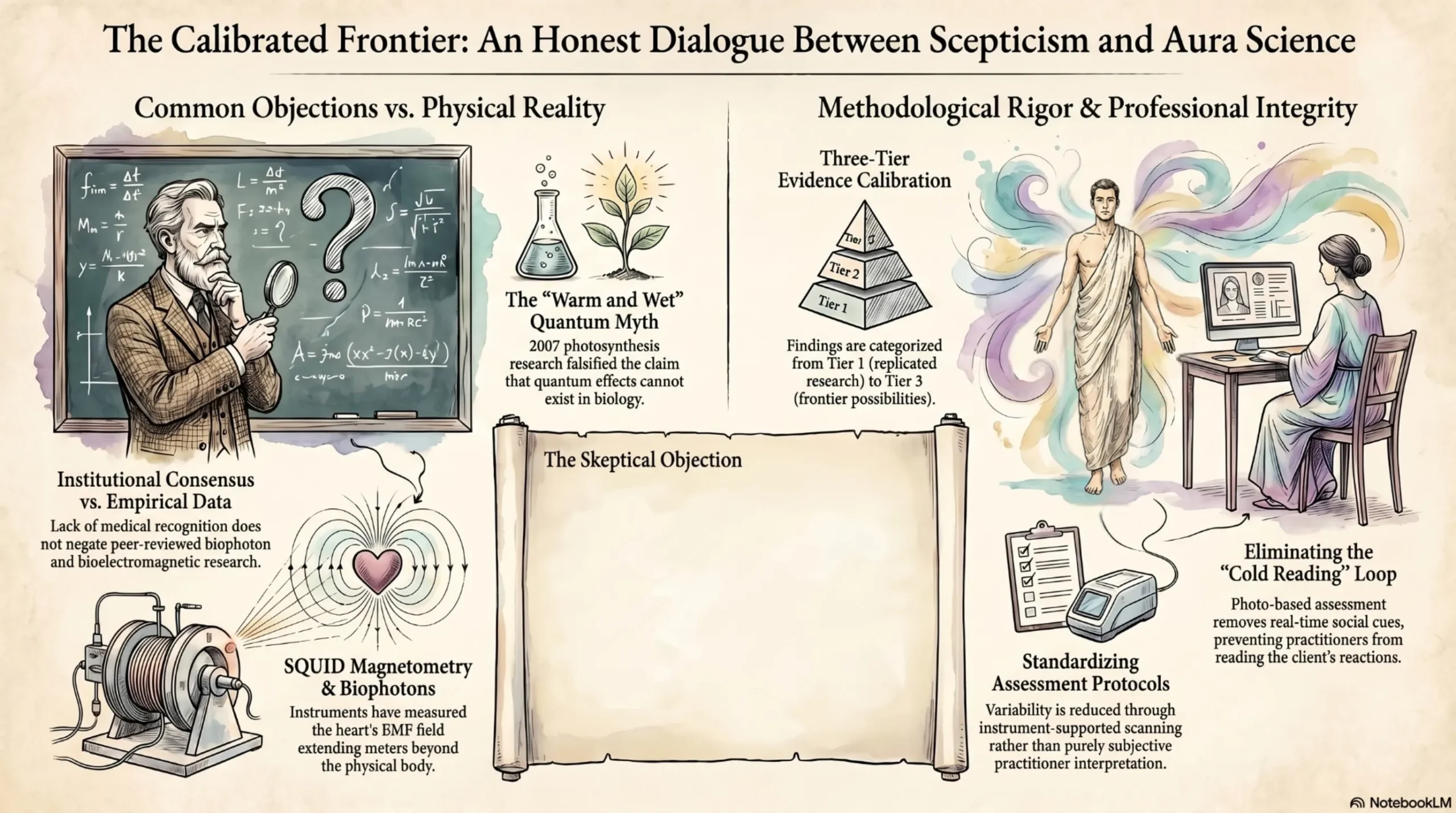
The Sceptical Objection | What Is Genuinely Valid in This Objection | Where This Objection Overclaims or Misstates | The Evidence-Based Response |
“There is no scientific evidence for the existence of the aura” | There is no mainstream scientific consensus on the aura as described in popular culture; major medical institutions do not recognise aura assessment as a diagnostic tool; the specific claims made by many aura practitioners have not been subjected to rigorous independent validation | The objection conflates the lack of mainstream institutional recognition with the absence of any scientific evidence; it ignores the substantial published literature in biophoton research (Popp), bioelectromagnetic field science (SQUID magnetometry), and quantum biology that describe physically real phenomena corresponding to what aura science calls the energy field; it treats institutional consensus as the criterion for evidence, which is itself a philosophically contested position in philosophy of science | Fritz-Albert Popp’s four decades of peer-reviewed biophoton research establish that all living cells emit coherent ultra-weak photons organised in patterns that carry biological state information; SQUID magnetometry has directly measured the body’s bioelectromagnetic field extending beyond the physical body; HeartMath Institute’s published research has established the heart’s EMF field’s measurable influence on physiological states at a distance; quantum biology has confirmed quantum coherence in living systems at physiological temperatures; the evidence that a physically real biofield exists is substantial and peer-reviewed, even where specific practitioner interpretations of that field are not independently validated |
“Aura readings are not replicable — different practitioners give different readings of the same person” | Inter-rater variability in in-person aura reading is real and documented; without standardised assessment frameworks and training validation protocols, two practitioners will produce readings of the same person that differ significantly; this is a genuine limitation of the field’s current professional infrastructure | The objection treats variability in practitioner interpretation as evidence that there is nothing to interpret, rather than as evidence that the field lacks standardised training and assessment protocols; inter-rater variability exists in many legitimate clinical fields (radiology, pathology, psychiatric diagnosis) without those fields being dismissed as unscientific; the objection does not distinguish between the field’s genuine phenomena and the practitioner’s interpretation of them | The objection correctly identifies a genuine professional infrastructure deficit rather than an evidential deficit about the field’s subject matter; the response is the development of standardised training frameworks, calibrated assessment protocols, and instrument-supported reading methodologies that reduce practitioner variability — as the patented photo-scanning technology at Aura Photo Science is designed to do; the comparison to radiology is instructive: early radiology had substantial inter-rater variability that was progressively reduced by standardised training and interpretation protocols, not by abandoning the field |
“The aura cannot be photographed or measured by any instrument” | The claim that photographs of the aura capture a directly visible coloured light field around the body is not supported by the physics of standard photography; standard visible-light cameras do not capture the aura as described in popular culture; the biofeedback-based aura photography available at wellness fairs does not directly measure the multi-layer biofield | The objection treats the specific popular-culture claim (visible coloured light around the body, directly photographable by standard cameras) as equivalent to all aura measurement claims; it ignores the instrumentation that does measure biofield-related phenomena: SQUID magnetometers measuring the body’s biomagnetic field; biophoton detectors measuring coherent ultra-weak photon emission; Kirlian photography capturing corona discharge patterns; GDV (Gas Discharge Visualisation) measuring electrophotonic emissions; and the patented photo-scanning technology that reads the biofield information encoded in the photograph | Multiple instruments measure biofield-related phenomena: SQUID magnetometers have produced the most precise measurements of the body’s biomagnetic field, confirming the cardiac field’s extension two to three metres from the body and the brain’s detectable field at a distance; biophoton detectors have documented coherent ultra-weak photon emission that differentiates healthy from pathological tissue; the specific limitation is the popular-culture colour-aura visible photography claim, not the measurability of the underlying biofield phenomena |
“Aura readings are cold reading — the practitioner uses social cues, Barnum statements, and confirmation bias” | Cold reading — the use of general statements that seem specific but apply to most people, combined with reading the client’s social and verbal cues — is a well-documented and genuinely widespread phenomenon in all forms of psychic and intuitive reading; confirmation bias in both practitioner and client can make genuinely vague readings seem accurate; the in-person reading context provides rich opportunities for cold reading that the practitioner may deploy without awareness | The objection does not distinguish between readings that operate through cold reading and readings that operate through standardised instrument-supported assessment; it assumes that all aura reading is cold reading without investigating the mechanism of specific methodologies; it does not account for readings conducted without any client interaction before delivery, which eliminates the primary mechanism of cold reading | The most direct response to the cold reading objection is methodological: the photo-based assessment methodology eliminates the primary cold reading mechanism by conducting the analysis from a photograph without prior client interaction; the reading is delivered in writing without the real-time social cue feedback loop that cold reading requires; the instrument-supported assessment component adds an objective measurement layer that is not susceptible to cold reading dynamics; the client’s verification of specific findings against their own experience — findings whose specificity goes beyond what Barnum statements could account for — is the most direct available evidence of assessment accuracy beyond cold reading |
“The placebo effect explains all reported benefits of aura readings” | The placebo effect is real, powerful, and likely accounts for some proportion of the subjective benefits reported by aura reading clients; expectation, ritual context, practitioner warmth, and the client’s investment in the reading experience all produce genuine psychological and physiological effects independent of the reading’s specific content accuracy | The placebo objection, taken to its logical conclusion, would dismiss every consultation-based intervention whose benefits include subjective experience dimensions — which includes most of medicine, psychology, and coaching; the objection does not account for aura-based practice prescriptions (pranayama, environmental changes, specific consciousness practices) whose benefits have been confirmed in controlled trials independently of the aura reading context; the objection does not explain findings that were accurate without the client’s prior knowledge and that the client subsequently verified | The evidence-based practices prescribed by the aura reading — meditation, pranayama, HRV coherence practices, yoga nidra, environmental optimisation — have documented benefits in randomised controlled trials independent of any placebo mechanism; if the placebo effect were the sole operative mechanism, the specific practice prescriptions calibrated to the individual field pattern would produce no better outcomes than generic wellness advice — a claim that is testable and for which the practitioner’s longitudinal client outcomes provide preliminary evidence; the placebo hypothesis does not predict the specificity of accurate readings |
“Quantum mechanics is misused in aura science — quantum effects do not operate at the biological scale” | Popular-culture ‘quantum’ vocabulary is frequently deployed in aura science without precision, creating a genuine scientific credibility problem; the direct application of quantum mechanics to macroscopic phenomena requires careful qualification that is often absent; some practitioners do use quantum vocabulary loosely to create credibility without mechanism specificity | The objection conflates the legitimate critique of loose quantum vocabulary with the dismissal of all quantum biology; it ignores the confirmed quantum effects in living biological systems — photosynthesis (Engel et al., Nature 2007), avian magnetic navigation (Ritz, Schulten), enzyme catalysis (Scrutton, Klinman), and olfaction (Turin) — that establish quantum effects at physiological temperatures in biological systems; the ‘too warm and wet’ objection has been experimentally falsified by the quantum biology literature | The response to this objection is the distinction between loose quantum vocabulary (which deserves criticism) and precise quantum biology (which the experimental literature confirms); the specific quantum principles applied to aura phenomena in this article series — coherence, decoherence, non-locality, entanglement, tunnelling, superposition — are each applied with mechanism specificity and evidence calibration that the sceptic’s objection to loose quantum claims does not address; the 2007 photosynthesis coherence finding is the most important single result because it falsifies the blanket ‘too warm and wet’ objection at the experimental level |
“Aura practitioners exploit grieving and vulnerable people” | This objection describes a genuine and widespread harm documented in the previous article in this series: practitioners who use fear-based manipulation, dependency creation, and false promises to exploit clients at their most vulnerable do exist and cause measurable harm; the field’s absence of professional accountability structures creates ideal conditions for this exploitation | The objection conflates all aura practice with its most exploitative examples; it does not distinguish between practitioners operating with explicit ethical frameworks (including the ten principles described in the previous article) and practitioners operating without any ethical framework; the existence of unethical practitioners in a field is not evidence that the field’s genuine subject matter is invalid, any more than unethical psychologists invalidate psychology | The response is the explicit, public ethical framework described in the previous article and the structural safeguards built into the practice: no fear-based marketing; no false urgency; money-back guarantee; scope-of-practice clarity; explicit professional referral for dimensions beyond the reading’s competence; no dependency creation; explicit prohibition of non-consensual readings; mandatory health disclaimer; the ethical framework’s public accountability is itself the most direct response to the exploitation objection |
“Aura science is culturally relative — it only ‘works’ within traditions that believe in it” | Cultural context does influence the framework within which aura experiences are interpreted; the meaning-making overlay that different cultures apply to biofield phenomena does vary; the Vedic tradition’s vocabulary for the aura is culturally specific even where the underlying phenomena it describes are not | The objection conflates the cultural specificity of the interpretive vocabulary with the cultural specificity of the underlying phenomena; biophoton emission, bioelectromagnetic field, and the body’s coherence properties are physically real and measurable regardless of the cultural context of the observer; the Vedic tradition’s vocabulary for describing these phenomena is culturally specific, but the phenomena themselves are not; the same quantum coherence in photosynthesis occurs regardless of whether the plant has a cultural relationship with quantum mechanics | The biofield’s physically real phenomena — biophoton emission, cardiac EMF, bioelectric field patterns — are culturally independent: they are measurable by instruments that operate without reference to cultural belief systems; the Vedic tradition’s descriptions of these phenomena are culturally specific interpretive frameworks for phenomena that Western biophysics is now describing in different vocabulary; the convergence of two culturally independent investigative traditions on the same descriptions — which this series has documented across multiple specific principle correspondences — is stronger evidence for the underlying phenomena’s reality than either tradition’s account alone would provide |
“Aura science has not produced a single confirmed predictive test” | The absence of a confirmed predictive test that meets standard scientific criteria — pre-registration, independent replication, controlled conditions — is a genuine limitation of the current state of aura research; the evidence base for specific aura reading claims is primarily practitioner observation and client report rather than controlled experimental evidence | The objection applies a standard that many established medical practices do not themselves meet; the standard of confirmed predictive testing has not been applied to large portions of clinical medicine, psychiatric diagnosis, and psychological assessment that are not dismissed as unscientific; the absence of controlled trials is partly a function of research funding priorities rather than inherent untestability; the biophoton coherence research does produce pre-symptomatic differentiation of healthy from pathological tissue that constitutes a form of predictive assessment | Popp’s biophoton coherence research has produced consistent differentiation of healthy from cancerous tissue that constitutes a form of confirmed predictive assessment — not yet in the clinical trial format that mainstream medicine would require for adoption, but in peer-reviewed published research that meets standard scientific criteria; the call for independent controlled trials of specific aura reading claims is legitimate and is the direction in which the field should move; honest acknowledgement of this gap is more credible than defensive dismissal of the standard |
“Aura readers make unfalsifiable claims — if the reading is wrong, they say the client’s energy has shifted” | The unfalsifiability objection identifies a genuine and widespread practice of post-hoc rationalisation in some aura reading contexts: the practitioner who explains every disconfirmation as a field shift rather than an assessment error is practising unfalsifiable reasoning that provides no genuine information | The objection, applied to all aura reading, assumes that all aura claims are structured to be unfalsifiable; it does not account for claims that are directly verifiable against the client’s experience (a depleted organ zone that corresponds to the client’s known health challenge is verifiable in the moment of reading); it does not account for the evidence-honest framework that explicitly acknowledges when findings are at the frontier and when they are established | The response is the distinction between unfalsifiable post-hoc rationalisation (a genuine problem) and calibrated probability assessment with acknowledged uncertainty (a legitimate framework for frontier science); the reading’s Tier 1 findings — meditation’s health benefits, pranayama’s physiological effects, HRV coherence’s immune benefits — are falsifiable and have been confirmed; the reading’s Tier 3 findings are explicitly presented as frontier with acknowledged uncertainty; the practice of honest uncertainty acknowledgement is itself the most direct response to the unfalsifiability objection |
“The Vedic tradition’s aura concepts are pre-scientific mythology” | The Vedic tradition’s cosmological and metaphysical framework is not identical to modern empirical science and should not be presented as such; specific cosmological claims in the tradition have not been subjected to and in some cases would not survive standard empirical testing | The objection conflates the tradition’s cosmological framework with its empirical clinical observation record; five thousand years of systematic observation of the relationship between field states and health, life, and consciousness outcomes constitutes a genuine empirical dataset even where the theoretical framework is not identical to modern science; the quantum biology literature’s convergence with specific Vedic descriptions — quantum coherence and Sattva, quantum entanglement and karma, non-locality and Vyapti — is not coincidental pattern-matching; it is two independent empirical traditions converging on the same phenomena | The Vedic tradition’s clinical prescriptions for specific field conditions — the pranayama sequences, the mantra practices, the consciousness interventions — are among the most extensively tested health interventions in human history; modern research has confirmed the mechanisms of many of these prescriptions (Kabat-Zinn’s MBSR, Blackburn’s telomerase research, Ornish’s gene expression research, the Kox et al. pranayama immune suppression study); dismissing this empirical record as mythology requires dismissing the research that confirms it, which is a stronger sceptical commitment than the evidence warrants |
“People who believe in auras are simply credulous or scientifically illiterate” | Credulous acceptance of aura claims without critical evaluation is real and common; the aura field does attract some clients who accept practitioner claims without the critical scrutiny they would apply to other domains; scientific literacy is unevenly distributed and does influence the evaluation of unusual claims | The objection is an ad hominem that describes the weakest version of the aura science believer rather than the strongest; it ignores the substantial population of educated, analytically sophisticated, scientifically literate professionals who engage with aura science after critical evaluation; it assumes that scientific literacy leads uniformly to scepticism about the aura, which is not true of scientists working in quantum biology, biophoton research, and bioelectromagnetics, several of whom are among the aura field’s most technically sophisticated proponents | The most direct response is the community of scientifically literate aura science researchers and practitioners: Fritz-Albert Popp (PhD, biophysics); Bruce Lipton (PhD, developmental biology); Candace Pert (PhD, pharmacology); Rollin McCraty (HeartMath Institute); Rupert Sheldrake (PhD, biology, Cambridge); the quantum biology researchers at UC Berkeley and the University of Surrey whose work confirms quantum effects in living systems; the ad hominem does not engage with the evidence these researchers have produced; engaging with the evidence requires engaging with the actual claims and the actual research, not with the weakest version of the belief |
The cold reading row is the objection I consider most practically consequential for the photo-based aura scanning methodology, because it describes the most direct mechanism by which in-person aura readings can produce apparent accuracy through social dynamics rather than genuine field assessment. Cold reading — the use of general statements that seem specific, combined with real-time feedback from the client’s verbal and non-verbal responses — is a well-documented psychological phenomenon that operates entirely outside conscious practitioner awareness in many cases. The practitioner who believes sincerely that they are reading the field may be partly reading the client’s social cues without knowing it.
The photo-based methodology’s most important methodological advantage over in-person reading is its structural elimination of the primary cold reading mechanism. The reading is conducted from a photograph without prior client interaction. There is no real-time social cue feedback loop. There is no verbal response to fine-tune the reading toward what the client visibly responds to. The reading is delivered in writing as a complete document before the client’s response is known. This is not merely a convenience feature. It is the most direct available methodological response to the cold reading objection — and it is why the photo-based reading is, in this specific respect, more methodologically rigorous than most in-person aura reading.
The unfalsifiability row is the one where I want to be most direct about a practice that I consider a genuine problem in my own field: the post-hoc rationalisation of disconfirmed readings as evidence of field shift. If every reading that proves inaccurate is explained by a subsequent change in the client’s field rather than an assessment error, the claim has been made unfalsifiable. And an unfalsifiable claim provides no genuine information. The honest response to a reading finding that does not correspond to the client’s experience is not ‘your field must have shifted.’ It is ‘this specific finding is not verified by your experience, which tells us something about the limits of this particular assessment.’ Calibrated honesty about assessment accuracy is what distinguishes genuine field science from unfalsifiable belief maintenance.
What Do Sceptics Get Genuinely Right That the Aura Field Must Honestly Acknowledge?
The defensive aura practitioner treats sceptical objections as attacks to be neutralised. The honest aura practitioner treats them as quality-improvement inputs. If the sceptic’s most valid objections were acted upon by the field — if overclaiming were replaced by calibrated evidence-tier communication; if self-referential knowledge loops were replaced by genuine engagement with independent scientific scrutiny; if exploitation were replaced by the professional accountability structures it requires; if placebo-level benefit were distinguished from reading-specific benefit through appropriate research design — the field that emerged from that process would be both more credible and more genuinely useful. The sceptic’s valid objections are the field’s most precise development roadmap.
What Sceptics Get Genuinely Right – And What Honest Aura Practice Must Commit To:
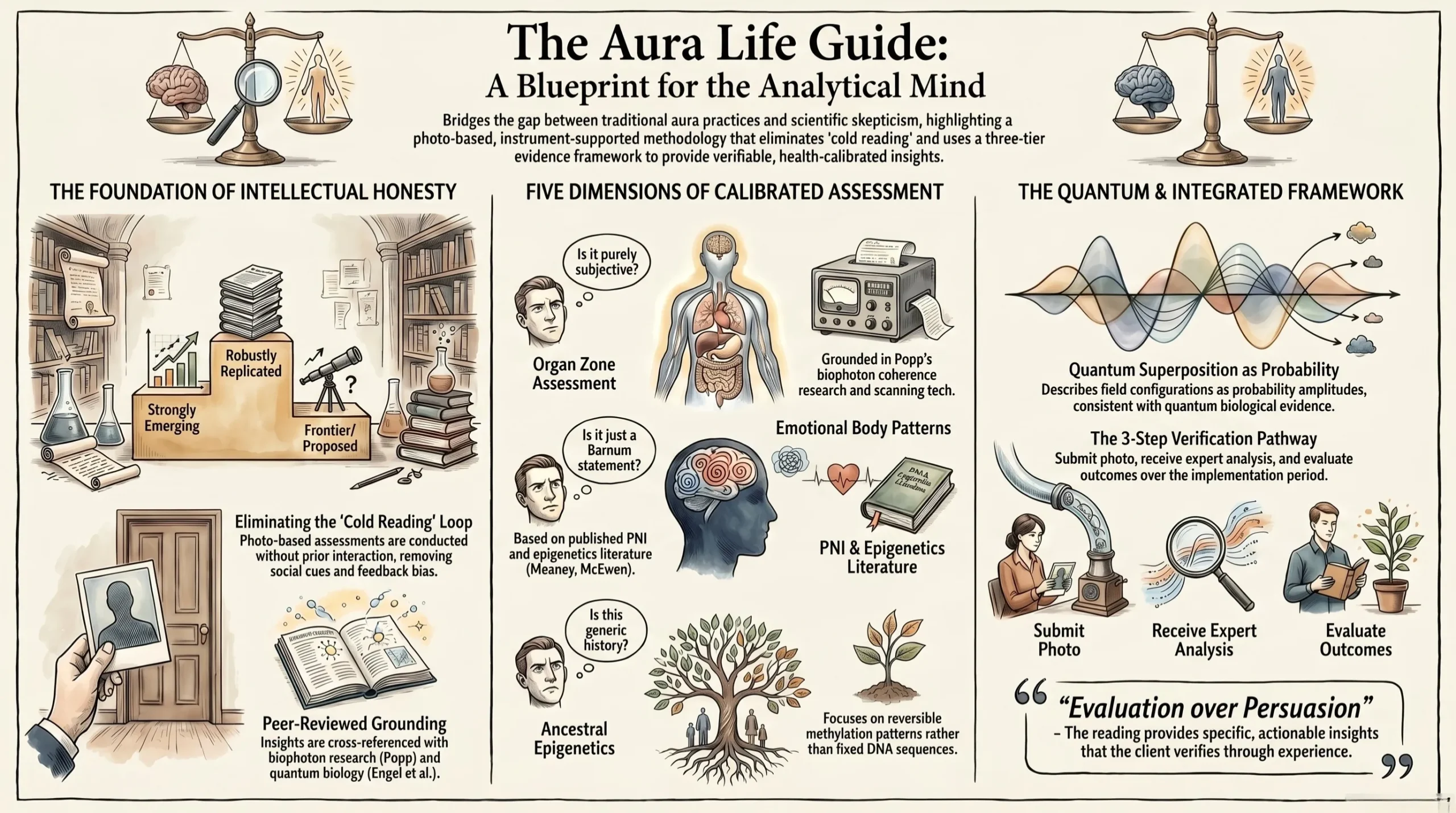
What Sceptics Get Genuinely Right | Why This Is a Legitimate Scientific Concern | What the Aura Field Has Not Done Well Enough | What Honest Aura Practice Must Commit To |
Many aura claims are made at certainty levels that vastly exceed the evidence supporting them | Overclaiming is the most damaging epistemic practice in any field that seeks scientific credibility; when specific claims are presented as established that are genuinely at the frontier, the entire field’s credibility is undermined when those claims are challenged; the sceptic’s demand for calibrated certainty is the correct demand | The field has not developed and enforced standardised evidence-tier communication norms; individual practitioners routinely present frontier claims as established science and personal beliefs as universal field knowledge; there is no professional infrastructure to identify and correct overclaiming | Every claim about aura phenomena must be presented at its actual evidence tier, explicitly and publicly; the three-tier framework (Tier 1 robust replicated research, Tier 2 strongly emerging, Tier 3 frontier and proposed) must become standard communication practice; practitioners must be willing to say ‘this specific claim is at the frontier of evidence’ as readily as they say ‘this specific finding is well-established’ |
The field is almost entirely self-referential — aura practitioners cite each other and the tradition rather than engaging with independent scientific validation | Self-referential knowledge systems are epistemically weak regardless of their internal coherence; genuine scientific credibility requires engagement with independent verification by parties with no prior commitment to the field’s conclusions; the sceptic’s demand for independent validation is correct | The field has not invested adequately in independent research partnerships with mainstream scientific institutions; it has not invited or facilitated the independent controlled trials that would provide the highest-quality evidence for its most specific claims; it has often responded to sceptical challenge with tradition-citing rather than evidence engagement | Honest aura practice must actively welcome independent scientific scrutiny rather than treating it as a threat; the most credible response to the self-referential knowledge objection is the invitation of independent researchers to conduct the controlled trials that would test the most specific practitioner claims; the field’s reluctance to invite this scrutiny has been more damaging to its credibility than any specific sceptical argument |
The exploitation of vulnerable clients is real, widespread, and caused by the field’s absence of professional accountability structures | As documented in the previous article in this series, the three cases of real harm to real clients — savings lost, marriage ended, cancer diagnosis delayed — are predictable outcomes of a field without licensing, professional standards enforcement, or complaint mechanisms; the sceptic’s concern about exploitation is correct and urgent | The field has not developed the professional infrastructure needed to identify, report, or sanction exploitative practice; it has not created the accountability mechanisms that would allow harmed clients recourse; it has allowed the worst practitioners to operate under the same banner as the most ethical ones without distinction | The development of professional standards, voluntary certification frameworks, public ethical commitments, and accessible complaint mechanisms is not optional for a field that wants scientific and public credibility; honest aura practice must actively advocate for the professional infrastructure that would protect clients and distinguish ethical from exploitative practice |
The placebo and expectation effects are real and may account for a substantial proportion of self-reported aura reading benefits | The placebo effect is among the most robust findings in all of medicine; expectation, ritual, practitioner warmth, and the client’s investment in the experience produce genuine physiological effects; the sceptic’s insistence that aura practice demonstrate benefits beyond placebo level is the correct scientific standard | The field has not invested in the controlled study designs that would allow placebo-adjusted benefit measurement; it has not pre-registered specific outcome predictions that would allow falsification; it has not distinguished systematically between the benefits of the placebo effect (which are genuine and valuable) and the benefits of specific reading content accuracy | Honest aura practice must welcome placebo-controlled research designs rather than treating them as hostile; the most direct response to the placebo objection is the pre-registration of specific outcome predictions followed by independent verification — which the field has the evidence base to initiate given the strong published research on its core practices; distinguishing practice benefits from specific reading accuracy benefits requires the research infrastructure the field has not yet built |
The self-referential knowledge row is the one where I am most personally challenged, because it describes a failure that I contribute to every time I cite another aura practitioner as evidence for an aura claim rather than citing an independently produced research result. The sceptic who asks ‘who produced this evidence and what was their prior commitment to the field’s conclusions?’ is asking the right question. Evidence produced by researchers with no prior commitment to the field’s conclusions is more credible than evidence produced by practitioners who already believe the conclusions. This is not a critique of practitioners’ integrity. It is basic scientific epistemology.
The most direct response to the self-referential knowledge objection is not more practitioner-evidence but genuine engagement with the independent research that confirms the practices. The Kox et al. PNAS study was conducted by immunologists with no prior commitment to pranayama; they were studying the Wim Hof Method, not validating an aura claim. The Ornish PNAS study was conducted by a conventional medical research team investigating lifestyle interventions, not aura science. The Engel et al. Nature study on quantum coherence in photosynthesis was conducted by physical chemists investigating energy transfer, not aura practitioners. These independent researchers, with no prior commitment to aura science’s conclusions, have produced the evidence that is most relevant to the field’s credibility claims. Citing them is not cherry-picking supportive research. It is engaging with the most relevant available evidence on each specific mechanism.
Where Does Scepticism About Aura Science Itself Become Unwarranted and What Evidence Does It Overlook?
The sceptic who applies their critical intelligence selectively — demanding rigorous controlled trials for aura science claims while accepting clinical psychiatry’s diagnostic categories, which rest on no more rigorous evidential foundation in many cases — is not practising calibrated scepticism. They are practising motivated scepticism: applying a high evidential standard to the claims they are predisposed to disbelieve and a lower one to the claims they are predisposed to accept. This is as epistemically problematic as the true believer’s selective citation of supportive evidence.
Four Specific Ways That Scepticism About Aura Science Overclaims:
- Treating institutional non-recognition as evidential absence: The history of medicine is replete with genuine phenomena that preceded mainstream institutional recognition by decades: the germ theory of disease was dismissed by mainstream medicine for thirty years; the existence of helicobacter pylori as a cause of stomach ulcers was rejected by mainstream gastroenterology for a decade after Marshall’s self-experiment; continental drift was dismissed by mainstream geology for fifty years after Wegener’s proposal. Institutional consensus is a lagging indicator, not a leading one. The biophoton emission literature, the bioelectromagnetic field research, and the quantum biology confirmations exist independently of whether mainstream medicine has incorporated them. Their evidential quality is not determined by the speed of mainstream adoption.
- Applying the ‘too warm and wet’ quantum objection after its experimental falsification: The objection that quantum effects cannot operate in warm, wet, noisy biological environments was the central sceptical argument against quantum biology until the 2007 Engel et al. Nature publication. That publication — replicated across multiple research groups in multiple photosynthetic organisms — demonstrated quantum coherence at physiological temperatures in a complex biological environment. The experimental falsification of the central sceptical argument is not a minor development. It is a paradigm shift in the relationship between quantum mechanics and biology. Continuing to deploy the ‘too warm and wet’ objection after its experimental falsification is not rigorous scepticism. It is the refusal to update a prior in the face of evidence.
- Dismissing the Vedic tradition’s empirical record as mythology: The Vedic tradition’s clinical prescriptions for specific field conditions have been independently confirmed to produce the health effects the tradition attributes to them, through the most rigorous research methods available: the MBSR meditation programme, the pranayama immune suppression finding, the telomerase activation research, the gene expression changes from comprehensive lifestyle programmes. The tradition predicted these effects through five thousand years of systematic observation before modern science produced the mechanism vocabulary to explain them. Dismissing this empirical record as mythology on the grounds that the tradition’s cosmological vocabulary is not identical to modern science’s vocabulary is to dismiss the clinical evidence because of the theoretical framework, rather than evaluating the evidence on its own terms.
- Applying inconsistent evidential standards across clinical fields: The sceptic who demands randomised controlled trials for aura reading claims while accepting DSM psychiatric diagnoses (which rest primarily on clinical consensus rather than biological mechanism confirmation), homeopathic-equivalent conventional medical practices (prescribed without robust evidence of mechanism), or coaching and counselling interventions (whose specific components are rarely tested against controlled comparison conditions) is applying an inconsistent evidential standard. Calibrated scepticism applies the same standard across all claims in the same clinical space. The question is not whether aura science meets a higher standard than comparable fields. It is whether it meets the same standard applied consistently.
How Does the Scientifically Minded Sceptic Evaluate an Aura Reading’s Genuine Value?
The scientifically minded sceptic is not the aura reading’s enemy. They are its most demanding and most valuable quality assurance mechanism. The reading that can satisfy a genuinely sceptical, analytically trained client — not by persuading them to believe in an unverifiable system, but by providing specific, accurate, actionable insights that they can verify against their own experience and that produce measurable improvement in their chosen life areas — has demonstrated something more valuable than any argument for the field’s credibility. It has demonstrated the field’s actual value to the kind of client who is most capable of evaluating it accurately.
I want to describe the evaluation pathway that I believe the honest sceptical client should follow, because it is the same pathway I would follow if I were encountering this practice for the first time without the evidence base I have built over eight years.
The Honest Sceptic’s Evaluation Framework for an Aura Reading:
- Assess the evidence-tier honesty: Does the practitioner present claims at their actual evidence tier, explicitly distinguishing established findings from frontier ones? A practitioner who presents all claims with equal certainty is not being intellectually honest. A practitioner who explicitly names which specific claims are Tier 1, which are Tier 2, and which are Tier 3 frontier is demonstrating the intellectual honesty that is a prerequisite for all other evaluation.
- Evaluate the cold reading potential: Is the reading conducted without prior client information and delivered without real-time social cue feedback? The photo-based methodology’s structural elimination of the cold reading mechanism is the most direct methodological response to this criterion. A reading delivered in writing from a photograph before client interaction removes the primary cold reading mechanism.
- Test the specificity of the findings: Do the reading’s specific findings — the organ zone pattern, the emotional body content, the ancestral inheritance identification — describe something specific enough that the client can verify or disconfirm against their own experience? A reading whose findings are so general that they could apply to anyone is not demonstrating assessment accuracy. A reading whose findings describe something specific that the client recognises as accurate and distinctive is providing preliminary evidence of genuine assessment.
- Evaluate the practice prescription’s mechanism: Are the prescribed practices grounded in published research with specific, nameable mechanisms? A prescription of ‘meditate and be positive’ has no individually calibrated mechanism. A prescription of ‘this specific pranayama sequence targets the specific biophoton coherence depletion identified in this specific zone through the documented autonomic-epigenetic mechanism’ is individually calibrated and mechanism-specific. The difference is evaluable.
- Assess the outcomes over the implementation period: Do the prescribed practices, applied as directed over the implementation period, produce better outcomes in the specific life areas addressed than the generic wellness practices the client has previously applied? This is the most direct available evidence of the reading’s specific value beyond placebo. It requires genuine implementation rather than theoretical evaluation, but it is the evaluation that is ultimately most informative.
How Is the Aura Life Guide Master Package Specifically Designed for the Sceptical, Analytically Minded Client?
Every design feature of the Aura Life Guide Master Package reflects a response to a legitimate sceptical concern. The photo-based methodology responds to the cold reading objection. The instrument support responds to the measurability objection. The evidence-tier framework responds to the overclaiming objection. The written delivery responds to the social influence objection. The money-back guarantee responds to the financial exploitation concern. The mandatory health disclaimer and professional referral guidance respond to the scope-of-practice objection. The scope limitation to the client’s own field responds to the non-consensual reading concern. The reading is designed, from the ground up, to be the version of aura practice that the honest sceptic’s objections would produce if those objections were treated as a design brief.
The Aura Life Guide Master Package for the Sceptical Client – Five Reading Dimensions, the Sceptic’s Concern, What the Evidence-Calibrated Reading Provides, and How the Analytically Trained Client Evaluates Its Value:
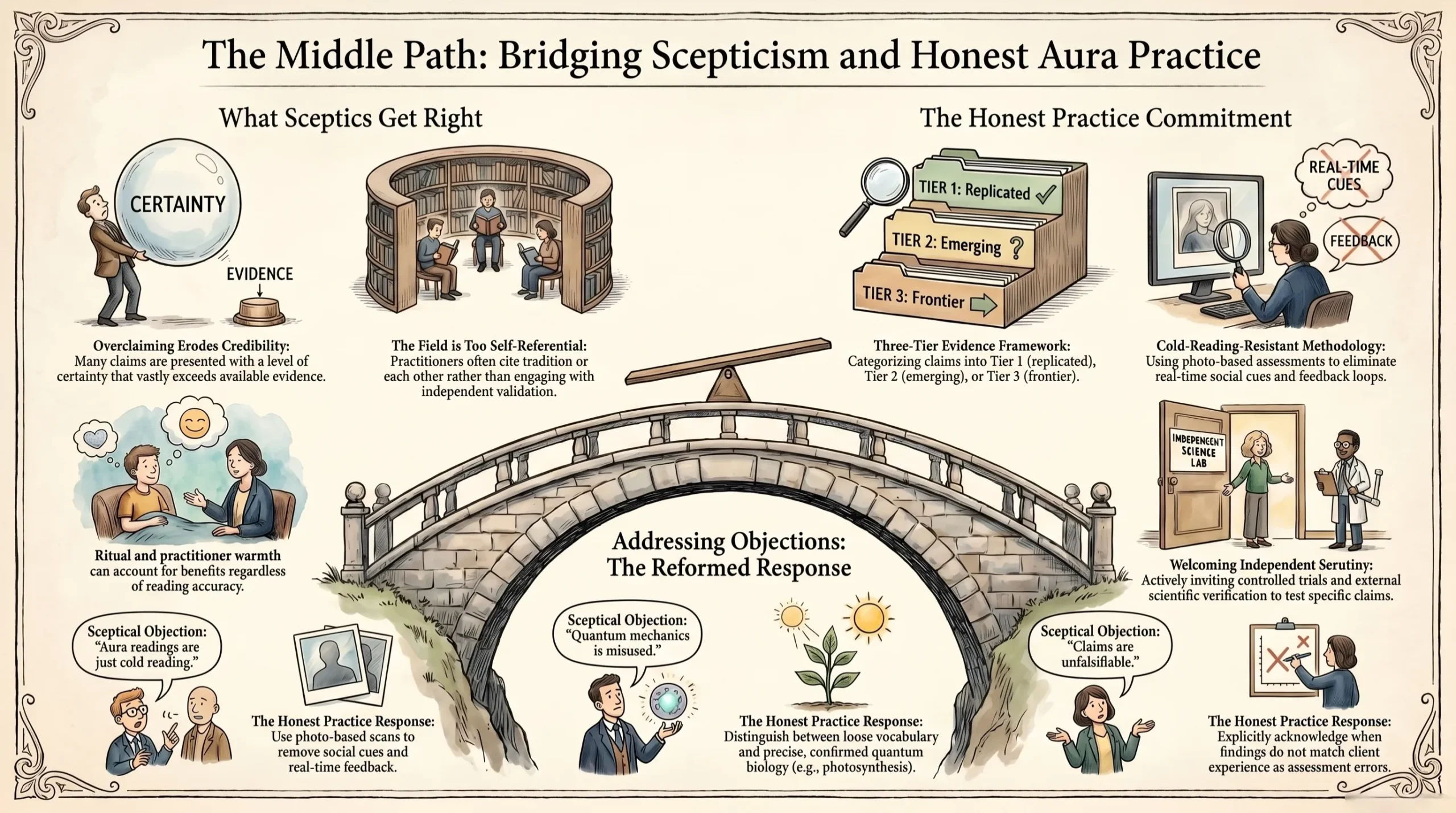
Reading Dimension | The Sceptic’s Reasonable Concern | What the Evidence-Calibrated Reading Provides | How the Analytically Trained Client Evaluates the Reading’s Value |
Pre-symptomatic organ zone biophoton coherence assessment | The sceptic reasonably asks: what is the physical basis for this assessment, is it instrument-supported or purely subjective, and how do I verify the finding independently? | The assessment is grounded in Popp’s peer-reviewed biophoton coherence research; the patented scanning technology provides instrument-supported assessment applied to the photograph’s light-field information; the specific organ zone finding can be cross-referenced against any conventional health assessment the client subsequently pursues; the finding is framed as a field-level pattern warranting investigation, not a diagnosis | The analytically trained client evaluates the pre-symptomatic finding by pursuing the conventional health investigation it recommends; if the zone depletion finding corresponds to findings in conventional investigation (elevated markers, functional test results), the reading’s accuracy has been independently verified; if no correspondence is found, the finding remains at the Tier 2-3 frontier level where it belongs; the client’s own subsequent experience is the primary verification pathway |
Emotional body pattern identification and its health implications | The sceptic asks: how is the emotional body pattern distinguished from the practitioner’s inference from client-provided information, and are the health implications genuinely specific rather than Barnum-statement level? | The photo-based methodology eliminates the primary cold reading mechanism — prior client information — by conducting the assessment before any client interaction; the health implications are grounded in the published PNI and epigenetics literature (Meaney, McEwen, Ader and Cohen) that establishes the specific emotional pattern’s specific health consequence; the finding is specific enough to be verifiable against the client’s own experience | The analytically trained client verifies the emotional body pattern finding against their own experience of the pattern’s health consequences over time; the specificity of the finding — whether it describes something the client recognises as genuinely accurate and distinctive rather than generically applicable — is the primary verification criterion; the reading’s explicit acknowledgement of the PNI evidence base allows the client to evaluate the claim’s scientific grounding independently |
Ancestral epigenetic inheritance pattern identification | The sceptic asks: how is the ancestral pattern distinguished from a generic family health history assessment, and what does the Vedic tradition’s ancestral clearing framework offer beyond what conventional genetic counselling provides? | The ancestral pattern identification is grounded in the transgenerational epigenetics literature (Yehuda, Dias and Bhattacharya, Skinner group) that has established the specific genes (FKBP5, NR3C1, SLC6A4) and mechanisms through which ancestral stress experiences are transmitted; the Vedic ancestral clearing practices target the epigenetic mark at a level that conventional genetic counselling does not — the reversible methylation pattern rather than the fixed DNA sequence | The analytically trained client evaluates the ancestral pattern finding by examining whether the identified pattern corresponds to a documented multi-generational health or life pattern in the family that the conventional genetic framework does not fully explain; the epigenetic reversibility claim is evaluable against the Ornish, Blackburn, and ancestral epigenetic research literature; the prescribed ancestral clearing practices are evaluable against their own documented health outcomes |
Quantum superposition and highest available configuration identification | The sceptic reasonably objects that quantum superposition applies at the subatomic scale and that its application to life-area configurations is metaphorical rather than mechanistic; what is the specific physical mechanism claimed? | The quantum biology literature (Engel photosynthesis, Ritz avian navigation, Scrutton enzyme catalysis) establishes that quantum effects operate in living biological systems at physiological temperatures; the superposition framework applied to the aura reading describes the probability amplitude of different field configurations, which is mechanistically consistent with the quantum biology evidence without requiring precise mechanism specification at every scale; the framework is presented as the most precise available description, not as a fully settled mechanism | The analytically trained client evaluates the superposition framework against the quantum biology literature independently; the framework’s predictive value — whether treating life-area patterns as probability amplitude distributions rather than fixed states produces more accurate and more transformative guidance than classical ‘work harder toward the goal’ framing — is evaluable in their own experience of implementing the prescribed practices; the framework’s usefulness as a conceptual tool is distinguishable from its completeness as a mechanism |
Five-life-area integrated assessment and practice prescription | The sceptic asks: how is the five-area integration distinguished from a skilled general interview, and how are the prescribed practices any different from the wellness advice any competent practitioner would give? | The five-area integration is distinguished from a skilled interview by the photo-based assessment’s access to unconscious content, pre-symptomatic patterns, and causal layer encodings that neither the client’s self-report nor the practitioner’s interview can reach; the prescribed practices are distinguished from generic wellness advice by their individual calibration to the specific zone pattern, their sequencing rationale (why this practice before that one), and their grounding in specific published mechanisms (Ornish gene expression, Blackburn telomerase, Kox et al. immune suppression, HeartMath HRV) | The analytically trained client evaluates the five-area integrated assessment against two criteria: first, whether the assessment produces specific findings about unconscious patterns, pre-symptomatic zone concerns, and ancestral inheritances that are accurate but that the client did not already know and could not have inferred from their own self-reflection; and second, whether the specifically sequenced, individually calibrated practice protocol produces better outcomes than the generic wellness practices the client has previously applied — a comparison that is evaluable over the implementation period |
The five-life-area integration row is where I want to speak most directly to the analytically sophisticated client who has done extensive self-reflection, good therapy, conventional health management, and financial planning — and who arrives at the reading with a genuine question rather than a desire for reassurance: what does this reading offer that my existing sophisticated self-knowledge does not? The honest answer is: access to the dimensions of the field that self-reflection structurally cannot reach. The unconscious emotional body content. The pre-symptomatic organ zone pattern. The ancestral epigenetic inheritance. The environmental decoherence source. These are not things the analytical mind can produce through more sophisticated self-analysis. They are properties of the field that the field-level assessment reaches and the self-reflective mind does not.
A client from Bangalore — a forty-year-old research scientist with a PhD in materials science and a methodological sophistication that she applied to the reading with characteristic precision — arrived with a structured evaluation framework of her own: she had identified five specific questions about her life situation that she believed should be addressable through the reading if the reading’s claims were accurate, and she had determined in advance what level of specificity in the responses would constitute evidence of genuine assessment versus cold reading. The Master Package reading addressed all five questions with the specificity she had required as her evidence threshold. She described her evaluation process in her feedback: ‘I came in to falsify the reading and found instead that I couldn’t. That is not the same as proving it. But it is more than I expected, and it’s enough for me to implement the prescriptions and evaluate the outcomes.’ That is the scientifically minded sceptic at their most honest. And it is exactly the kind of engagement the reading is designed to merit.
Are You Ready to Evaluate the Evidence-Calibrated Aura Reading for Yourself?
Namaste, my friend — whether you arrived at this article as a genuine sceptic seeking an honest engagement with the field’s evidence and objections, or as someone who has always wanted an aura reading but whose analytical intelligence required the intellectual honesty that most aura practice does not provide — I hope this article has shown you what evidence-calibrated, ethics-grounded, sceptic-designed aura practice looks like.
The Aura Life Guide Master Package does not ask you to suspend your critical intelligence. It asks you to apply it: to the evidence-tier framework, to the cold-reading-resistant methodology, to the mechanism-specific practice prescriptions, and to the outcomes you observe over the implementation period. Five life areas. All seven zones. Every claim at its honest evidence tier. Every prescription with its published mechanism. Every finding specific enough to verify against your own experience. Delivered in writing, from a photograph, before any interaction that could enable cold reading, within 24 to 48 hours.
Using our patented photo-scanning technology and Multiple Advanced Gadgets. Drawing on eight years of practice and 1,000+ readings. With our money-back guarantee — the structural expression of our confidence that the reading will demonstrate its genuine value to even the most critical evaluator.
Three Steps to Your Evidence-Calibrated Aura Life Guide:
- Submit Photo – Upload a recent, clear photograph of yourself. The complete field information of your aura is accessible through our patented photo-scanning technology and Multiple Advanced Gadgets — without prior client interaction, without social cue feedback, without the cold reading mechanism that the methodology is specifically designed to eliminate.
- Expert Analysis – I personally decode your complete aura across all five life areas, presenting every finding at its honest evidence tier, grounding every prescription in its published mechanism, and acknowledging explicitly what remains at the frontier. The reading is designed for your critical evaluation, not for your uncritical acceptance.
- Transform – Receive your personalised Aura Life Guide — complete five-area integrated analysis, evidence-tier-calibrated findings, mechanism-specific practice prescriptions, and the professional referral guidance appropriate to your specific situation — delivered within 24–48 hours with our money-back guarantee.
⚠️ Disclaimer: Aura analysis and energetic guidance are for personal growth and awareness only. They are not a substitute for professional medical, financial, legal, or psychological advice. Please consult qualified professionals for any health or financial concerns.
Q1: Is there any scientific evidence for the existence of the aura?
Yes — though the evidence is more nuanced than either full validation or complete absence. Fritz-Albert Popp’s four decades of peer-reviewed biophoton research establish that all living cells emit coherent ultra-weak photons in patterns carrying biological state information; SQUID magnetometry has directly measured the body’s bioelectromagnetic field extending beyond the physical body; HeartMath Institute’s published research has established the heart’s EMF field’s measurable influence on physiological states; quantum biology has confirmed quantum coherence, entanglement, and tunnelling in living systems. The evidence for a physically real biofield is substantial and peer-reviewed. What is not yet established is the independent validation of specific practitioner interpretations of that field.
Q2: Are aura readings just cold reading?
In-person aura readings are potentially susceptible to cold reading — the use of general statements combined with real-time social cue feedback — and this is a legitimate sceptical concern. The most direct methodological response is the photo-based assessment methodology used at Aura Photo Science: the reading is conducted from a photograph without prior client interaction and delivered in writing before any client response is known. This structural design eliminates the primary cold reading mechanism — the real-time social cue feedback loop. The reading’s specific findings, specific enough to be verifiable or disconfirmed against the client’s own experience, are the primary evidence that the assessment is providing genuine information beyond cold reading.
Q3: What do sceptics get genuinely right about aura science?
Sceptics get four things genuinely right about aura science: many claims are made at certainty levels vastly exceeding their evidence; the field is largely self-referential rather than independently validated; client exploitation by some practitioners is real, widespread, and enabled by the field’s absence of professional accountability structures; and the placebo and expectation effects are real and may account for a substantial proportion of reported benefits. These are legitimate scientific concerns that deserve substantive responses from the field, not defensive dismissal. Honest aura practice must commit to evidence-tier calibration, independent validation engagement, professional accountability development, and placebo-distinguishing research design.
Q4: Where does scepticism about aura science become unwarranted?
Scepticism about aura science becomes unwarranted in four specific ways: when it treats institutional non-recognition as equivalent to evidential absence (the biophoton and bioelectromagnetic literature exists independently of mainstream institutional adoption); when it continues to apply the ‘too warm and wet’ quantum objection after Engel et al.’s 2007 Nature publication experimentally falsified it; when it dismisses the Vedic tradition’s five-thousand-year empirical record of clinical prescriptions that modern research has confirmed produce genuine health effects; and when it applies a higher evidential standard to aura science than it applies to comparable clinical fields including psychiatric diagnosis and coaching interventions.
Q5: How should a sceptical client evaluate whether an aura reading has genuine value?
A sceptical client should evaluate an aura reading through five criteria: whether the practitioner presents claims at their honest evidence tier (distinguishing established from frontier); whether the methodology is designed to eliminate cold reading (as the photo-based approach is); whether the specific findings are accurate and specific enough to be verifiable against the client’s own experience; whether the prescribed practices are grounded in published mechanisms rather than generic wellness advice; and whether the practices produce better outcomes over the implementation period than generic wellness practices the client has previously applied. A reading that meets these criteria has demonstrated genuine value through critical evaluation rather than through persuasion or belief.