Why Study Aura for Self-Awareness? 10 Career Blind Spots Revealed | Aura Photo Science India
Namaste, I’m Mukesh Shah. There is a question I am asked at almost every reading — not as a theoretical question but as the quiet, urgent question underneath the stated career concern: ‘Why does this keep happening to me?’
The Bangalore software architect who has changed employers four times in eight years and encountered the same authority conflict in every new context. The Mumbai marketing director who is extraordinary at her work but has been passed over for promotion three times in a row in circumstances she cannot fully explain. The Delhi entrepreneur who has started three ventures with genuine promise and watched each one stall at exactly the same stage. The Pune physician who has spent twenty years serving patients with extraordinary competence and arrived at fifty with the specific, sourceless grief of a person who knows they have been excellent but suspects they have not been themselves.
These are not career problems. They are self-awareness problems. The pattern that keeps repeating is not in the circumstances. It is in the field. And the reason conventional self-knowledge tools — therapy, coaching, personality assessment, peer feedback — have not resolved it is that they address the pattern at the level of behaviour and biography rather than at the level of the field-encoding that is generating the behaviour and the biography.
In eight years of aura analysis and more than 1,000 Career & Purpose readings across Mumbai, Delhi, Bangalore, Pune, Ahmedabad, and Hyderabad, the single most consistent finding I encounter is this: the client already knows the answer to the question they have come to ask. Not consciously. Not articulably. But the field knows. The dharmic signature is present and clear and specific. The shadow gift is coherent and waiting. The samskara’s pattern is encoded at the field level and repeating with a precision that is almost mathematical. The aura reading’s contribution to self-awareness is not to tell the client something they could not have discovered from inside. It is to give the field’s knowing a specific, nameable, actionable form. To make the implicit explicit. To give the already-known a working language.
This article is about why aura study is the most specifically calibrated self-awareness tool available for the career and purpose questions that matter most — the ones that conventional self-knowledge tools circle but cannot quite reach.
What Is the Difference Between Behavioural Self-Awareness and Field-Level Self-Awareness?
Most self-aware professionals I meet in my practice have done substantial work on their behavioural self-awareness. They can describe their patterns accurately, map their triggers reliably, and name their relational dynamics with impressive precision. The work they have done is real and valuable. And they have arrived at the aura reading because the behavioural pattern knowledge, however precise, has not resolved the pattern’s repetition. The pattern is still repeating. The question is still ‘why does this keep happening?’ The behavioural description of the pattern is thorough. The causal field encoding that is generating the pattern is still invisible.
This is the specific gap that field-level self-awareness fills: the causal layer’s encoding, which operates beneath the biographical memory that therapy accesses, beneath the behavioural pattern that coaching addresses, and beneath the self-reported preference that personality tools map. The samskara is not a memory. It is a field-level probability distribution that biases every subsequent quantum event in the field’s network toward the pattern it encodes. The ancestral script is not a belief. It is an epigenetically transmitted field orientation that the individual experiences as their own considered perspective on what is possible and appropriate. These are not accessible through introspection alone, however sophisticated. They are readable in the field — and the aura reading’s most fundamental self-awareness contribution is making them visible with enough specificity to be addressed.
Key Quantum Principles Behind the Human Aura:
- Wave-particle duality – You exist as both physical matter and vibrating energy simultaneously
- Quantum coherence – Your cells communicate through organised, light-based energy fields
- Bioelectromagnetism – Your heart and brain emit electromagnetic fields that extend several feet beyond your body
- Biophoton emission – Every cell radiates light at specific, measurable frequencies
In my analysis of over 1,000 auras, I have seen these principles play out in very real, human lives — where energetic disruptions in the aura precede physical or emotional symptoms by weeks, sometimes months. The aura is your early warning system. Learn to read it, and you hold the key to true transformation.
What Are the Ten Self-Awareness Blind Spots That Only Aura Study Reliably Reveals?
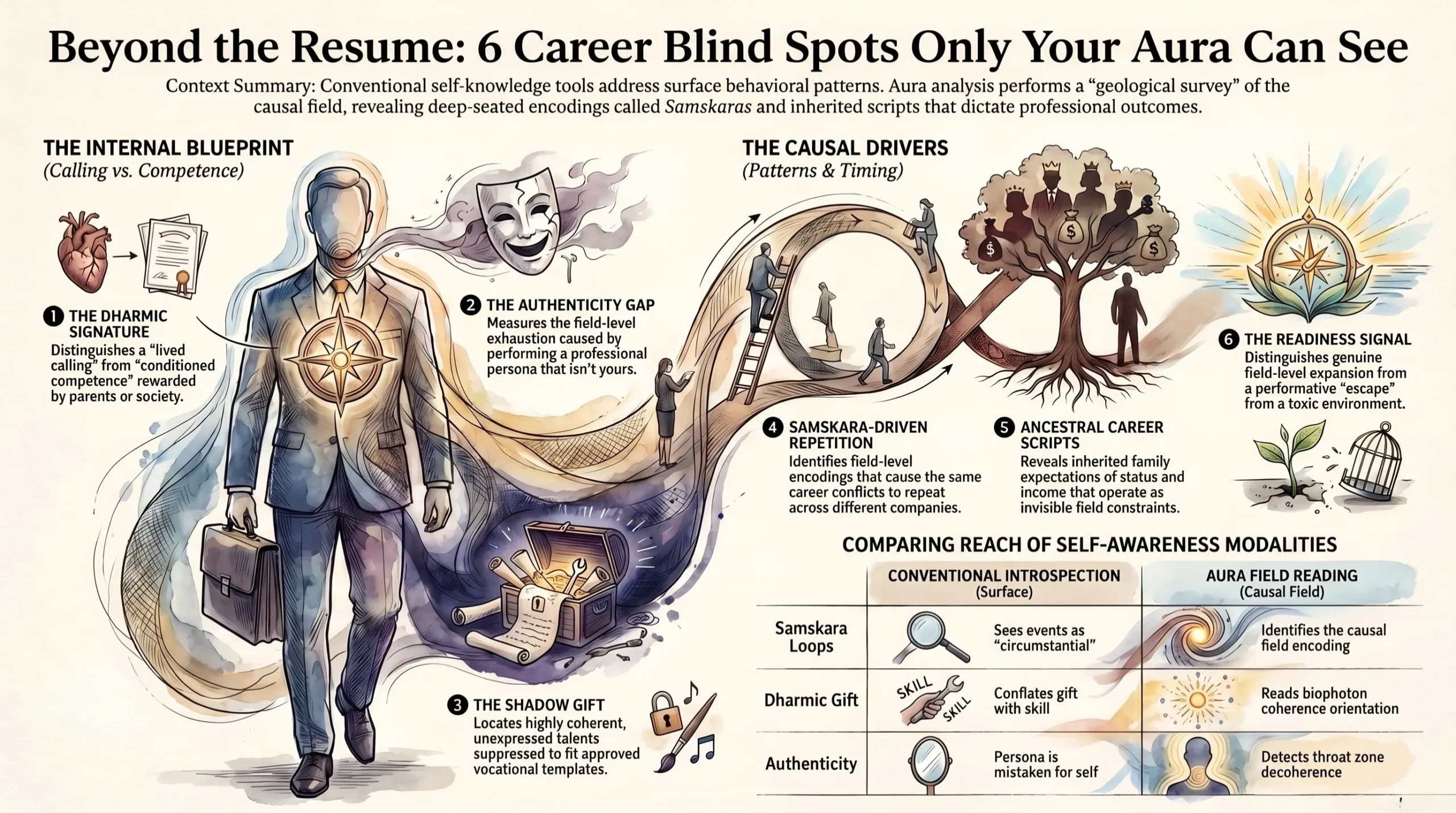
I want to be precise about what ‘blind spot’ means in this context. I am not claiming that conventional self-knowledge tools provide nothing of value — the comparison table later in this article presents each tool’s genuine contributions honestly. I am claiming something more specific: that these ten dimensions of self-awareness have a structural property that makes them systematically inaccessible to introspection-based self-knowledge — they are visible from outside the field but not from inside it. Just as the eye cannot see itself directly, the field cannot perceive its own deepest configuration without the trained practitioner’s external perspective.
Ten Self-Awareness Blind Spots Revealed Only Through Aura Study – What Conventional Introspection Cannot Access, What the Reading Sees, and What the Career Consequence Is:
Self-Awareness Blind Spot | Why Conventional Introspection Cannot Reliably Access This | What the Aura Reading Sees Instead | The Career & Purpose Consequence If It Remains Unseen | What the Reading Prescribes to Address It |
The dharmic signature: the specific gift configuration the individual was born to express | Conventional introspection conflates dharmic gifts with acquired competencies, socially rewarded skills, and parental projections. The person who has been excellent at something since childhood often cannot distinguish the dharmic gift from the conditioned performance — particularly when the gift has been used primarily in service of others’ agendas rather than its own authentic expression. Aptitude tests measure performance but not the field quality that distinguishes a performed competence from a lived calling. | The upper zone’s biophoton coherence pattern reads the field’s specific orientation: the direction in which the crown and throat zones produce the highest coherence, the quality of the Vijnanamaya kosha’s field organisation, and the constitutional field-type signature that points to the category of dharmic expression. The reading distinguishes the high-coherence dharmic field signature from the high-amplitude but decoherent performance field of the conditioned competence. | The individual spends their career optimising a competence rather than expressing a calling. The material success is real; the interior aliveness is absent. The energy drainage of performing a high-level competence that does not correspond to the dharmic gift is one of the most consistent patterns I see in mid-career professionals from Bangalore, Mumbai, and Delhi who are externally successful and internally empty. | The upper zone dharmic signature mapping: a specific articulation of the field’s native orientation that the client can use as a reference point to distinguish opportunities that resonate with the dharmic field from those that merely deploy the conditioned competence. This is the reading’s single most practically consequential self-awareness contribution for the career-dissatisfied professional. |
Samskara-driven career patterns that repeat across multiple contexts | The repetition of a career pattern — the same conflict with authority figures, the same self-sabotage at a specific achievement threshold, the same choice of the smaller but safer opportunity — typically appears in retrospect as a series of circumstantial events rather than as a pattern. The person experiencing the repetition is inside it and cannot see its shape from inside. Therapy can map biographical patterns after the fact; it cannot read the causal field encoding that is generating the pattern prospectively. | The causal body’s samskara layer holds the specific field encodings that produce characteristic pattern repetition across the life span. The reading identifies the samskara’s field signature — not its biographical source, which belongs to the therapeutic process — but its field-level configuration: where in the zone network the pattern’s energy lives, how it relates to the dharmic signature, and what the specific field-level intervention category that can begin to shift the attractor state. | The career pattern repeats for the third or fifth time with a different cast of characters and the same essential structure: the threshold at which the individual consistently retreats, the relationship type with which they consistently create conflict, the project category that consistently stalls at the same stage. Without the field-level pattern identification, the behavioural response is to work harder on the surface symptom without addressing the causal field encoding. | Causal body samskara mapping and the specific mantra sadhana or deep contemplative practice category most precisely targeted to the identified field attractor state. The reading names the pattern at the field level, not the biographical level — giving the client a working framework that complements rather than replaces the biographical therapeutic process. |
The authenticity gap: the distance between the expressed professional self and the field’s actual orientation | The professional persona is constructed under social pressure so gradually and so long ago that most people cannot distinguish it from their actual field orientation. The professional identity’s competence is real; its cost in field coherence depletion is invisible from inside the persona. The person who has performed their professional identity for twenty years has lost access to the pre-persona field orientation that the performance was constructed to manage, impress, or protect. | The throat zone’s coherence quality reads the authenticity of the expressed professional self’s correspondence to the field’s underlying orientation. A high-coherence throat zone indicates genuine alignment between expressed identity and field nature. A decoherent throat zone with high amplitude indicates performative professional identity: the person is broadcasting fluently and loudly in a frequency that is not their field’s native tone. The gap between the throat zone’s amplitude and its coherence quality is the authenticity gap’s field signature. | The energy cost of performing an inauthentic professional identity accumulates as chronic decoherence in the throat and heart zones — producing the specific fatigue that is not physical tiredness but the exhaustion of sustained self-misrepresentation. In my practice across 1,000+ readings, this pattern is most prevalent among professionals who transitioned into a field chosen for its salary, status, or family expectation rather than its resonance with their field’s native orientation. | Throat zone coherence restoration through authentic expression practice: specific communication practices that progressively close the authenticity gap; the Satya (truthfulness) svadhyaya practice as the primary field-level authenticity restoration discipline; and, where the gap is wide, the Career & Purpose reading’s dharmic reorientation mapping that identifies the direction in which the field’s native expression is most likely to be found. |
Ancestral career scripts operating below conscious awareness | The ancestral career script — the family’s encoded expectation of what constitutes a legitimate vocation, a sufficient income, an appropriate social station — operates as a non-conscious field constraint that the individual experiences as their own considered preference. The Pune software engineer who ‘chose’ engineering because it was the obvious right choice has often inherited a family field script that made engineering the only choice their field could perceive. The script is invisible because it is identical with the perceiving subject’s self-concept. | The ancestral layer of the causal body reads the inherited field scripts that have shaped the individual’s career orientation without their awareness. The reading can identify the presence and approximate category of ancestral career constraint: the scarcity-consciousness inheritance that prevents the individual from pursuing a lower-initial-income dharmic path; the status-anxiety inheritance that requires the individual to occupy a recognisably prestigious role; the gender-role inheritance that restricts the scope of perceived vocational options. | The individual continues to make career decisions within the constraint of an ancestral field script they have never consciously examined and cannot easily access through conventional introspection. The result is a career that satisfies the family’s inherited field expectations while remaining chronically unsatisfying to the individual’s own dharmic field orientation. The script is so deeply embedded that the dissatisfaction is often not experienced as career dissatisfaction but as a vague, sourceless sense that something important is missing. | Ancestral field script identification and the specific pitru tarpana or lineage-clearing practice most appropriate to the identified script category. The reading names the inherited constraint at the field level, giving the client a working awareness of the ancestral dimension of their career orientation that enables more conscious navigation of its influence. |
The energy-drain map: which activities, environments, and relationship types deplete the field and which restore it | The individual knows which activities they find draining and which they find energising — but typically attributes this differential to preference, introversion-extroversion, or circumstantial stress rather than to the field’s constitutional decoherence response to specific energy types. The constitutional field-type’s specific decoherence triggers are invisible as a unified pattern from inside the experience of each separate draining event. | The constitutional field-type assessment reads the specific decoherence signature of the individual’s field: the specific environments (competitive, emotionally chaotic, bureaucratically constrictive, isolating), activity types (detail management, public performance, interpersonal mediation, solitary creation), and relational field types that produce the identified pattern of field depletion. The energy-drain map is the career application of the Health & Vitality reading’s field decoherence assessment. | The professional constructs a career that is technically successful but structurally mismatched to their field’s constitutional energy requirements: the introvert constitutional field type in a high-performance networking-dependent role; the creative-synthesis field type in a compliance and protocol management position; the visionary-leadership field type in an execution-and-delivery role. The mismatch produces chronic energy depletion that reduces the career’s sustainable performance ceiling. | A specific career energy ecology assessment: the field’s constitutional decoherence triggers mapped against the individual’s current professional environment, with specific recommendations for structural adjustments (role scope, team composition, working environment, interaction-to-solitude ratio) that reduce the chronic energy drain and restore the field’s sustainable operating coherence. |
The purpose horizon: whether the individual’s sense of career purpose extends beyond immediate role performance to a larger contribution framework | The immediate job’s tasks and rewards are fully visible; the larger contribution framework that the individual’s dharma is pointing toward is typically obscured by the operational demands of the present role. The person who is functioning effectively in their current position often cannot see the larger arc of contribution their field is oriented toward because the current role’s visibility blocks the field’s further horizon. | The crown zone’s field orientation reads the individual’s dharmic horizon: the larger contribution field that the current role is either aligned with, partially aligned with, or misaligned with. The reading identifies the quality and direction of the crown zone’s coherence as a pointer toward the scale and nature of the contribution the field is oriented to make — beyond the current role, toward the career’s larger meaningful arc. | The individual optimises their performance within a role that is two or three sizes smaller than their field’s actual dharmic horizon. The career’s immediate metrics are good; its trajectory is constrained by the individual’s failure to perceive the larger arc that their field is already oriented toward. The unexplored horizon produces a specific restlessness — not dissatisfaction with the current role but a persistent sense that the field is pointing toward something larger. | Crown zone dharmic horizon mapping: a specific articulation of the contribution scale and direction that the field’s orientation most clearly points toward, with a career arc navigation framework that uses the current role as a platform rather than a ceiling and identifies the specific next-stage moves most aligned with the field’s larger purpose orientation. |
The readiness signal: whether the field is genuinely ready for a specific transition or is performing readiness in response to external pressure | The individual making a major career transition — a new role, a new sector, an entrepreneurial move, a return to education — experiences their enthusiasm, planning, and commitment as evidence of readiness. What conventional introspection cannot access is whether the enthusiasm is the field’s genuine forward movement or a performance of movement produced by environmental pressure (a redundancy, a toxic manager, a peer’s success) without the field’s underlying preparation being complete. | The reading distinguishes the field’s genuine forward movement signature from the performed readiness signature. The genuine forward movement presents as increasing coherence in the direction of the transition: the relevant zones brightening, the authenticity gap between expressed identity and field orientation narrowing, the energy-drain pattern reducing. The performed readiness presents as high amplitude without coherence increase in the relevant zones — a lot of energy directed toward the transition without the field’s underlying preparation. | The individual makes a transition for which the field is not genuinely prepared, encountering the same pattern in the new context that the transition was intended to escape. The most common version of this in my practice: the Hyderabad professional who exits a draining corporate role to start their own venture, only to recreate the same authority-conflict, same self-sabotage threshold, same energy-drain ecology in the new entrepreneurial context — because the field’s pattern was not addressed before the transition. | Transition readiness assessment: a specific field-level distinction between genuine forward movement and performed readiness, with the specific practice preparation required to bring the field to genuine readiness before the transition is made. Where the field is genuinely ready, the reading amplifies and directs the forward movement. Where it is not yet ready, the reading identifies what field-level preparation is required first. |
The shadow gift: a dharmic capacity that has been suppressed, dismissed, or actively hidden because it did not conform to the family’s, peer group’s, or culture’s approved vocational template | The shadow gift is, by definition, the capacity that the individual has learned not to show — not to themselves and especially not to others. The suppression is typically so complete that the individual does not experience the shadow gift as a hidden capacity. They experience it as an interest they outgrew, a skill they never fully developed, a direction they once considered and correctly abandoned. The suppression’s rationalisation is experienced as considered self-knowledge rather than as field constraint. | The shadow gift appears in the aura reading as a zone of high coherence that is structurally inconsistent with the surrounding field pattern — a bright, well-organised zone that the individual’s current career is not utilising. The reading identifies the shadow gift not by biography but by field: the specific zone coherence quality that points to the suppressed capacity, its relationship to the dharmic signature, and the specific expression channels through which it is most likely to find its natural outlet. | The individual lives a career built around the approved gift while the shadow gift — sometimes the more powerful, more original, and more specifically dharmic of the two — remains dormant. The cost is not merely the unexpressed capacity’s absence but the active field decoherence produced by the sustained suppression: the shadow gift’s zone produces a specific type of field incoherence when persistently unexpressed that gradually undermines the coherence of adjacent zones. | Shadow gift identification and the specific integration path: a graduated expression framework that introduces the shadow gift into the professional field in stages aligned with the field’s current readiness — not a sudden dramatic life reversal but a progressive reintegration of the suppressed capacity into the professional identity’s architecture. |
The collaboration field: which partnership and team field types amplify the individual’s contribution and which diminish it | The individual knows which colleagues and collaborators they work well with — but attributes this to personal chemistry, shared values, or complementary skills rather than to field-to-field coherence dynamics. The constitutional field-type’s specific amplification and depletion responses to different partner field types are experienced as personality compatibility without being understood as a field relationship that can be prospectively assessed rather than retrospectively explained. | The constitutional field-type assessment identifies the specific partner field type configurations that amplify the individual’s field coherence in collaborative work. The reading maps the field’s natural complementarity: which zone-strength profiles in a partner or team produce field-to-field resonance and coherence amplification, and which produce field interference. The collaboration field assessment is a prospective career tool — applicable to hiring decisions, partnership choices, and team composition assessments. | The individual repeatedly chooses or accepts collaborative relationships that are field-depleting rather than field-amplifying, reducing the sustainable performance ceiling of their collaborative work below its potential. The most consequential version in my practice: the entrepreneur from Ahmedabad who consistently chooses implementation-oriented co-founders who complement their own implementation weakness without providing the visionary-strategic field amplification that their dharmic contribution most requires. | Collaboration field mapping: a specific articulation of the partner zone-strength configurations that most amplify the individual’s dharmic contribution, with a practical screening framework for applying this field-level assessment to the specific partnership, hiring, and team composition decisions the individual is facing at the time of the reading. |
The timing signal: whether the field’s current configuration is in an expansion phase or a consolidation phase | The individual makes career timing decisions based on external opportunity signals — the market condition, the offer’s timing, the peer group’s momentum — without access to the field’s own internal timing rhythm. The Vedic tradition’s Jyotish framework provides the most developed timing intelligence available from any single tradition, but even without the full Jyotish analysis, the field’s current phase carries specific timing information that the individual cannot read from inside the experience of the phase. | The reading identifies the field’s current expansion-consolidation cycle phase through the zone network’s overall coherence direction: expansion phase presents as increasing inter-zone coherence, brightening amplitude in the directional zones (throat, crown), and a sense of readiness pressure building in the field. Consolidation phase presents as deepening coherence within zones without amplitude expansion — the field is integrating previous growth rather than generating new growth, and premature expansion during this phase depletes rather than advances. | The individual makes an expansion move during a field consolidation phase — launching a venture, making a high-profile transition, accepting a scope-enlarging role — when the field’s underlying preparation is consolidating rather than forward-generating. The result is not necessarily failure but a quality of friction and effort that would not be present if the move were made during the field’s genuine expansion phase: the same move producing a different quality of outcome depending on the field’s phase alignment. | Career timing intelligence: the specific field phase assessment integrated with the relevant Jyotish timing indicators (where the natal chart is available) to produce a composite timing map that distinguishes the field’s genuine expansion windows from its consolidation phases. The reading’s timing dimension is the most practically consequential self-awareness contribution for the career decision facing a specific near-term choice. |
The dharmic signature row deserves extended commentary because it is the one that produces the most consistently emotional client response. When I describe the field’s specific dharmic orientation to a mid-career professional who has spent fifteen years performing a conditioned competence rather than expressing a calling, the recognition is often immediate and visceral — not because the reading has introduced something new but because it has named, with specific vocabulary and specific field evidence, something the client has known at a level below the professional identity’s management but has not been able to articulate or act on without the field-level confirmation. The reading’s contribution is not the dharmic knowledge. The field already has that. The contribution is the specific, practitioner-confirmed articulation that gives the knowledge enough form to become the basis for action.
The energy-drain map row is the one with the most immediately practical career applications — because the specific structural adjustments it identifies (role scope, team composition, working environment, interaction-to-solitude ratio) are often achievable within the current professional context rather than requiring a major career transition. The most common outcome of this dimension of the Career & Purpose reading for professionals in Hyderabad’s pharmaceutical sector and Ahmedabad’s business community is not a career change but a career reconfiguration: the same organisation, the same broadly defined role, but with the specific structural adjustments that reduce chronic field decoherence and restore sustainable operating coherence. The result is a meaningfully improved quality of professional experience without the material risk of a major transition.
How Does Aura Self-Awareness Compare to Other Self-Knowledge Tools?
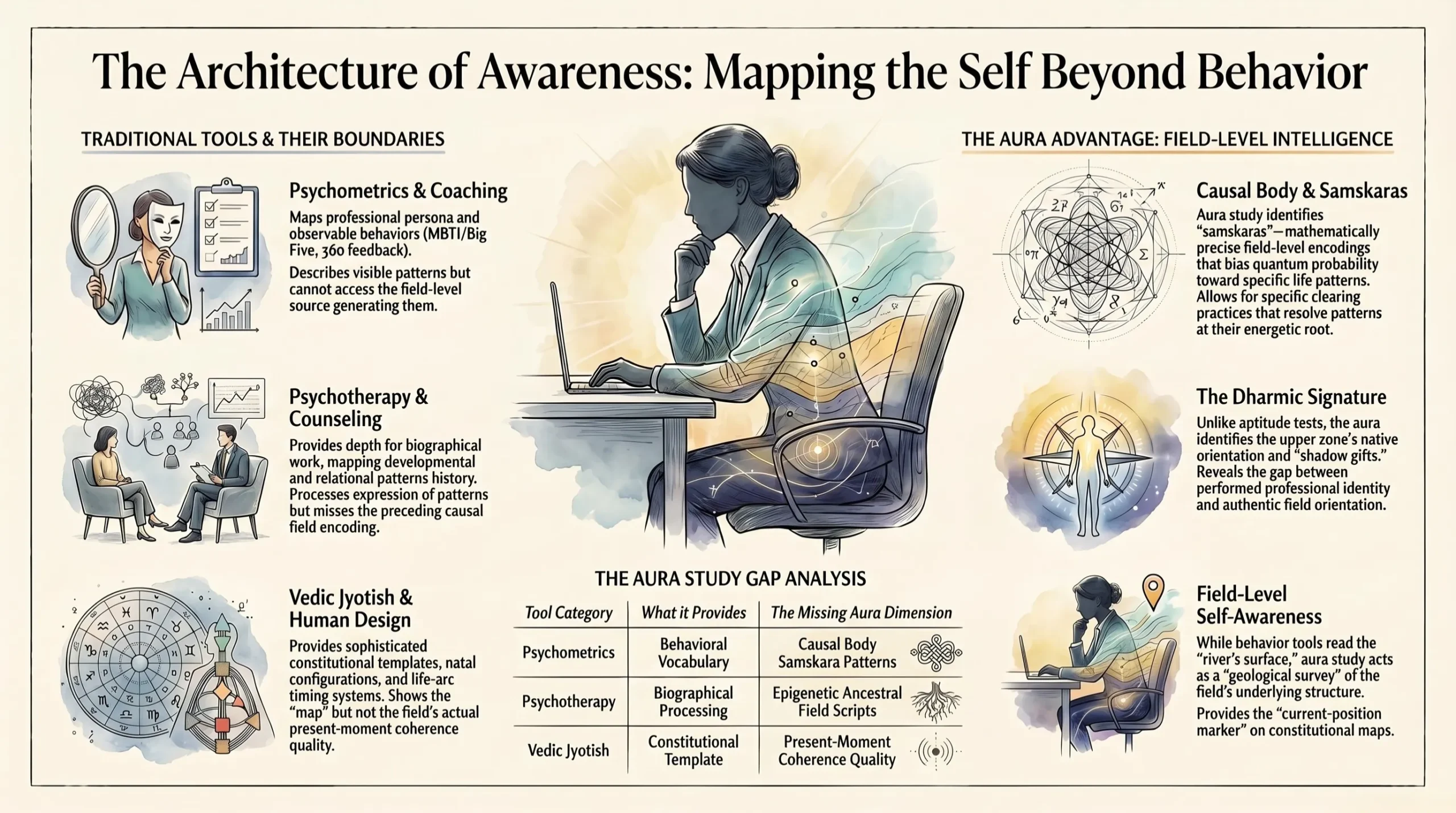
I have always been cautious about claiming more than the aura reading actually provides, because overclaiming is the fastest available path to losing the trust of the analytically minded clients who benefit most from the reading’s contributions. The comparison table I present below is a deliberate attempt to describe each tool’s genuine strengths with the same care I apply to describing the aura reading’s. If I have done it honestly — and I believe I have — the table will confirm both what each tool does genuinely well and where the aura reading fills gaps that the other tools leave open.
Aura Self-Awareness Compared to Six Other Self-Knowledge Tools – What Each Provides, What Each Misses, and How Aura Study Complements Each:
Self-Knowledge Tool | What It Genuinely Provides | What It Does Not Access | Depth of Self-Awareness Available | How Aura Study Complements It Without Replacing It |
Psychometric personality assessment (MBTI, Big Five, DISC, Enneagram) | A reliable, standardised vocabulary for describing observable behavioural patterns and cognitive style preferences. Useful for team communication, role-fit assessment, and initial self-description. The Big Five has the strongest psychometric validity; the Enneagram provides the deepest motivational layer of the four. | The dharmic gift’s specific field signature; the causal body’s samskara pattern and its career repetitions; the ancestral field scripts; the field’s current expansion-consolidation phase; the authenticity gap between expressed professional identity and field orientation; the shadow gift’s field location; the collaboration field’s amplification map. | Behavioural pattern depth: high. Motivational depth: moderate to high (Enneagram). Causal field depth: none. Constitutional field-type assessment: partial (Big Five conscientiousness maps partially to the Vedic constitutional type). Temporal dynamics: none. | Psychometric tools describe the pattern that is visible in behaviour; the aura reading identifies the field-level source of that pattern and the specific intervention that can shift it. The Enneagram’s nine types and the aura reading’s constitutional field-type assessment are most complementary when used together: the Enneagram names the behavioural structure of the defence; the aura reading locates the field encoding that the defence is protecting and identifies the clearing practice most precisely targeted to it. |
Psychotherapy and psychological counselling | The most effective available tool for biographical pattern work: mapping the developmental history that produced the current behavioural and relational patterns, providing a structured relationship within which new relational patterns can be practised, and integrating the emotional content of significant biographical events through a sustained, boundaried therapeutic process. | The causal body’s field encoding at the level that precedes its biographical expression; the ancestral field scripts that are transmitted epigenetically rather than through remembered experience; the field’s dharmic signature and its career application; the constitutional field-type’s specific energy ecology; the timing intelligence of the field’s current phase. | Biographical pattern depth: very high. Emotional processing depth: very high. Relational pattern depth: high. Causal field depth: none to low. Ancestral field depth: low (unless specifically ancestral-trauma oriented). Dharmic signature: none. | The aura reading’s most important contribution for clients in therapy is the causal field layer’s identification: it provides a field-level map of where the pattern lives that complements the biographical map the therapeutic process is constructing. The two approaches address the same pattern at different layers of its manifestation. The reading identifies the field encoding; the therapy processes its biographical expression. Together they address the pattern more completely than either alone. |
Vedic Jyotish (Indian astrology) | The most sophisticated timing and constitutional framework in the Vedic tradition: natal chart’s dharmic indicators (dharma bhavas, atmakaraka, navamsha), dasha timing system’s career phase mapping, and the full planetary picture of the individual’s constitutional field type and life arc. The most directly compatible self-knowledge tool with the aura reading’s framework. | The field’s current coherence state in the present moment: the natal chart shows the constitutional configuration and the timing arc but not the current field’s actual coherence quality, which varies from the natal configuration depending on accumulated practice, life events, and field restoration or depletion patterns. | Constitutional depth: very high. Timing depth: very high (unmatched by any other tool). Dharmic mapping: very high. Current-moment field coherence: none. Samskara field encoding: high (karaka planets and their afflictions). Ancestral field: high (fifth and ninth house indicators). | The aura reading and Jyotish are the most complementary self-knowledge tool pair in the series: Jyotish provides the constitutional template and the timing arc; the aura reading provides the current-moment field coherence assessment within that template and arc. Where the Jyotish chart shows a dharmic potential in the natal configuration, the aura reading shows whether the current field’s coherence is aligned with that potential or blocked from expressing it by an identified field decoherence pattern. |
360-degree feedback and professional coaching | The most externally validated self-knowledge tool: aggregated feedback from colleagues, managers, and direct reports provides a calibrated picture of the professional’s perceived impact, behavioural patterns, and development opportunities that the individual’s self-report alone cannot provide. Professional coaching provides structured goal-setting and accountability within the framework of the professional’s own priorities. | The dharmic gift’s field signature (colleagues assess performance, not dharmic alignment); the causal field’s pattern encoding; the ancestral constraints on career perception; the shadow gift’s field location; the field’s current phase and timing. The 360’s feedback horizon is the professional persona’s observable performance — it does not assess the person behind the persona. | Observable performance depth: very high. Perceived impact: high. Dharmic alignment: none. Field-level pattern source: none. Timing intelligence: none. The most externally oriented of the six tools — it reads the professional’s impact on the external field rather than the internal field’s configuration. | The aura reading provides the complementary internal picture for the 360’s external one: where the 360 shows how the professional is perceived, the reading shows what field-level pattern is generating the perception. The most valuable combination is a 360 followed by a Career & Purpose reading: the 360 identifies the professional pattern’s external impact; the reading identifies the field-level source and the specific intervention to address it. |
Meditation and contemplative practice | The most direct available self-knowledge tool for field-level self-awareness: sustained meditation practice gradually makes the field’s patterns visible to the practitioner’s own inner perception. The practitioner who has maintained a serious daily practice for five or more years begins to develop the inner observation capacity that the aura reading provides from outside. Meditation is the path to the self-knowledge that the reading accelerates. | The specific causal field encoding’s career application without a practitioner’s external reading perspective; the ancestral layer’s identification without the trained practitioner’s pattern recognition; the collaboration field’s amplification map; the transition readiness distinction; the shadow gift’s location without external perspective. The serious meditator often knows something is unresolved; the reading identifies specifically what and where. | Present-moment awareness depth: potentially very high with sustained practice. Causal field visibility: moderate to high (with serious long-term practice). Dharmic signature: moderate (becomes clearer with practice). Timing intelligence: moderate. External perspective on the field’s pattern: none — the practitioner is always inside their own field. | The aura reading’s most natural client is the serious meditator who has developed sufficient inner observation capacity to recognise the reading’s findings as accurate but who benefits from the trained practitioner’s external perspective and specific identification of what the inner observation has been circling without quite naming. The reading accelerates the self-knowledge that the meditation practice is building: naming specifically what the practice has been approaching, providing the specific practice calibration that the stage of development requires. |
Human Design and Gene Keys | A modern synthesis of Jyotish, Kabbalah, I Ching, and the Chakra system providing a specific bodygraph map of the individual’s defined and undefined energy centres, profile type, strategy and authority. Human Design’s strategy and authority framework is particularly useful for decision-making alignment. Gene Keys provides a deep contemplative framework for the shadow-gift-siddhi transformation arc. | The field’s current coherence state in the present moment; the ancestral field’s specific current-generation expression; the causal body’s samskara field encoding beyond the natal configuration; the environmental field’s influence on the individual’s current field; the specific practice prescription calibrated to the current-moment field state rather than the natal configuration. | Constitutional depth: high. Dharmic mapping: high (incarnation cross and profile). Decision-making alignment: high (strategy and authority framework). Current-moment field: none. Practice calibration to current field state: none. Ancestral current-generation expression: none. | Human Design and the aura reading are most valuably combined as constitutional map and current-moment assessment: the Human Design bodygraph provides the constitutional template of defined and undefined centres; the aura reading assesses which of the undefined centres are currently being conditioned by environmental or ancestral influences, providing the current-moment field management intelligence that the static bodygraph cannot. Gene Keys’ shadow-gift-siddhi arc and the aura reading’s shadow gift identification are the most directly complementary dimensions of the two frameworks. |
The meditation row is the most philosophically important in the table, because it names the relationship between the aura reading and sustained contemplative practice with the precision that relationship deserves. Meditation is the path to the self-awareness that the reading accelerates. This is not a marketing comparison. It is a genuine statement of the relationship between the two: the serious meditator who has maintained a daily practice for years is developing exactly the field-level self-awareness capacity that the reading provides from outside. The practitioner’s trained external perspective does not replace the meditator’s inner observation capacity — it provides the external confirmation, the specific naming, and the calibrated practice prescription that the inner observation alone cannot provide without years of additional practice to develop the level of inner clarity required.
The Jyotish row is the most practically important for the Indian client, because Jyotish is the self-knowledge tool most deeply embedded in Indian cultural practice and the one whose framework is most directly compatible with the aura reading’s Vedic foundation. The combination of a Jyotish natal chart reading — which provides the constitutional template and the timing arc — with a Career & Purpose aura reading — which provides the current-moment field coherence assessment within that template and arc — is, in my experience, the most powerful single self-knowledge tool combination available within the Vedic tradition. The natal chart knows the configuration; the aura reading knows the current state of the configuration. Together they provide both the map and the current-position marker.
How Does Aura Self-Awareness Transform Career and Purpose Navigation at Eight Key Life Turning Points?
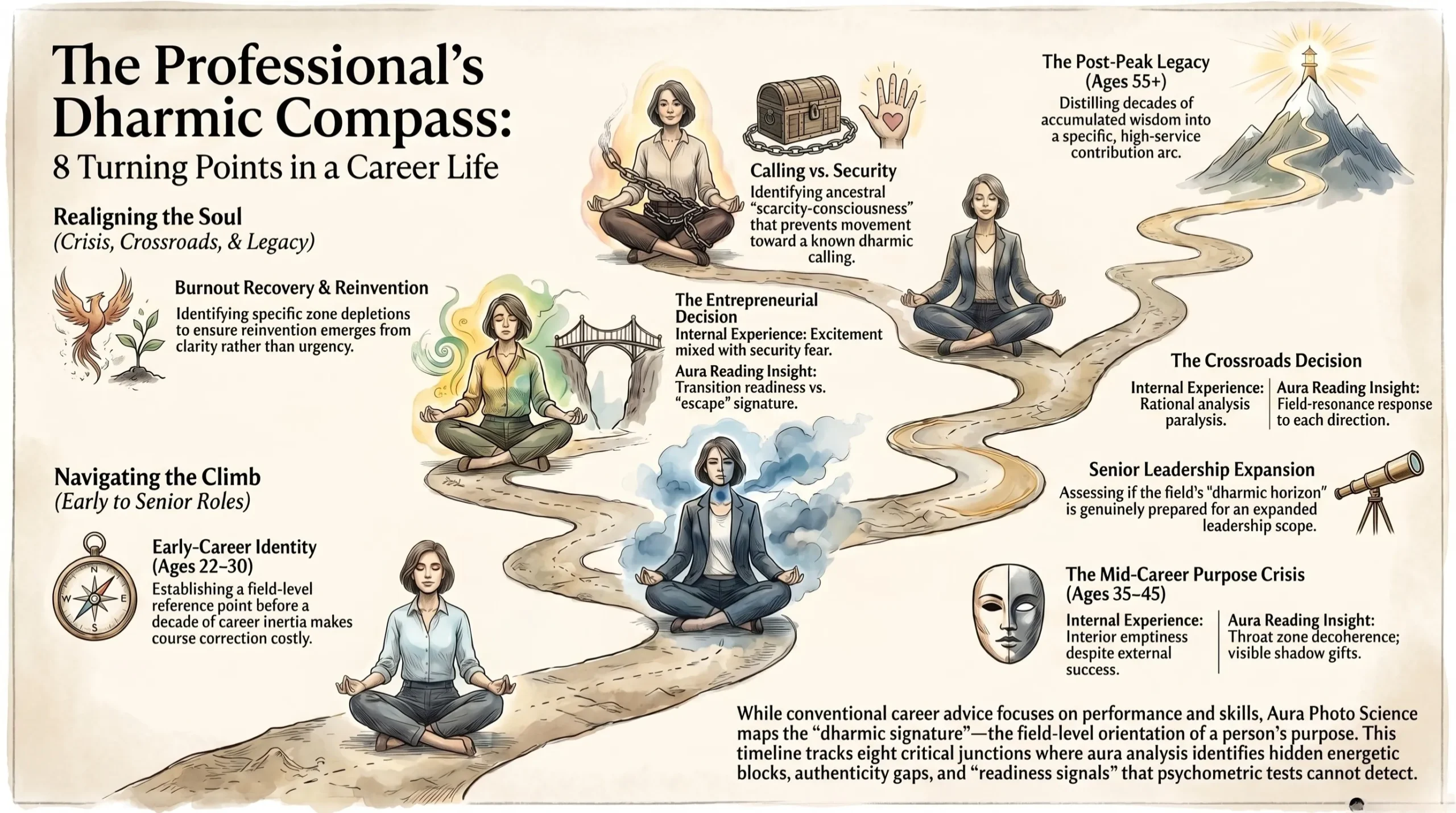
The turning points in this table are the moments I most commonly encounter in my Career & Purpose practice. They are the moments where the stakes are highest and the self-awareness requirement is most specific and most urgent. They are also the moments where the gap between behavioural self-awareness and field-level self-awareness is most consequential — because the decision made at the turning point will shape the career’s next decade in ways that are not easily reversed.
Eight Career Life Turning Points and How the Career & Purpose Aura Reading Navigates Each With Field-Level Precision:
Career Life Turning Point | What the Person Is Usually Experiencing | What the Aura Reading Sees at This Turning Point | How the Career & Purpose Reading Navigates This Turning Point With Precision |
The early-career identity formation period (ages 22–30) | Pressure to choose a direction before the field’s dharmic signature is clear; the simultaneous presence of multiple genuine interests without a way to identify which is the dharmic gift and which is the conditioned interest; the social pressure to demonstrate progress in a conventionally legible career direction | The field’s dharmic signature is present from birth but may be obscured by early-career field decoherence from educational conditioning; the crown and throat zones’ coherence quality in the directions of genuine dharmic resonance versus socially conditioned interest are distinguishable in the aura reading even when the individual cannot distinguish them from inside | The Career & Purpose reading at this stage provides the dharmic signature’s specific field articulation — a grounded, specific description of the field’s native orientation that the individual can use as a reference point for evaluating opportunities, choices, and directions rather than navigating entirely by external validation signals. The reading does not prescribe a career path; it maps the field’s orientation and gives the individual the self-knowledge to evaluate paths against that orientation. For the 22-to-30 professional, this may be the most consequential self-knowledge investment available: a field-level reference point established before the first ten years of career inertia make course correction progressively more costly. |
The mid-career plateau and purpose crisis (ages 35–45) | External success with interior emptiness; the persistent sense that the career’s achievements are real but insufficient; the inability to articulate specifically what is missing because the field’s dharmic gap cannot be named within the career’s own performance vocabulary; the fatigue of sustained high performance in a role that does not engage the field’s deepest resources | The authenticity gap between the professional persona and the field’s actual orientation is typically most visible in this life phase: the throat zone’s decoherence after fifteen or more years of performance in a direction misaligned with the dharmic signature; the shadow gift’s coherent zone standing out against the surrounding pattern; the samskara’s career repetition pattern clearly established after enough repetitions to be read at the field level | This is the most common presenting moment in my Career & Purpose practice across 1,000+ readings. The mid-career professional from Mumbai, Delhi, or Bangalore who is externally successful and internally depleted is the reading’s most grateful recipient, because the reading names specifically what conventional career advice cannot: the field’s actual orientation, the authenticity gap’s location and magnitude, the shadow gift’s specific nature, and the specific reorientation arc most aligned with the field’s dharmic configuration. The reading does not produce a midlife crisis. It resolves one: giving the interior emptiness its specific field-level name and its specific field-level address. |
The entrepreneurial transition decision | Simultaneous excitement about the entrepreneurial possibility and fear of the security loss; difficulty distinguishing genuine entrepreneurial dharma from the desire to escape a draining corporate environment; the question of whether the timing is right without any framework for assessing the field’s actual readiness beyond the business plan’s financial projections | The transition readiness signature: whether the field’s movement toward the entrepreneurial direction is genuine forward expansion or performed readiness generated by the desire to escape the current environment; the samskara patterns that are likely to recreate themselves in the entrepreneurial context if not addressed before the transition; the dharmic gift’s alignment or misalignment with the specific venture’s nature | The Career & Purpose reading at the entrepreneurial decision point provides three specifically valuable assessments simultaneously: first, the transition readiness distinction — is this the field’s genuine expansion or an escape? Second, the dharmic alignment assessment — is the specific venture’s nature resonant with the field’s dharmic gift, or does it deploy the conditioned competence in a new context without engaging the dharmic gift? Third, the samskara preparation map — what specific field-level clearing is required before the transition to prevent the corporate context’s patterns from recreating in the entrepreneurial context? The reading’s practical value at this decision point is directly proportional to the scale of the decision’s consequences. |
The senior leadership or significant scope expansion moment | The excitement of expanded responsibility combined with the uncertainty about whether the field is genuinely prepared for the new scope; the imposter syndrome’s specific quality at the leadership threshold; the question of whether the leadership identity can be authentic rather than performed | The crown zone’s coherence quality at the leadership threshold: whether the field’s dharmic horizon genuinely extends to the leadership scope being offered, or whether the scope is larger than the field’s current configuration can sustain authentically; the throat zone’s authenticity in the leadership voice; the heart zone’s coherence for the relational field demands of the expanded scope | The Career & Purpose reading at the leadership threshold provides the specific field-level validation or caution that the individual’s own uncertainty cannot provide. For the field whose dharmic horizon genuinely extends to the leadership scope, the reading amplifies and directs the forward movement, identifying the specific field preparation practices that will bring the heart and throat zones into alignment with the crown zone’s already-present leadership coherence. For the field whose current configuration is not yet aligned with the offered scope, the reading identifies the specific field development required and whether the timeline is feasible within the opportunity’s window. |
The burnout recovery and reinvention period | Exhaustion, disorientation, and the loss of the professional identity’s coherence following burnout; the uncertainty about whether to return to the same field, explore a related direction, or reinvent entirely; the difficulty of making career decisions from a field that is depleted and disoriented rather than coherent and clear-directed | Burnout presents a specific aura field signature: systemic biophoton coherence depletion across multiple zones simultaneously, with the most acute decoherence in the zone most chronically overused (throat and crown in leadership burnout; root and solar plexus in financial-pressure burnout; heart zone in relational-field burnout). The reading can distinguish burnout recovery’s specific field phase from the post-recovery reinvention phase — two very different field states that are often confused with each other during the recovery period. | The Career & Purpose reading at the burnout recovery stage is used in two phases: first, immediately after the acute phase, to identify the specific zone depletion pattern, the overuse dynamic that produced it, and the restoration sequence required before any significant career decision can be made from a coherent field. Second, as the restoration progresses, to map the reinvention direction from the recovered field’s own dharmic signature rather than from the exhausted field’s survival decisions. The most important single contribution the reading makes at this stage: the specific articulation that the reinvention direction should emerge from the restored field’s dharmic clarity, not from the depleted field’s urgency. The timing of the reinvention reading is as consequential as its content. |
The post-peak career contribution phase and legacy question (ages 55+) | The shift from achievement-oriented to legacy-oriented career motivation; the question of how to direct the accumulated experience, wisdom, and resources toward the contribution that will matter most; the recognition that time horizon has changed and that the field’s remaining contribution years deserve a different quality of intention than the achievement years | In the post-peak phase, the aura field’s dharmic signature is typically more visible and less obscured by conditioned performance than at any previous life stage: the field’s accumulated wisdom has progressively clarified the dharmic orientation, and the achievement drive’s field noise has reduced. The reading at this stage often confirms with striking clarity what the individual has been approaching for decades; it identifies the specific contribution arc that distils the career’s wisdom into its highest available service. | The Career & Purpose reading at the legacy phase provides the contribution arc map: the specific domains, forms, and recipient communities in which the individual’s accumulated dharmic gift can be most precisely applied to the contribution that their field is most oriented to make. This is the reading’s most philosophically complete application — not career management but wisdom deployment. The reading identifies the specific next decade’s highest contribution direction and the specific practices that maintain the field’s coherence through the post-peak years’ natural field transition. |
The career crossroads with two or more apparently viable directions | The paralysis of genuine choice between two directions that both appear viable, both have legitimate supporters, and both have real costs; the difficulty of evaluating the choice from within the field that must make it; the experience that rational analysis has been exhausted without producing clarity, and that the decision is being made from the most immediate pressure rather than the deepest knowing | The Career & Purpose reading at the crossroads presents the field’s coherence response to each direction: not which direction is objectively better but which direction produces the higher coherence resonance in the individual’s specific field configuration. The field’s resonance response to each direction is a function of the dharmic signature, the energy ecology, the samskara patterns that each direction will engage, and the crown zone’s horizon alignment with each direction’s scale and nature. | This is the most immediately decision-useful application of the Career & Purpose reading: the client comes with two directions and the reading provides the field’s resonance assessment of each. This is not a simple ‘choose this one’ directive — the reading presents the field’s specific resonance pattern for each direction, the specific field-level preparation required before either direction can be pursued most coherently, and the specific timing intelligence about which direction the field’s current phase is most ready for. The client leaves with a field-level assessment framework for the decision rather than either a prescription or a paralysis. |
The calling versus security conflict: the known dharmic direction opposed by the security of the current path | The simultaneous clarity about the dharmic direction and the fear of the material security risk; the field knows what it is called toward but the ancestral scarcity-consciousness and the root zone’s fear pattern prevent the movement; the gap between the known calling and the taken action that produces the specific self-betrayal distress of knowingly failing to follow one’s dharma | The root zone’s fear pattern and the ancestral scarcity-consciousness inheritance are visible at the field level as the specific constraint holding the individual at the boundary between the known calling and the taken action. The reading identifies the specific field encoding — the samskara, the ancestral script, the root zone’s decoherence pattern — that is producing the hesitation, and distinguishes it from the genuine practical preparation requirements that the calling’s pursuit requires. | This is the most personally consequential Career & Purpose reading situation, and the one that most directly addresses the relationship between self-awareness and self-authorisation. The reading’s contribution is not to urge the individual to take the leap — that would be irresponsible career guidance. It is to identify specifically what field-level work is required to bring the root zone’s coherence into alignment with the calling’s direction, to distinguish the legitimate practical preparation from the ancestral scarcity-consciousness’s rationalised avoidance, and to provide a sequenced field preparation path that moves the individual from the paralysis of the calling-security conflict toward the field’s genuine readiness to pursue the calling from a position of coherent strength rather than desperate flight. |
A client from Pune — a forty-one-year-old pharmaceutical company director who had led three successful drug launches and built a genuinely respected reputation in her field — arrived at the Career & Purpose reading at her first major crossroads. Her company had offered a promotion to Vice President that was, by every conventional measure, the right next move: larger scope, better compensation, increased visibility. And she was considering, simultaneously, an approach from a non-profit health equity organisation that would pay sixty percent less and carry none of the corporate status but that had engaged something in her that the VP offer had not.
The reading identified the specific field resonance pattern: her crown zone’s dharmic horizon was oriented toward the health equity contribution’s scale of impact in a way that the VP role’s expanded corporate scope did not engage. Her samskara pattern included a specific ancestral scarcity-consciousness inheritance that had shaped her career toward maximum security accumulation as the primary criterion. The reading distinguished the ancestral constraint from the legitimate practical consideration: she had real material obligations that the compensation difference would affect, and these were not to be dismissed as mere fear. But the field’s dharmic orientation toward the health equity direction was not ambiguous.
The reading’s prescription was not ‘take the non-profit role.’ It was: address the ancestral scarcity field script through the specific pitru tarpana practice identified; spend six months in the VP role’s financial security building the resource buffer that would make the transition genuinely viable rather than financially precarious; and use that six months to develop the non-profit relationship more fully so that the transition, when made, would be from the field’s genuine readiness rather than from a desperate escape from the corporate context. She followed this prescription. Fourteen months after the reading, she made the transition from a position of financial stability and field readiness rather than desperation. She described the reading’s contribution as giving her calling the field-level confirmation she had needed to take it seriously — and the ancestral constraint’s identification as the specific self-awareness that had allowed her to work with the fear rather than be governed by it.
What Is the Daily Practice of Aura Self-Awareness and How Does It Deepen Over Time?
The most common misunderstanding about the aura reading’s self-awareness contribution is that it is a one-time event: you receive the reading, you receive the insight, and that insight is then either implemented or not. This misunderstands the nature of field-level self-awareness as a practice. The reading provides the initial map and the specific practice prescriptions. The daily practice of field-level self-observation develops the capacity to use that map in real-time, to notice the field’s coherence responses to specific situations and choices as they happen, and to recognise the samskara pattern activating in the moment rather than naming it only after the pattern has completed its repetition.
The Three Daily Practices of Field-Level Self-Awareness:
- The dharmic signature reference point practice: The Career & Purpose reading provides a specific articulation of the field’s dharmic orientation. The daily practice is to use this articulation as a reference point for evaluating the decisions, opportunities, and directions that the day presents. Not a rigid filter — the field’s orientation is a direction, not a destination — but a consistent orientation check: does this direction increase the field’s resonance with its dharmic signature or decrease it? The practice develops gradually from an effortful conscious check to an intuitive felt-sense response that becomes the practitioner’s natural mode of career decision navigation.
- The zone coherence morning observation: A specific five-minute daily practice — most effectively performed in the meditation period immediately following pranayama — of scanning the zone network’s current coherence quality. Not a detailed technical assessment but a qualitative observation: which zones feel clear and coherent, which feel dense or congested, which feel depleted or absent. The accumulated observations across weeks and months develop the practitioner’s inner field-reading capacity: the ability to notice when a specific zone’s quality changes in response to a specific decision, environment, or relationship type. This is the beginning of the self-directed field-level self-awareness that the reading catalyses.
- The samskara pattern recognition practice: The reading identifies the samskara’s characteristic field signature: the specific zone complex that activates when the pattern is triggered, the specific emotional-energetic quality that accompanies the activation. The daily practice is to notice this signature in real-time: when the familiar quality arises in the familiar zone complex, to recognise it as the samskara’s activation rather than as an objective response to the current situation. This recognition does not immediately stop the pattern’s expression. But it creates the witness perspective that is the necessary precondition for the pattern’s progressive transformation through the prescribed samskara clearing practice.
A client from Delhi — a forty-seven-year-old management consultant who had received the Career & Purpose reading two years before this conversation — wrote to describe the specific practical change in his career navigation that the sustained daily practice had produced. He described not a dramatic career transformation — he was still in the same broadly defined professional domain — but a qualitative shift in how he navigated within it. He could now feel, reliably and in real-time, when a client engagement was aligned with his field’s dharmic orientation and when it was deploying his conditioned competence in a direction that would drain rather than develop him. He could feel the samskara pattern’s activation approaching in certain client relationship dynamics, and use the recognition to choose a different response than the pattern’s habitual one. He described the two years of daily practice as having produced more practical self-awareness than the preceding ten years of therapy, coaching, and personality assessment combined — not because those tools had been without value, but because the field-level layer they had not reached was the layer where the most consequential patterns lived.
Are You Ready for the Field-Level Self-Awareness That Your Career Has Been Waiting For?
Namaste, my friend — if this article has named the specific self-awareness gap that your career has been circling — the pattern that keeps repeating without resolution, the sense of misalignment between what you are performing and what you are actually oriented toward, the shadow gift that has been coherently waiting while your approved competence has been fully deployed, the ancestral script that has been shaping your career decisions from below the level of your conscious deliberation — then you already know why the Career & Purpose aura reading is the specific self-awareness tool your career question requires.
The Career & Purpose reading maps the field’s specific dharmic signature, identifies the samskara pattern’s causal encoding, locates the shadow gift’s coherent zone, names the ancestral career constraint, assesses the transition readiness signal, and provides the specific daily practice framework that transforms the reading’s one-time insight into a sustained field-level self-awareness practice. All seven zones. The full five-layer field body. The causal layer’s deepest encodings. Delivered in writing, from a photograph, within 24 to 48 hours.
Using our patented photo-scanning technology and Multiple Advanced Gadgets. Drawing on eight years of practice and 1,000+ Career & Purpose readings across India. With our money-back guarantee.
Three Steps to Your Field-Level Career Self-Awareness:
- Submit Photo – Upload a recent, clear photograph of yourself. Your complete field — dharmic signature, samskara pattern, shadow gift, ancestral script, energy ecology, transition readiness, and timing phase — is accessible through our patented photo-scanning technology and Multiple Advanced Gadgets.
- Expert Analysis – I personally decode your complete Career & Purpose aura field across all seven zones, identifying the ten blind spots that are most relevant to your specific current career situation, and providing the specific practice framework most precisely calibrated to your field’s configuration and your career’s current turning point.
- Transform – Receive your personalised Career & Purpose Aura Guide — dharmic signature map, samskara pattern identification, shadow gift location, ancestral constraint naming, energy ecology assessment, transition readiness signal, and daily field-awareness practice framework — delivered within 24–48 hours with our money-back guarantee.
⚠️ Disclaimer: Aura analysis and energetic guidance are for personal growth and awareness only. They are not a substitute for professional medical, financial, legal, or psychological advice. Please consult qualified professionals for any health or financial concerns.
Q1: How does studying the aura improve self-awareness?
Studying the aura improves self-awareness by accessing the field-level layer of self-knowledge that behavioural and biographical introspection cannot reach: the causal body’s samskara encoding that generates recurring career patterns; the dharmic signature’s specific configuration that distinguishes a performed competence from a genuine calling; the ancestral field scripts transmitted epigenetically below conscious awareness; the shadow gift’s suppressed coherent zone; and the field’s current expansion-consolidation timing phase. These dimensions of self-awareness are visible from outside the field through the trained practitioner’s aura reading, but are systematically inaccessible through introspection alone because the field cannot perceive its own deepest configuration from inside.
Q2: What is a dharmic signature in an aura reading?
A dharmic signature in an aura reading is the specific pattern of biophoton coherence in the upper zone network — primarily the crown and throat chakras and the Vijnanamaya kosha’s field organisation — that indicates the individual’s native dharmic orientation: the specific gift configuration they were born to express. The dharmic signature distinguishes the field’s highest coherence direction (the dharmic calling) from the high-amplitude but less coherent directions of conditioned competence and socially approved performance. In the Career & Purpose reading, identifying the dharmic signature is the most practically consequential single finding for professionals experiencing the gap between external success and interior aliveness.
Q3: What is a shadow gift in the context of aura self-awareness?
A shadow gift in aura self-awareness is a dharmic capacity that appears in the reading as a coherent, well-organised zone that the individual’s current career is not utilising — because the capacity was suppressed, dismissed, or deliberately hidden at some point in the past because it did not conform to the family’s, peer group’s, or culture’s approved vocational template. The shadow gift’s zone is often among the most coherent in the entire field because it has not been depleted by decades of performance demands. The Career & Purpose reading identifies the shadow gift’s field location, its relationship to the dharmic signature, and the specific integration path that introduces the suppressed capacity into the professional field progressively.
Q4: How does the aura reading differ from personality tests like MBTI for career guidance?
Personality tests like MBTI and the Big Five provide standardised descriptions of observable behavioural patterns and cognitive style preferences — highly reliable for team communication and initial self-description, but operating only at the pattern’s observable expression level. The aura reading operates at the pattern’s causal field level: it identifies the causal body’s samskara encoding generating the pattern, the ancestral field scripts shaping career perception below conscious awareness, the dharmic signature’s specific field configuration, the shadow gift’s location, and the field’s current timing phase. The most complete career self-awareness combines both: personality tools describe the behavioural structure; the aura reading identifies the field-level source and the specific clearing practice.
Q5: What is the daily practice of aura self-awareness for career development?
The daily practice of aura self-awareness for career development involves three specific practices prescribed in the Career & Purpose reading: first, the dharmic signature reference point — using the reading’s specific articulation of the field’s native orientation as a daily evaluation reference for career decisions and opportunities; second, the zone coherence morning observation — a five-minute daily scan of the zone network’s current coherence quality that progressively develops the individual’s inner field-reading capacity; and third, the samskara pattern recognition practice — using the reading’s identified samskara signature to recognise the pattern’s activation in real-time rather than only in retrospect. Sustained daily practice across months and years progressively develops the viveka — the clear field-level discrimination — that transforms the reading’s one-time insight into a lifetime career navigation tool.