What Is the Aura’s Connection to the Nervous System? Polyvagal & Field Science | Aura Photo Science India
Namaste, I’m Mukesh Shah. There is one question that more than any other separates the clients who receive lasting transformation from the Health & Vitality reading from those who receive temporary improvement: do they understand that their aura and their nervous system are not two separate things?
The aura’s field is not floating above the nervous system, independent of it, requiring separate attention through a separate set of practices. The nervous system is the physical body’s primary field-generation and field-coordination network. The vagus nerve’s electrical field is the body’s most extensive inter-organ coherence cable — connecting the brainstem to the heart, the lungs, the gut, the liver, and the immune system in a continuous bioelectromagnetic field network. The heart’s cardiac field, the brain’s electromagnetic field, and the body’s biophoton emission field are all generated by and responsive to the nervous system’s state. When the nervous system is in sympathetic overdrive, the aura’s field reflects that state with precise specificity. When the nervous system’s vagal tone is restored to its optimal level, the aura’s zone coherence improves with equal specificity.
In eight years of aura analysis and more than 1,000 Health & Vitality readings across Mumbai, Delhi, Bangalore, Pune, Ahmedabad, and Hyderabad, the most consistently informative single indicator I work with is the relationship between the client’s described life context and the aura field’s nervous system state signature. The Bangalore tech professional whose field reads as chronic sympathetic dominance has already told me the most important thing about their health trajectory before I have looked at any organ-specific zone: the autonomic nervous system’s state is the master variable whose restoration unlocks every other dimension of the Health & Vitality protocol’s effectiveness.
This article maps the aura-nervous system connection with the precision it deserves: the polyvagal framework’s seven nervous system states and their exact aura field signatures; nine specific nervous system conditions and their zone reading patterns; the six most evidence-supported restoration practices that address both simultaneously; and the clinical case study that most directly illustrates why understanding this connection is the difference between the Health & Vitality protocol’s surface application and its deepest available transformation.
The scientific framework I draw on most extensively in this article is Stephen Porges’ Polyvagal Theory — one of the most consequential advances in autonomic neuroscience of the last three decades. Porges’ framework describes the nervous system’s hierarchical organisation — from the evolutionarily ancient dorsal vagal freeze response through the sympathetic fight-flight system to the uniquely mammalian ventral vagal social engagement system — in terms that map with remarkable precision onto the aura tradition’s description of the field’s quality gradations. The Vedic tradition’s Tamas-Rajas-Sattva framework is, I have become convinced, the five-thousand-year observational equivalent of Porges’ twenty-first century neurological characterisation of the same biological reality.
What Is the Nervous System’s Role in Generating the Aura’s Field?
To understand why the vagus nerve is the aura’s most important single physical structure, consider its anatomy. The vagus nerve is the longest nerve in the body. It travels from the brainstem through the neck, chest, and abdomen, innervating the heart, lungs, oesophagus, stomach, intestines, liver, spleen, kidneys, and the reproductive organs. Its fibres constitute approximately 75% of the entire parasympathetic nervous system. And critically — the fact that changes everything about how we understand the gut-brain relationship and the aura’s field coordination — approximately 80% of the vagus nerve’s fibres are afferent: they carry information upward from the organs to the brain, not downward from the brain to the organs.
This means the body’s field is primarily a bottom-up communication network, not a top-down control system. The heart sends more information to the brain than the brain sends to the heart. The gut sends more information to the brain than the brain sends to the gut. The body’s field’s primary information flow direction is from periphery to centre — and the vagus nerve is the primary cable carrying that information. The aura reading’s zone-specific assessment is, at one level of description, a field-level reading of the information travelling through the vagal network’s afferent pathways at the moment of the reading.
The heart’s cardiac electromagnetic field is the aura’s most measurable and most clinically significant single component. The HeartMath Institute’s research has established that the cardiac field encodes the autonomic nervous system’s HRV coherence state in its frequency pattern; that the cardiac field’s information content is detectable in the ECG of a nearby person’s body; and that when two individuals with coherent cardiac fields are in proximity, measurable HRV synchronisation occurs. The cardiac field’s coherence state is the aura reading’s heart zone coherence assessment translated into a measurable electromagnetic parameter — the most directly verifiable single component of the multi-zone aura assessment.
What Are the Seven Nervous System States and Their Precise Aura Field Signatures?
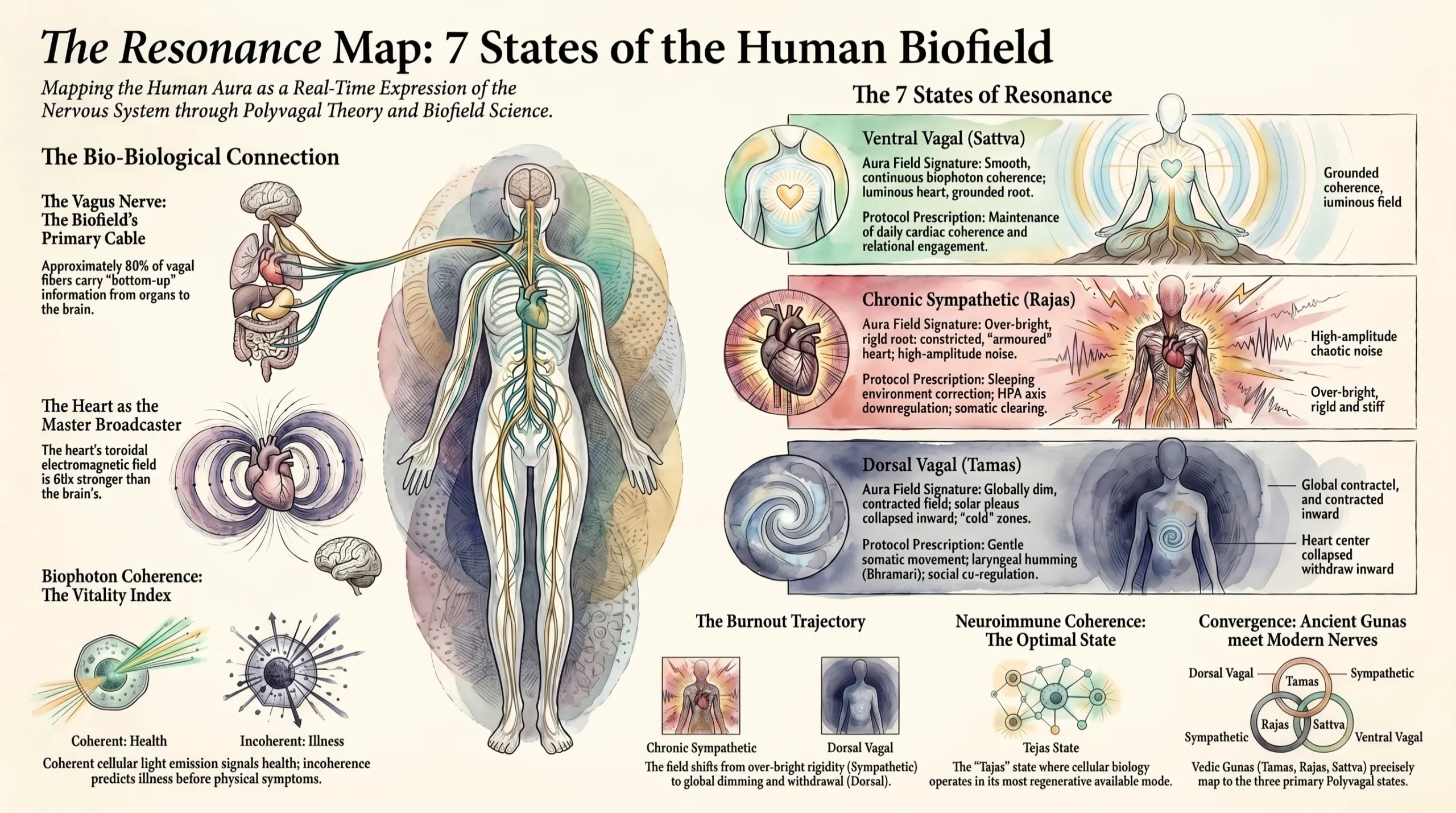
The polyvagal framework’s value for the Health & Vitality reading is its specificity. Not all forms of field decoherence are the same. The chronic sympathetic dominance pattern and the dorsal vagal freeze pattern produce superficially similar presentations in a clinical conversation — both produce fatigue, reduced engagement, and diminished quality of life — but their field signatures are entirely different, their restoration protocols are different in both sequence and content, and applying the wrong protocol to the wrong state produces further depletion rather than restoration. The Vedic tradition’s Tamas-Rajas-Sattva framework is the most concise available description of this three-state organisation: Rajas corresponds to the sympathetic mobilisation state, Tamas to the dorsal freeze state, and Sattva to the ventral vagal’s coherent baseline. The polyvagal framework adds the clinical precision that distinguishes the blended states and identifies the specific transition pathways between them.
Seven Nervous System States – Polyvagal Neuroscience, Aura Field Signature, Reading Indicator, and Protocol Response:
Nervous System State (Polyvagal Framework) | The Neuroscience: What Is Happening in the Nervous System | The Corresponding Aura Field Signature in Each Zone | The Health & Vitality Reading Indicator | What the Five-Stage Protocol Prescribes to Restore This State |
Ventral vagal: safe and social — the baseline coherent nervous system state | The ventral vagal complex (myelinated vagus nerve, facial muscles, middle-ear ossicles, larynx, pharynx) is engaged. Heart rate is steady and variable (high HRV). The social engagement system is active: facial expressiveness, prosodic voice tone, capacity to hear human speech in the presence of background noise. Cortisol is at its natural circadian baseline. Immune regulation is balanced. Oxytocin is available. The body is in its recovery and growth mode. | The entire zone network shows smooth, well-organised biophoton coherence with zone-to-zone coherence continuity. The heart zone (Anahata) is luminous and open. The throat zone (Vishuddha) is clear and resonant. The crown and third-eye zones are alert and receptive without strain. The root and sacral zones are grounded and easeful without rigidity. The solar plexus zone is quietly confident without effortful assertion. The overall field impression is of a system at home in itself. | This is the target state that all five stages of the Health & Vitality protocol are working toward: the full ventral vagal coherent field whose self-reinforcing stability — once established — progressively consolidates the zone network’s coherence across the circadian cycle, the weekly rhythm, and the seasonal rhythm. When the reading identifies a client whose field is predominantly in this state, the protocol focuses on consolidation and the specific practices that maintain coherence through the chronic stressors of the client’s life context. | Stage 4 and 5 consolidation practices: HRV coherence maintenance training (sustaining ventral vagal dominance through daily cardiac coherence practice); the three-tone pranayama protocol (Nadi Shodhana, Bhramari, and Udgeeth in sequence — each targeting a different dimension of the social engagement system’s field coherence); bhakti and satsang as relational ventral vagal field maintenance (the social engagement system’s coherence is maintained and elevated through loving relational engagement); the Shabbat-equivalent weekly restoration practice calibrated to the constitutional field type. |
Ventral-sympathetic blend: mobilised coherence — the high-performance state | Sympathetic activation is present but co-regulated by the ventral vagal system. Heart rate is elevated with preserved HRV variability. Cortisol and adrenaline are elevated but not dominating the regulatory loop. The prefrontal cortex remains engaged. The immune system is temporarily downregulated for performance but not chronically suppressed. The body is in its peak mobilisation mode with the ventral vagal’s recovery capacity intact. | The zone network shows elevated amplitude with preserved coherence. The solar plexus and root zones are bright and assertive. The throat and crown zones are forward-directed and purposeful. The heart zone maintains its coherence as the field’s stabilising centre despite the sympathetic arousal. The overall field impression is of a system in full confident motion — the Sattvic-active field quality rather than the Rajasic-driven field quality. | This state is the appropriate context for Career & Purpose ambitions, creative launches, and high-stakes professional performance. The reading distinguishes this state from the chronic sympathetic activation state that depletes it: the preserved heart zone coherence and the elevated-but-variable HRV are the key field indicators. The protocol’s goal is not to reduce this state but to ensure that the recovery capacity (Stage 2’s mitochondrial vitality and Stage 1’s circadian foundation) is sufficient to sustain it without depletion. | Stage 2 vitality support: constitutional pranayama for mitochondrial quantum coherence (ensuring the ATP supply for sustained mobilised coherence); Ashwagandha adaptogen for cortisol normalisation within the sympathetic activation range; Stage 1 environmental correction for the nightly circadian quantum restoration that enables the next day’s ventral-sympathetic mobilisation without cumulative HPA depletion; performance pranayama (Kapalabhati for the pre-performance sympathetic field activation that preserves ventral vagal co-regulation). |
Chronic sympathetic dominance: the sustained fight-flight state — the most common urban professional pattern | The sympathetic nervous system is chronically dominant without adequate recovery intervals. HRV is reduced and rigid (low HRV coherence). Cortisol is elevated across the circadian cycle, disrupting the natural morning peak-evening trough rhythm. The amygdala’s threat-detection sensitivity is upregulated. The prefrontal cortex’s executive function is progressively impaired by chronic cortisol. The immune system is chronically suppressed. The gut microbiome is disrupted by sustained sympathetic tone. The vascular endothelium is under chronic inflammatory load. | The root zone is persistently over-bright and rigid — high amplitude without coherence, a driven, compulsive quality rather than the grounded rootedness of ventral vagal health. The solar plexus zone is enlarged and tense. The heart zone shows the specific decoherence pattern of the emotional body’s chronic suppression under performance pressure: a constricted, armoured quality rather than the luminous openness of the ventral vagal state. The crown and third-eye zones show a driven brightness that is directed rather than receptive. The field’s overall impression is of a system at war with its own restorative requirements. | This is the most common presenting field pattern in my practice across urban professionals in Mumbai, Delhi, Bangalore, Hyderabad, and Pune: the field that reads as driven, productive, and apparently well-functioning by conventional metrics while the HRV coherence, the heart zone’s constriction, and the root zone’s rigidity signal the chronic depletion trajectory that will eventually produce the burnout, the cardiovascular vulnerability, or the immune breakdown that brings the client to the Health & Vitality reading. | Stage 1 (priority): sleeping environment quantum correction for the circadian cortisol rhythm restoration that chronic sympathetic dominance disrupts; Stage 2: Ashwagandha and Shatavari for HPA axis downregulation; Stage 3: somatic emotional clearing for the suppressed emotional body’s contribution to the chronic sympathetic loading; cardiac HRV coherence training (HeartMath protocol) as the most directly targeted single intervention for chronic sympathetic dominance; Nadi Shodhana pranayama twice daily as the parasympathetic activation anchor; mandatory minimum sleep quantity (Stage 1 prescription). |
Dorsal vagal freeze: the shutdown state — the most underrecognised pattern in the aura field | The dorsal vagal complex (unmyelinated vagus nerve) produces a global shutdown of the nervous system’s mobilisation capacity. Heart rate slows and becomes rigid (very low HRV). Metabolism slows. The digestive system may be dysregulated (irritable bowel, bloating, sluggish motility). Blood pressure may be low. The individual may experience dissociation, emotional numbness, cognitive fog, and a pervasive sense of meaninglessness. The freeze state is the nervous system’s most ancient survival response to inescapable threat. | The zone network shows a globally depleted, dim, contracted field — the biophoton coherence is present but low in amplitude and faintly organised, as if the system has withdrawn its field investment from the periphery to concentrate its remaining vitality in the core. The root and sacral zones are contracted and cold. The solar plexus zone is collapsed inward. The heart zone is withdrawn, defended, and barely visible compared to its ventral vagal luminosity. The throat and crown zones are dim and unresponsive. The overall field impression is of a system that has given up its expansive engagement with life. | The freeze state’s field signature is the one most commonly misread as laziness, lack of motivation, depression, or spiritual bypassing by both the client and those close to them. The aura reading’s most important contribution for this pattern is its correct identification: this is not a character failing or a spiritual deficiency. It is a nervous system state with a specific field signature, a specific causal history (typically trauma, chronic helplessness, or prolonged inescapable stress), and a specific restoration sequence that is quite different from the sympathetic dominance protocol. | The freeze restoration sequence is the most careful in the entire protocol and must proceed gently from the bottom of the polyvagal hierarchy upward: Stage 1 environmental safety (the field cannot emerge from freeze in an unsafe environment — sleeping environment correction, daily sunlight contact, and natural rhythm restoration come first); gentle somatic movement practices (walking, gentle yoga, swimming) before pranayama intensification; social engagement system activation through face-to-face relational contact (the ventral vagal’s myelinated vagus requires relational co-regulation to emerge from dorsal freeze); Bhramari humming as the single most neurologically targeted freeze-exit pranayama; trauma-informed ancestral clearing only after the Stage 1-2 foundation is stable. |
Ventral-dorsal blend: the meditative deep rest state | The ventral vagal system and the dorsal vagal system are simultaneously engaged in a co-regulated state that produces the most restorative available condition without full shutdown. Heart rate slows pleasantly. HRV deepens. The body’s metabolic rate reduces (similar to deep sleep without the unconsciousness). The immune system’s repair processes are maximally active. The brain’s default mode network shifts toward integrative processing. This is the neurological correlate of deep meditation and yoga nidra. | The zone network shows a deeply coherent, inwardly luminous field — the biophoton amplitude is lower than in the ventral-sympathetic mobilised state but its coherence quality is higher: each zone’s internal organisation is precise and deeply settled, with zone-to-zone coherence continuity of the highest available quality. The heart zone is expansive, deep, and softly luminous. The crown zone is open and receptive rather than directed. The root zone is grounded and completely at ease. The overall field impression is of a system in its deepest available restoration. | This state is the target of Stage 4’s yoga nidra prescription and the delta wave sleep optimisation protocol. It is the state in which the Ornish programme’s 48-gene expression changes (PNAS 2013) are most accessible: the nightly epigenetic maintenance cycle, the immune repair cascade, the mitochondrial quality control cycle, and the DNA repair pathway activation all operate most effectively in this ventral-dorsal blend state. The reading identifies whether the client’s daily practice and sleep architecture provide sufficient access to this state. | Stage 4 yoga nidra: the specific yoga nidra sequence calibrated to the client’s dominant nervous system state and constitutional field type — each phase of the yoga nidra sequence (rotation of consciousness, pairs of opposites, sankalpa, visualisation) engages a different dimension of the ventral-dorsal blend’s neuroscience; Stage 1 delta wave sleep optimisation through the environmental correction that enables the deepest sleep architecture; the progressive muscle relaxation technique as the yoga nidra entry-point for clients whose chronic sympathetic dominance prevents direct access to the ventral-dorsal blend without somatic preparation. |
Polyvagal dysregulation: rapid cycling between states without stable baseline | The nervous system oscillates rapidly between sympathetic activation, ventral vagal engagement, and dorsal vagal withdrawal without achieving stable dwell time in any state. HRV is chaotic rather than simply low or high. The cortisol rhythm is disrupted and erratic. The individual may experience this as emotional volatility, unpredictable energy, inexplicable fatigue following periods of high performance, and difficulty maintaining consistent mood or motivation. The autonomic nervous system’s coherence is disrupted at the regulatory level. | The zone network shows a highly variable, inconsistently organised field: some zones brighter and some dims, the pattern changing significantly across readings taken at different times of day or during different emotional states. The heart zone cycles between openness and constriction rapidly. The root zone oscillates between rigidity and collapse. The solar plexus zone shows erratic amplitude fluctuations. The field’s inter-zone coherence continuity is absent or inconsistent — the zones are not organising as a coherent network but as a collection of semi-independent field compartments. | Polyvagal dysregulation is the field pattern most associated with the combination of childhood developmental trauma, highly demanding adult environments, and insufficient nervous system repair time. It is the field pattern I most commonly see in the highly intelligent, highly driven professional from Bangalore or Delhi who is functioning at a high level externally while experiencing a persistent, inexplicable quality of inner fragmentation that neither productivity nor achievement resolves. | The dysregulation protocol prioritises rhythm restoration above all interventions: the same practices at the same times each day, creating a predictable nervous system rhythm that the autonomic system can begin to organise around; Stage 1 environmental correction for the circadian anchoring that polyvagal dysregulation has lost; HRV biofeedback training as the most direct available nervous system coherence restoration tool; Nadi Shodhana at consistent times (not just when dysregulated) as the daily rhythm anchor; somatic movement before all sitting practices to resolve the body’s sympathetic-dorsal cycling before asking the nervous system to achieve stillness. |
Neuroimmune coherence: the optimal state beyond baseline — the field’s highest available health configuration | This is the state beyond mere absence of dysregulation: the nervous system’s autonomic balance is so consistently maintained at the ventral vagal baseline that the downstream neuroimmune, neuroendocrine, and neurocardiac systems all operate in their highest available configuration. Natural killer cell activity is elevated. Anti-inflammatory cytokines (IL-10) predominate. DHEA-to-cortisol ratio is optimal. Telomerase activity is elevated. BDNF promotes neural plasticity. The individual in this state does not merely feel well. Their cellular biology is in its most regenerative available mode. | The zone network in neuroimmune coherence shows the field’s most elevated available expression: all seven zones are coherent and individually well-organised; inter-zone coherence continuity is strong and smooth; the field’s amplitude is abundant without agitation; the heart zone is fully luminous and expansive; the crown zone is open and receptive to the universal field; the entire field radiates the quality that the Vedic tradition describes as Tejas — luminous vital radiance — distinct from the merely healthy field in the same way that deep physical fitness is distinct from the absence of disease. | The neuroimmune coherence state is the goal of the Health & Vitality reading’s complete five-stage protocol — not a theoretical aspiration but a practically achievable field state whose biological markers are measurable (Blackburn’s telomerase, Ornish’s 48-gene expression, HeartMath’s HRV coherence score, Kox et al.’s IL-10 elevation) and whose field signature is distinctly readable. The reading identifies the specific stages and practices required to move the individual’s current field configuration toward this state. | The complete five-stage protocol applied in sequence: each stage’s foundation enabling the next stage’s intervention to reach deeper. The neuroimmune coherence state is not achievable by addressing Stage 5 first — the causal body’s samskara clearing produces the deepest available field transformation only when the Stage 1 circadian quantum foundation and the Stage 2 mitochondrial vitality and the Stage 3 emotional body clearing have prepared the nervous system’s capacity to sustain the elevated coherence that Stage 5’s transformation requires. The sequence is the biology. |
The dorsal vagal freeze row deserves special emphasis because it is the most under-identified pattern in the Health & Vitality reading’s clinical context. The frozen state’s field signature — global amplitude reduction, contracted zones, heart zone withdrawal — is superficially similar to the exhausted sympathetic system’s late burnout presentation. The critical clinical distinction is in the solar plexus zone’s quality and the root zone’s texture: in sympathetic burnout, the solar plexus is depleted but retains its outward orientation; in dorsal freeze, it has collapsed inward. In sympathetic burnout, the root zone is still reaching toward the earth even in its depletion; in dorsal freeze, the root zone has retracted its earth connection entirely. Getting this distinction right is not merely important for the reading’s accuracy. It is essential for the protocol’s safety: applying the Kapalabhati sympathetic activation protocol to a client whose field is in dorsal freeze produces a further dysregulation rather than a restoration.
The neuroimmune coherence row is the one that most consistently surprises clients who arrive expecting the reading to diagnose a problem. When the reading identifies a field that is already in or approaching the neuroimmune coherence state, the reading’s value is not diagnosis but consolidation: naming the practices that are working, identifying the specific remaining vulnerabilities to coherence disruption, and prescribing the Stage 4 and 5 practices that can elevate the field beyond its current level toward its highest available configuration. The Vedic tradition’s description of Tejas — the luminous vital radiance that characterises the spiritually developed practitioner’s field — is the subjective description of what the neuroimmune coherence state feels like from the inside. It is distinguishable from the merely healthy field in the same way that deep physical fitness is distinguishable from the absence of disease.
What Are the Aura Zone Patterns of Nine Specific Nervous System Conditions?
I want to name explicitly what this table represents and what it does not. It maps the aura zone patterns that I observe in the Health & Vitality reading when clients describe or present with these nervous system conditions — drawn from more than 1,000 readings across eight years of practice. It does not represent a diagnostic claim that the aura reading can diagnose these conditions in the clinical medical sense, which it cannot and does not. It represents the pattern-recognition dimension of the reading’s clinical contribution: the practitioner’s identification of the field-level pattern whose characteristics suggest a specific nervous system state, presented alongside the client’s own report and the reading’s broader field assessment, as a contribution to the client’s self-understanding and their informed navigation of when to prioritise aura field restoration practices and when to additionally seek conventional medical assessment.
Nine Nervous System Conditions – Neurological Mechanism, Aura Zone Pattern, Field Evidence Base, and Protocol Response:
Nervous System Condition | The Primary Neurological Mechanism | The Aura Zone Pattern the Reading Identifies | The Biophoton / Bioelectromagnetic Field Evidence | What the Health & Vitality Protocol Offers for This Pattern |
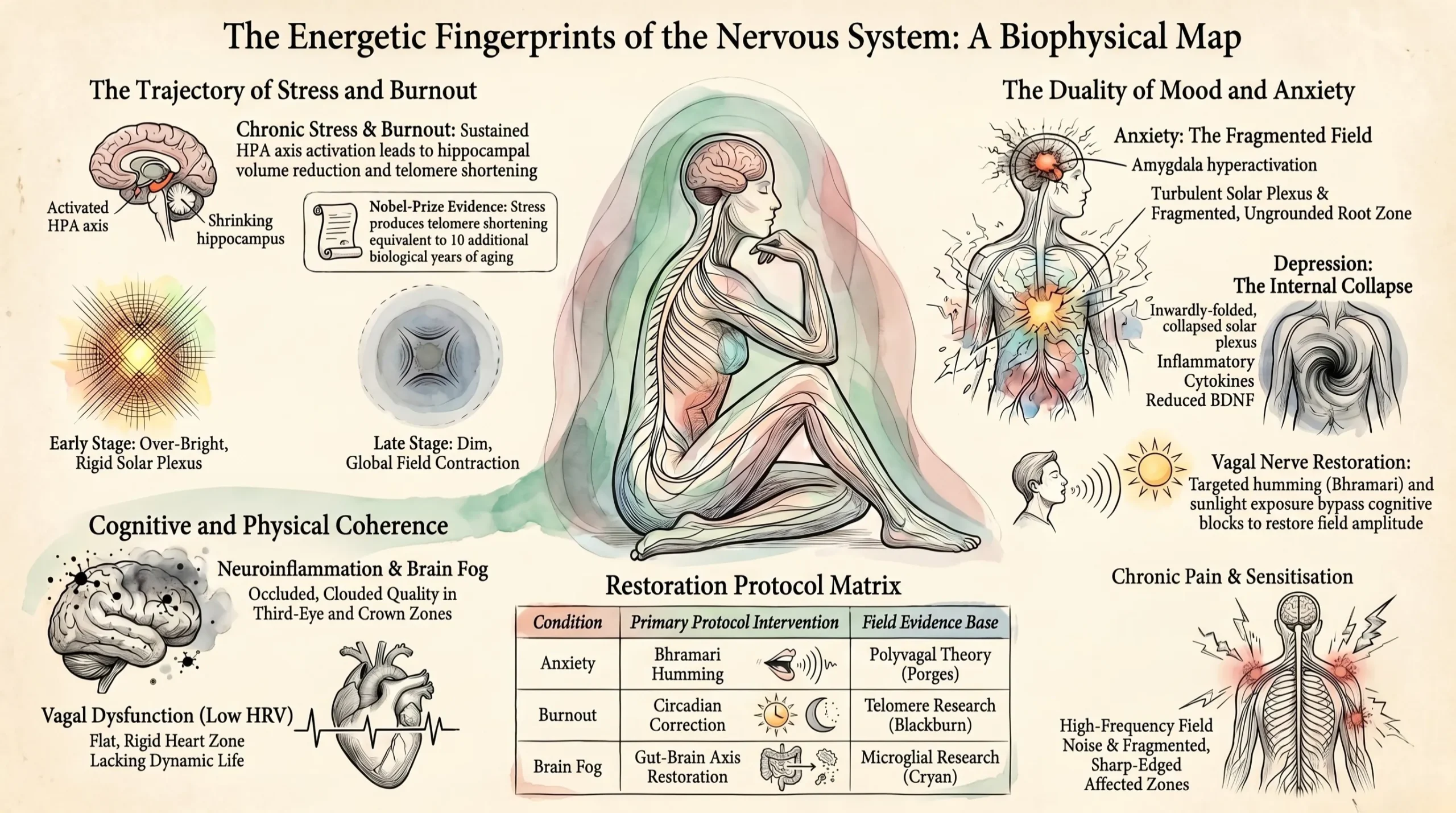
Chronic stress and burnout | Sustained HPA axis activation producing chronic cortisol elevation, adrenal fatigue (HPA hyporesponse in late-stage burnout), hippocampal volume reduction, prefrontal cortex executive impairment, and telomere shortening (Blackburn, Epel). The transition from high-cortisol sympathetic dominance to low-cortisol dorsal freeze is the burnout trajectory’s characteristic progression. | Early burnout: root and solar plexus zones over-bright and rigid with heart zone decoherence. Late burnout: global field amplitude reduction with all zones dim and contracted, the dorsal freeze signature described in Table 1. The transition between these two patterns is the field-level burnout trajectory: the reading can identify the stage of the progression and the urgency of intervention. | Blackburn and Epel’s Nobel-awarded research: chronic psychological stress produces measurable telomere shortening at rates equivalent to 10 additional biological years in maximally stressed caregivers. HeartMath’s HRV coherence research: burnout produces specific HRV pattern changes (rigid low-frequency dominance) distinguishable from healthy sympathetic activation by coherence analysis. Popp’s biophoton research: the stressed organism’s biophoton field loses coherence before the stress-associated biological changes reach measurable marker thresholds. | The burnout protocol sequenced by stage: early burnout prioritises the sympathetic downregulation protocol (Stage 1 circadian correction, Ashwagandha, Nadi Shodhana twice daily, mandatory sleep floor); late burnout requires the freeze restoration sequence from Table 1 (gentle somatic movement first, Bhramari humming, social engagement system activation) before pranayama intensification. The reading’s burnout stage identification determines the protocol entry point: the wrong entry point applied at the wrong stage produces further depletion rather than restoration. |
Anxiety disorders (generalised anxiety, panic disorder) | Amygdala hyperactivation with reduced prefrontal cortex regulatory capacity. The threat-detection system’s sensitivity is upregulated beyond adaptive levels. The HPA axis is in sustained sub-threshold activation. Interoception (the body’s internal state sensing) is dysregulated: the anxious individual’s bodily sensations are over-amplified and misread as threat signals. The autonomic nervous system’s sympathetic branch is chronically primed. | The anxiety field pattern is distinct from the simple sympathetic dominance pattern: the root zone is not merely over-bright but fragmented — the coherence is disrupted rather than merely elevated. The solar plexus zone shows a specific anxious quality distinct from the assertive brightness of healthy sympathetic activation: it is turbulent rather than directed, high-amplitude but spatially disorganised. The crown and third-eye zones show a tight, contracted quality of vigilant monitoring rather than receptive openness. | Porges’ Polyvagal Theory: anxiety disorders represent a ventral vagal regulatory failure in which the social engagement system cannot sufficiently co-regulate the sympathetic branch’s activation, allowing the amygdala’s threat detection to dominate consciousness. Brown and Gerbarg (Journal of Alternative and Complementary Medicine, 2005): Sudarshan Kriya pranayama produces significant reductions in anxiety measures with proposed vagal mechanisms; the pranayama’s slow respiratory oscillation directly activates the ventral vagal’s inhibitory tone on the sympathetic branch. | The anxiety protocol targets the ventral vagal’s regulatory capacity rather than the sympathetic arousal itself: Bhramari humming as the most neurologically targeted single vagal tone intervention; slow paced breathing (4-7-8 pranayama) at a respiratory frequency of 4-6 cycles per minute that directly drives the baroreceptor reflex’s vagal activation; the root zone grounding sequence (specific asana and earthing practice) to restore the root zone’s fragmented coherence to a grounded rather than anxious quality; the Stage 3 emotional body clearing for the suppressed emotional content that maintains the amygdala’s chronic activation. |
Depression and low mood | Reduced monoamine neurotransmitter availability (serotonin, dopamine, noradrenaline) combined with elevated inflammatory cytokines (the ‘inflammatory hypothesis of depression’), HPA axis dysregulation (either hyper- or hypo-cortisolism depending on subtype), and BDNF reduction impairing neural plasticity. The dorsal vagal freeze state and clinical depression share overlapping neurobiological mechanisms — the former is the polyvagal description of the latter’s nervous system substrate. | The depression field pattern overlaps with the dorsal freeze field signature: global amplitude reduction, heart zone withdrawal, root and sacral zone contraction. The specific depression indicator that distinguishes it from simple exhaustion is the solar plexus zone’s quality: in fatigue, the solar plexus zone is depleted but structurally intact; in the depression pattern, the solar plexus zone shows a specific internal collapse — the zone’s inward-folded quality that corresponds to the withdrawn self-relationship of the depressed state rather than the outward-collapsed quality of mere exhaustion. | Greenfield’s Human Brain (2014) and multiple meta-analyses: exercise produces antidepressant effects equivalent to SSRIs in mild-to-moderate depression through BDNF upregulation, monoamine restoration, and anti-inflammatory cytokine reduction. Kox et al. (PNAS 2014): Wim Hof method pranayama produces IL-10 (anti-inflammatory) elevation and TNF-α (pro-inflammatory) reduction — directly targeting the inflammatory depression mechanism through breath practice. The vagus nerve’s anti-inflammatory reflex (the cholinergic anti-inflammatory pathway) is the mechanistic bridge between pranayama and the inflammatory hypothesis of depression. | The depression protocol sequence: Stage 1 mandatory daily sunlight exposure (the single most evidence-based chronobiological intervention for the HPA circadian dysregulation of depression); Stage 2 aerobic movement prescription (BDNF-generating moderate aerobic activity as the biological foundation that the pranayama intervention builds upon); Kapalabhati pranayama for the sympathetic field activation that lifts the dorsal freeze toward the ventral-sympathetic mobilised state as an intermediate stage toward ventral vagal coherence; the Stage 3 somatic emotional clearing for the suppressed grief content that the inflammatory mechanism is often maintaining. |
Vagal dysfunction and low heart rate variability | Reduced vagal tone produces consistently low HRV — the cardiac field’s beat-to-beat variability — which is the single most robust cardiovascular risk predictor available (Tsuji et al., Circulation, 1994). Low vagal tone is associated with cardiovascular disease, metabolic syndrome, chronic inflammation, reduced immune regulation, and all-cause mortality risk. The vagus nerve’s role as the body’s primary anti-inflammatory reflex pathway means that low vagal tone produces systemic inflammatory dysregulation across all organ systems. | The low vagal tone field pattern shows a specific quality in the heart zone: the Anahata chakra’s field is present but its amplitude variation — the beat-to-beat field modulation that corresponds to the cardiac field’s HRV — is reduced and rigid. The field reads as flat rather than dynamically alive in the heart zone. The zone-to-zone coherence continuity is reduced, as the vagal system’s role as the inter-organ coherence network’s primary coordinator produces a general field fragmentation when the vagal tone is insufficient. | The HeartMath Institute’s extensive HRV coherence research is the most directly applicable evidence for the vagal tone-aura field relationship: the cardiac field’s coherence state encodes the vagal tone as a measurable electromagnetic field parameter. McCraty et al.’s research on HRV coherence training’s effects on immune function, cognitive performance, and emotional regulation validates the cardiac field’s central coordinating role in the aura’s zone network coherence. Tsuji et al.’s Circulation paper establishes low HRV as a mortality predictor with the same statistical power as established cardiac risk factors. | The vagal tone restoration protocol is the Health & Vitality reading’s most directly cardioprotective dimension: HeartMath HRV coherence training as the primary intervention (five to fifteen minutes twice daily of paced breathing at the resonant frequency of approximately 0.1 Hz that maximally drives baroreceptor reflex-mediated vagal activation); Bhramari humming (the vagus nerve’s laryngeal and pharyngeal branches are directly activated by the humming vibration’s stimulation of the superior and recurrent laryngeal nerve’s vagal contribution); cold water exposure to the face (the diving reflex’s vagal activation mechanism); omega-3 supplementation for vagal tone support. |
Chronic pain syndromes and central sensitisation | Central sensitisation is the nervous system’s maladaptive plasticity response to chronic pain: the dorsal horn neurons’ pain-signal processing threshold lowers progressively, producing increased sensitivity, spreading pain distribution, and pain-independent-of-peripheral-tissue-damage. The HPA axis, the sympathetic nervous system, and the inflammatory cytokine network are all co-dysregulated in central sensitisation. The social engagement system’s capacity for pain modulation through relational co-regulation is impaired. | The central sensitisation field pattern shows a specific combination of over-bright and decoherent zones corresponding to the affected body region, combined with a global field agitation — a fine, high-frequency noise quality in the biophoton field that is distinct from both the simple sympathetic over-brightness and the dorsal freeze’s dimness. The affected zones show a fragmented, sharp-edged quality. The heart zone shows the emotional body’s grief and helplessness load from the pain experience. The root and sacral zones show the fear-load of the chronic pain identity’s psychological dimension. | The neuropeptide substance P (the primary pain-signal neurotransmitter) and the endocannabinoid system’s interaction with the biophoton field has been proposed as a mechanism for the aura’s zone coherence influence on pain perception; the vagus nerve’s anti-inflammatory reflex directly reduces the cytokine-mediated peripheral sensitisation that feeds central sensitisation; Moseley and Butler’s graded motor imagery research confirms the nervous system’s pain modulation plasticity — the same plasticity that the aura’s field restoration practices engage through the nervous system’s field environment. | The chronic pain protocol addresses the central sensitisation through multiple convergent approaches: Stage 2’s pranayama for the endocannabinoid system’s pain-modulating endogenous cannabinoid production; Stage 3’s emotional body clearing for the grief and helplessness that amplify the pain signal through the emotional brain’s pain-modulation circuit; yoga nidra as the most evidence-supported mind-body pain intervention (multiple RCTs in chronic pain populations); the zone-specific mantra frequency prescription for the affected zone’s field agitation; Stage 1’s sleep restoration for the sleep deprivation’s central sensitisation amplification removal. |
Neuroinflammation and brain fog | Neuroinflammation is microglial activation — the brain’s immune cell network becoming chronically activated — producing cognitive impairment, fatigue, low mood, and systemic inflammatory symptoms. The blood-brain barrier’s integrity is compromised by chronic cortisol and inflammatory cytokines. The gut-brain axis dysregulation (leaky gut producing lipopolysaccharide endotoxin translocation into the circulation) is a primary neuroinflammation driver. The vagal anti-inflammatory reflex’s failure to regulate the microglial activation is a central mechanism. | Neuroinflammation produces a specific third-eye and crown zone field pattern: a clouded, occluded quality in the Ajna and Sahasrara zones that is distinct from the simple depletion of general fatigue. The zones are not dim — they retain some amplitude — but their internal organisation is obscured, as if the biophoton field’s coherence quality is blocked by an interfering field layer. The gut zone (below the solar plexus) shows a specific inflammatory agitation pattern that corresponds to the gut-brain axis’ neuroinflammation driver. | The gut-brain axis research (Cryan, Dinan — multiple Nature Reviews Neuroscience publications): gut microbiome dysbiosis produces neuroinflammatory changes through the vagal afferent pathway and the systemic inflammatory cytokine network. The vagus nerve’s 80% afferent composition means the gut sends far more information to the brain than the brain sends to the gut: the gut’s inflammatory state is the primary driver of the neuroinflammatory field, not the brain’s autonomous response. Pranayama’s gut motility restoration through vagal activation is the field-level mechanism for the gut-brain axis’ neuroinflammation resolution. | The neuroinflammation protocol targets the gut-brain-field axis simultaneously: Stage 2’s plant-based nutrition prescription for gut microbiome restoration (the single most evidence-based neuroinflammation intervention); Stage 2’s pranayama for the vagal activation that drives gut motility normalisation and activates the cholinergic anti-inflammatory reflex; Stage 1’s sleep restoration for the glymphatic system’s nightly neuroinflammatory clearance cycle (the glymphatic system removes neuroinflammatory debris during slow-wave sleep — Stage 1’s circadian correction enables this clearance); the third-eye zone pranayama sequence (Nadi Shodhana with extended exhale) for the crown-zone field coherence restoration. |
Sleep disorders and circadian dysregulation | Circadian rhythm disruption through irregular light exposure, shift work, geopathic stress field sleeping environment, and excessive evening artificial light produces HPA axis phase misalignment, immune rhythm disruption, and impaired glymphatic neuroinflammatory clearance. The sleep architecture’s slow-wave delta sleep proportion is reduced, impairing the nightly epigenetic maintenance cycle (DNMT activation), DNA repair (OGG1 pathway), and immune memory consolidation. | The circadian dysregulation field pattern is the most identifiable in the aura reading because it produces a specific temporal quality that distinguishes it from other field states: the zone network’s coherence appears incomplete, as if the field has not fully recharged from its nightly restoration cycle — the field equivalent of the physical body’s morning tiredness after insufficient sleep. All zones are present but their amplitude is uniformly reduced in a way that suggests a restoration deficit rather than a localised decoherence. | The cryptochrome radical pair quantum biology research (previous article) confirmed that the circadian clock’s primary light-sensing mechanism is a quantum biological process sensitive to environmental electromagnetic fields. Walker’s Why We Sleep (2017, University of California Berkeley) synthesises the most extensive available evidence for sleep’s biological functions — each function corresponding to a specific dimension of the field’s nightly restoration: slow-wave delta for DNA methylation maintenance; REM for emotional field processing; sleep spindles for memory consolidation; glymphatic activity for neuroinflammation clearance. | Stage 1 of the Health & Vitality protocol is specifically the circadian restoration protocol: sleeping environment geopathic stress field assessment and relocation if indicated; blue light elimination after sunset; consistent sleep and wake times; direct sunlight exposure within 30 minutes of waking (cortisol morning peak restoration); earthing and Schumann resonance restoration; the specific evening pranayama sequence (Bhramari and slow Nadi Shodhana) for the melatonin onset support through vagal activation’s downstream sympathetic downregulation. This single stage, consistently applied, produces the most broadly beneficial health field restoration available of any single intervention. |
Autonomic neuropathy (including diabetic and dysautonomia presentations) | The autonomic nervous system’s peripheral nerve function is impaired, disrupting the cardiac, digestive, genitourinary, and vasomotor autonomic control pathways. HRV is severely reduced or absent. Postural hypotension, gastroparesis, bladder dysfunction, and temperature dysregulation are clinical presentations. The vagal nerve’s functional integrity is compromised at the peripheral level, disrupting the anti-inflammatory, cardiac regulatory, and gut-motility functions that depend on it. | Autonomic neuropathy produces the most globally disrupted inter-zone coherence pattern in the reading: because the autonomic nervous system is the field’s primary physical coordination network, its peripheral nerve impairment disrupts the biophoton coherence continuity between zones that the intact autonomic network maintains. The field reads as a collection of partially connected zones rather than a continuously organised network. The root, sacral, and gut zones show the most acute decoherence corresponding to the neuropathy’s primary clinical locations. | The autonomic nervous system’s role as the body’s primary inter-organ coherence network makes it the physical equivalent of the nadi network’s field coordination function: the peripheral autonomic nerve fibres carry the bioelectromagnetic field signals that maintain zone-to-zone coherence continuity across the physical body’s separate organ systems. The autonomic neuropathy’s field fragmentation is the direct physical consequence of this coordination network’s impairment. | The autonomic neuropathy protocol is the most conservative and most medically deferential in the five-stage framework: this pattern always requires concurrent neurological and endocrinological medical management that the aura reading’s protocol complements but does not replace. The reading’s complementary contribution: Stage 2’s alpha-lipoic acid and B-vitamin support for peripheral nerve regeneration; the pranayama practices’ central autonomic network training (the CNS-level autonomic control that remains accessible even when peripheral autonomic nerves are impaired); yoga nidra for the field’s residual restoration capacity; Stage 1’s comprehensive lifestyle correction for the modifiable drivers of the neuropathy’s progression. |
A client from Mumbai — a forty-eight-year-old financial sector director who had managed a team through two years of pandemic-related market volatility and arrived describing a fatigue that was unlike anything in his previous twenty-year career — presented the chronic sympathetic dominance to late burnout transition pattern with unusual clarity. The reading identified the root and solar plexus zones’ over-bright rigidity in the first layer of analysis, consistent with the twelve-to-eighteen months of chronic sympathetic dominance that preceded his current state, combined with the heart zone’s beginning of the constriction pattern that marks the transition toward the late burnout’s global depletion. The crown and third-eye zones were still directing outward with the driven brightness of the high-performance sympathetic state — but their coherence quality showed the prefrontal cortex’s impairment beginning to affect the direction’s quality.
The reading identified the transition point: he was at the threshold between early and late burnout, the most critical intervention window. The early burnout protocol — Stage 1 mandatory sleep floor and circadian correction, Stage 2 Ashwagandha and cardiac HRV coherence training, Stage 3 somatic emotional clearing for the suppressed emotional body’s HPA loading — was prescribed with specific urgency because the late burnout’s dorsal freeze transition, once entered, requires a substantially longer and more careful restoration sequence. He implemented the protocol completely over twelve weeks. His HRV coherence score, measured with the HeartMath Inner Balance device he purchased at the reading’s suggestion, improved from a consistently low-coherence pattern to medium-coherence within six weeks and high-coherence within twelve. He described the reading’s contribution as giving him the specific field-level language for the trajectory he was on, making visible what the conventional medical check-up’s normal results had not: the pre-burnout depletion’s field signature that would have produced the late burnout’s full clinical presentation within another six to twelve months.
How Do the Six Evidence-Supported Restoration Practices Address the Nervous System and the Aura Simultaneously?
The practices in this table are the Health & Vitality reading’s most neurologically grounded prescriptions. They are not prescribed because the Vedic tradition recommends them, though it does. They are prescribed because the nervous system neuroscience and the aura field’s coherence assessment both converge on them as the most precisely targeted available interventions for the specific nervous system state and zone decoherence pattern the reading identifies. The Vedic tradition’s five-thousand-year observational refinement of these practices and the modern neuroscience’s mechanistic characterisation of them are complementary descriptions of the same practical reality.
Six Nervous System–Aura Restoration Practices – Neurological Mechanism, Zone Target, Vedic Name, and Evidence Base:
Practice | The Neurological Mechanism | The Aura Zone It Primarily Targets | The Vedic Tradition’s Name and Description | The Evidence Base and Why This Practice Is First-Line in the Protocol |
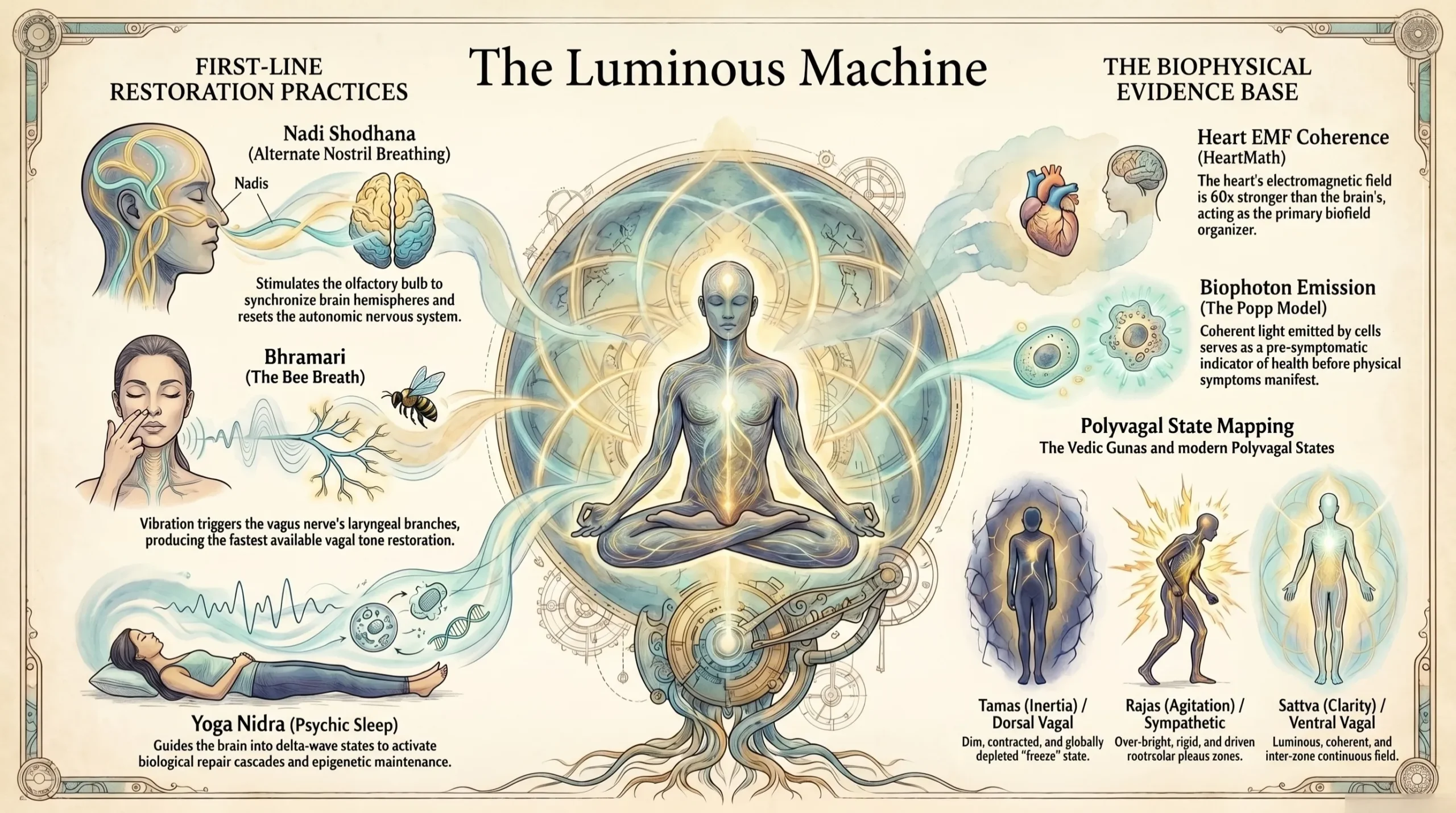
Nadi Shodhana (Alternate Nostril Breathing) | The alternating nasal airflow stimulates the contralateral hemisphere’s olfactory bulb and orbitofrontal cortex asymmetrically, producing interhemispheric synchronisation through the corpus callosum. The slow paced breathing rate (4–6 cycles per minute) drives baroreceptor reflex-mediated vagal activation. The breath retention phases activate the interoceptive awareness that restores the insula’s body-sense regulation. The rhythmic alternation resets the autonomic nervous system’s left-right sympathetic-parasympathetic oscillation cycle. | Ida and Pingala nadi channels (corresponding to the left and right autonomic nervous system branches); the third-eye zone (Ajna chakra) as the corpus callosum’s interhemispheric integration field node; the heart zone for the HRV coherence elevation produced by the resonant respiratory frequency | Nadi Shodhana Pranayama: ‘channel purification breath’ in Sanskrit. Described in the Hatha Yoga Pradipika and the Gheranda Samhita as the most fundamental pranayama practice for restoring prana flow balance between the Ida (lunar, left, parasympathetic) and Pingala (solar, right, sympathetic) nadis. The Sushumna nadi’s activation — the central channel’s prana flow — is the Vedic description of the interhemispheric synchronisation that Nadi Shodhana produces. | Telles et al. (Indian Journal of Physiology and Pharmacology, 1994): Nadi Shodhana produces significant HRV increase compared to breath awareness control. Brown and Gerbarg (Journal of Alternative and Complementary Medicine, 2005): comprehensive review of pranayama’s autonomic nervous system effects; Nadi Shodhana’s HRV elevation is among the most consistently replicated pranayama findings across independent research groups. Kamath et al. (2015): left nostril breathing activates the right hemisphere’s parasympathetic association areas. This practice is first-line because it directly addresses the autonomic imbalance that is present in all seven nervous system states listed in Table 1 except the ventral vagal baseline. |
Bhramari Humming Pranayama | The humming vibration stimulates the vagus nerve’s laryngeal branches (superior and recurrent laryngeal nerves) directly, producing the highest available non-invasive vagal tone elevation per unit time of any pranayama. Nitric oxide (NO) is released into the nasal sinuses during humming, producing vasodilation and anti-inflammatory effects. The combined effect of the vagal activation and the nasal NO release produces significant parasympathetic dominance within two to three minutes of practice. The auditory self-stimulation activates the cochlear nerve’s connection to the vagal dorsal motor nucleus. | Vishuddha (throat zone) as the practice’s primary resonance location; Anahata (heart zone) for the vagal HRV elevation’s cardiac field coherence increase; Ajna (third-eye zone) for the intracranial vibration’s direct influence on the cranial nerve network that includes the vagus | Bhramari Pranayama: ‘the bee breath’ in Sanskrit, named for the humming sound’s resemblance to the bee’s drone. Described in the Hatha Yoga Pradipika as producing the highest available bliss state (ananda) in the practitioner through the direct stimulation of the Brahmarandhra (the cranial field’s highest energy point) by the humming vibration. The Vedic tradition’s description of the humming’s bliss effect corresponds precisely to the vagal activation’s oxytocin and endorphin release that neuroscience has since documented. | Pramanik et al. (Journal of Alternative and Complementary Medicine, 2010): Bhramari pranayama produces immediate and significant blood pressure and heart rate reduction through vagal activation. Sergueef et al. (Journal of the American Osteopathic Association, 2011): humming produces a fifteen-fold increase in nasal sinus nitric oxide compared to quiet nasal breathing. Porges’ Polyvagal Theory identifies the laryngeal vagal branches as the most accessible non-invasive vagal stimulation target — making Bhramari the polyvagal theory’s most directly theoretically grounded pranayama. This is first-line for anxiety, freeze, and vagal dysfunction protocols specifically because it is the fastest available vagal tone restoration practice. |
Yoga Nidra (Psychic Sleep) | Yoga nidra systematically guides the nervous system from beta (alert) through alpha (relaxed) to theta (hypnagogic) and briefly into delta (deep sleep) wave states while maintaining meta-awareness. The theta state’s hippocampal theta rhythm activates memory consolidation and emotional processing. The delta phase activates the slow-wave sleep’s biological repair cascade: DNMT-mediated DNA methylation maintenance, OGG1 DNA repair activation, immune memory consolidation, glymphatic clearance, and melatonin-dependent nightly epigenetic restoration. Unlike sleep, yoga nidra’s maintained meta-awareness allows the conscious sankalpa (intention) to be embedded during the theta state’s heightened neuroplasticity window. | All seven zones receive the nightly coherence restoration that the ventral-dorsal blend state (described in Table 1) enables; the heart zone’s emotional field processing occurs in the theta state’s emotional memory integration phase; the crown zone receives the delta state’s deepest available field restoration; the sankalpa’s embedding during theta-state neuroplasticity is the mechanism of the causal body’s samskara-clearing function | Yoga Nidra: ‘yogic sleep’. Described in the Mandukya Upanishad’s analysis of the four states of consciousness (waking, dreaming, deep sleep, and turiya — the witness awareness). Systematised by Swami Satyananda Saraswati (Bihar School of Yoga) as the complete technique for accessing the deep sleep state’s biological restoration with maintained witness awareness. The Vedic tradition’s description of the hypnagogic threshold as the ‘doorway to the subconscious’ corresponds to the theta state’s neuroplasticity window that the sankalpa’s embedding requires. | Ferreira-Vorkapic et al. (Frontiers in Human Neuroscience, 2015): yoga nidra produces significant cortisol reduction and DHEA increase in military personnel populations. Parker et al. (Medical Hypotheses, 2010): yoga nidra’s delta state equivalence confirmed by EEG measurement and proposed as the mechanism of its restorative biological effects. The Ornish programme’s 48-gene expression changes (PNAS 2013) include yoga nidra as a component practice: the delta-state DNA methylation maintenance and OGG1 repair activation are the epigenetic mechanisms of the yoga nidra’s gene expression effects. This is first-line because it is the single practice that accesses the most biological repair mechanisms simultaneously. |
Kapalabhati (Skull-Shining Breath) | Kapalabhati’s rapid active exhalations produce a rhythmic sympathetic nervous system activation through the intrathoracic pressure oscillation’s effect on the cardiac sympathetic nerve’s afferent signalling. The practice also produces a significant metabolic alkalosis through CO₂ exhalation, which activates the carotid body’s chemoreceptors and produces an arousal response. The Wim Hof method (Kox et al., PNAS 2014) uses a mechanistically equivalent technique and produces voluntary innate immune suppression — confirming the immune modulation accessible through this class of pranayama. | Root zone and sacral zone for the sympathetic field activation that lifts the dorsal freeze state toward ventral-sympathetic mobilisation; solar plexus zone (Manipura) as the Vedic tradition’s seat of Agni (digestive and metabolic fire) whose activation Kapalabhati directly stimulates; crown zone for the metabolic alkalosis’s cerebral vasodilation effect on the prefrontal cortex’s activation | Kapalabhati Pranayama: ‘skull-shining breath’ or ‘skull-brightening breath’ in Sanskrit, named for the traditional description of the practice’s purifying effect on the brain and sinuses. Classified in the Hatha Yoga Pradipika as a kriya (cleansing practice) rather than a pranayama, indicating its role as a preparatory field-clearing practice before the more refined pranayama techniques. The Vedic tradition’s description of Kapalabhati as an Agni-stimulating practice corresponds precisely to the sympathetic activation and metabolic stimulation that neuroscience documents. | Kox et al. (PNAS 2014): the Wim Hof method’s mechanistically equivalent breath technique produces voluntary suppression of the innate immune inflammatory response in a randomised controlled trial (p < 0.001) — the most dramatic single pranayama-class evidence in the literature. Telles et al. (Alternative Therapies in Health and Medicine, 2011): Kapalabhati produces significant autonomic and respiratory changes consistent with sympathetic activation. This is first-line for depression and freeze protocols specifically because it activates the sympathetic field’s mobilisation from the dorsal freeze state as the necessary intermediate step toward ventral vagal coherence recovery. |
Slow paced breathing and the resonant frequency protocol (0.1 Hz, 4–6 breaths per minute) | Breathing at 4 to 6 cycles per minute (the cardiac autonomic resonant frequency identified by Lehrer and Vaschillo) maximally drives the baroreceptor reflex’s vagal activation: at this specific frequency, each inhalation’s sympathetic activation and each exhalation’s parasympathetic activation are in phase with the baroreflex’s natural oscillation period, producing the maximum available vagal tone increase per breath cycle. This is the HeartMath coherent breathing protocol’s physiological mechanism. HRV coherence increases by 300-500% during the resonant frequency practice compared to normal breathing. | Anahata (heart zone) as the primary target: the cardiac field’s HRV coherence elevation is the most directly measurable field change produced by this practice; the vagal activation’s downstream effects on all organ systems produce a generalised field coherence elevation across all zones corresponding to the vagus nerve’s organ-specific innervation | Pranayama as the general category; the specific 4-6 breath per minute practice corresponds most closely to the Vedic tradition’s description of the ‘Samavritti’ (equal-ratio) pranayama and the ‘Puraka-Kumbhaka-Rechaka’ (inhale-hold-exhale) cycle practised at the rate that the practitioner’s constitution and current state most naturally sustains. The HeartMath coherent breathing protocol is the most precisely neurologically characterised version of the resonant frequency practice, but its mechanism is the Vedic slow pranayama’s. | HeartMath Institute: multiple randomised controlled publications confirming HRV coherence training’s immune function improvement, cognitive performance enhancement, and emotional regulation improvement. McCraty et al. (American Journal of Cardiology, 1995): the cardiac coherence protocol produces IgA (immune antibody) elevation within six weeks of daily practice. Lehrer and Vaschillo (Applied Psychophysiology and Biofeedback, 2000): the resonant frequency identification and its maximal HRV amplification confirmed. This is first-line for vagal dysfunction, chronic sympathetic dominance, and cardiovascular risk protocols because HRV is the single most robust available biomarker of the practice’s field restoration effect — providing the client with measurable outcome confirmation. |
Earthing and Schumann resonance restoration | Direct physical contact with the Earth’s surface transfers free electrons to the body’s bioelectrical field, normalising the body’s electrical potential to the Earth’s reference potential (the Schumann resonance frequency of 7.83 Hz). The electron transfer reduces the body’s accumulated positive charge (from environmental EMF exposure and insulation from the Earth), which is correlated with reduced zeta potential of blood cells (producing blood viscosity reduction) and reduced inflammatory cytokine levels (through antioxidant electron donation to reactive oxygen species). | Root zone (Muladhara chakra) as the primary grounding field target corresponding to the Earth connection’s field restoration; the entire zone network’s baseline coherence normalisation as the bioelectric potential restoration resets the field’s reference frequency to the Schumann resonance’s 7.83 Hz — the field’s evolutionary baseline that all zones are calibrated to when unperturbed | Prithvi dharana: ‘Earth element contemplation’ in the Vedic tradition. The root zone’s Muladhara chakra is explicitly the Earth element’s field node — its coherence is directly dependent on the individual’s conscious connection to the Earth’s field. The Vedic tradition’s prescription of bare-foot walking on natural ground, sitting directly on the earth during practice, and sleeping close to the earth level are all applications of the earthing mechanism that modern bioelectric research has now confirmed physiologically. | Ober, Sinatra, Zucker (Earthing, 2010): randomised controlled earthing experiments confirming cortisol circadian rhythm normalisation, inflammatory cytokine reduction, pain reduction, and sleep quality improvement. Chevalier et al. (Journal of Environmental and Public Health, 2012): comprehensive earthing review confirming blood viscosity reduction, inflammatory marker reduction, and autonomic nervous system normalisation. This is first-line in Stage 1 specifically because it addresses the most upstream available nervous system restoration intervention: restoring the body’s bioelectric reference potential to the Earth’s baseline frequency before any more specific interventions are applied. |
The earthing row is the one that most consistently produces sceptical responses from the urban professional audience of my practice — and the one whose evidence is most directly applicable to the specific environmental health challenge of urban Indian professional life. The urban professional in Mumbai’s high-rise apartment or Bangalore’s tech campus office spends their entire working day electrically insulated from the Earth’s surface by rubber-soled shoes, elevated floors, and synthetic floor coverings. The Ober et al. randomised controlled research is not a marginal or speculative finding. It is a published, peer-reviewed confirmation that this insulation from the Earth’s surface produces measurable inflammatory, cardiovascular, and autonomic consequences — and that restoring the Earth contact through fifteen to thirty minutes of direct skin contact with natural ground per day reverses those consequences in measurable ways. The root zone’s coherence restoration through earthing is the aura reading’s description of the same biological restoration that the earthing research documents.
The Bhramari row is the most immediately accessible of the six for the client who wants a single practice to begin with. Bhramari requires no special equipment, no specific environment, and no prior training. Two to three minutes of humming produces measurable heart rate and blood pressure reduction within the session. The nasal nitric oxide release’s vasodilatory and anti-inflammatory effects begin immediately. And the throat zone’s field response to the humming vibration is among the most immediate and most perceptible subjective changes available from any single pranayama practice — making it the reading’s most frequently prescribed single starting practice for clients whose throat zone decoherence is the primary presenting pattern.
How Does the Polyvagal Theory Confirm the Vedic Tradition’s Tamas-Rajas-Sattva Framework?
The practical implication of this convergence for the Health & Vitality reading’s protocol is significant. The Vedic tradition has developed a five-thousand-year library of practices specifically designed to shift the field from Tamasic and Rajasic states toward the Sattvic baseline — exactly the three-state transition that polyvagal neuroscience is now characterising mechanistically. The pranayama practices, the dietary prescriptions, the sleep recommendations, the community practices, and the contemplative disciplines of the Vedic tradition are not random assemblages of traditional wisdom. They are a systematically tested protocol for nervous system state management that predates the neuroscience by fifty centuries.
The Three-State Correspondence in Detail:
- Tamas – Dorsal Vagal Freeze: The Vedic tradition describes Tamas as the guna of inertia, heaviness, darkness, and the contracted withdrawal from life’s engagement. The Tamasic field’s specific qualities — dim, contracted, withdrawn, cold, unresponsive — are the precise subjective description of the dorsal vagal freeze state’s biophoton field signature. The Vedic prescription for Tamas is always activation before refinement: Kapalabhati, vigorous physical movement, sunlight, warmth, spicy food, stimulating company — all practices that shift the nervous system from dorsal freeze toward sympathetic activation as the necessary intermediate step toward the ventral vagal coherent baseline. The polyvagal framework’s freeze-to-mobilisation-to-safe transition sequence is the neuroscientific description of the Vedic tradition’s Tamas-to-Rajas-to-Sattva transformation path.
- Rajas – Sympathetic Mobilisation: The Vedic tradition describes Rajas as the guna of agitation, driven activity, heat, ambition, and the restless reaching after objects of desire. The Rajasic field’s specific qualities — over-bright, rigid, driven, hot, compulsive — are the precise subjective description of the chronic sympathetic dominance state’s biophoton field signature. The Vedic prescription for Rajas is always parasympathetic downregulation: slow pranayama, cooling diet, reduced stimulation, meditation, contemplative practice — all practices that shift the nervous system from chronic sympathetic dominance toward the ventral vagal’s parasympathetically balanced coherent baseline. The polyvagal framework’s chronic sympathetic to ventral vagal transition is the neuroscientific description of the Vedic tradition’s Rajas-to-Sattva transformation path.
- Sattva – Ventral Vagal Coherence: The Vedic tradition describes Sattva as the guna of clarity, luminosity, balance, lightness, and the naturally coherent field of the individual who is neither frozen nor agitated but fully present. The Sattvic field’s specific qualities — smooth, luminous, coherent, dynamically alive, inter-zone continuous — are the precise subjective description of the ventral vagal safe-and-social state’s biophoton field signature. The Vedic prescription for Sattvic cultivation is the maintenance practice rather than the corrective practice: the sattva-maintaining disciplines that preserve the coherent baseline against the Tamasic and Rajasic pulls of the daily life context. The polyvagal framework’s ventral vagal coherence maintenance practices are the neuroscientific description of the Vedic tradition’s Sattva cultivation disciplines.
Are You Ready for the Nervous System–Grounded Health and Vitality Reading?
Namaste, my friend — if this article has mapped the connection between your aura’s field and your nervous system with sufficient precision that you now understand why the Health & Vitality reading’s five-stage protocol addresses the autonomic nervous system’s state before any organ-specific zone, and why the sequence of the protocol is as important as its content — you are ready to receive the reading’s contribution at its deepest available level.
The Health & Vitality reading identifies your specific nervous system state from its field signature, maps the zone-specific consequences of that state across all seven zones, and prescribes the specific sequence of practices most precisely calibrated to your nervous system’s current configuration and the restoration pathway it requires. Not a generic wellness plan. A field-specific nervous system restoration protocol, derived from the most precise available reading of your own field’s current state.
Using our patented photo-scanning technology and Multiple Advanced Gadgets. Drawing on eight years of practice and 1,000+ readings across India. With our money-back guarantee.
Three Steps to Your Nervous System–Grounded Health and Vitality Reading:
- Submit Photo – Upload a recent, clear photograph of yourself. Your complete nervous system state, its zone-specific field consequences, and the five-stage restoration sequence your field requires are all accessible through our patented photo-scanning technology and Multiple Advanced Gadgets.
- Expert Analysis – I personally decode your complete Health & Vitality aura field, identifying your specific polyvagal state from its field signature, mapping all nine nervous system pattern indicators, and prescribing the specific six-practice restoration sequence most precisely calibrated to your current nervous system configuration.
- Transform – Receive your personalised Health & Vitality Aura Guide — polyvagal state field assessment, all seven zones mapped, nervous system–specific restoration protocol, six evidence-based practices calibrated to your field, and circadian quantum restoration foundation — delivered within 24–48 hours with our money-back guarantee.
⚠️ Disclaimer: Aura analysis and energetic guidance are for personal growth and awareness only. They are not a substitute for professional medical, financial, legal, or psychological advice. Please consult qualified professionals for any health or financial concerns.
Q1: What is the connection between the aura and the nervous system?
The aura’s field is generated and coordinated by the nervous system through three primary mechanisms: the heart’s cardiac electromagnetic field (extending two to three metres beyond the body, encoding the autonomic nervous system’s HRV coherence state); the brain’s neural electromagnetic field (whose frequency patterns encode the consciousness state); and the body’s biophoton emission field (whose spatial organisation and coherence quality are directly modulated by the autonomic nervous system’s regulatory state). The vagus nerve is the most important single physical structure in the aura’s field generation: it coordinates the cardiac, neural, and biophoton fields as the body’s primary inter-organ bioelectromagnetic coherence network. The aura’s zone-specific coherence reflects the autonomic nervous system’s state with precise specificity.
Q2: How does Polyvagal Theory relate to aura states?
Polyvagal Theory’s three-state nervous system hierarchy — dorsal vagal freeze, sympathetic mobilisation, and ventral vagal safe-and-social — maps precisely onto the Vedic tradition’s Tamas-Rajas-Sattva three-guna framework and onto three distinguishable aura field signatures. The dorsal vagal freeze state produces the Tamasic field’s global amplitude reduction, contracted zones, and heart zone withdrawal. The chronic sympathetic state produces the Rajasic field’s over-bright rigid root and solar plexus zones with heart zone constriction. The ventral vagal safe-and-social state produces the Sattvic field’s smooth, coherent zone network with luminous heart zone and open crown. Each polyvagal state has a specific aura restoration protocol distinct from the others, making the correct state identification the most important single variable in the Health & Vitality reading’s protocol prescription.
Q3: What role does the vagus nerve play in aura health?
The vagus nerve is the aura’s most important single physical structure. Its 80% afferent composition means the body’s field is primarily a bottom-up information network — the organs sending more information to the brain than vice versa. The vagus nerve coordinates the cardiac field’s HRV coherence, the gut-brain axis’ neuroinflammatory regulation, the cholinergic anti-inflammatory reflex, the immune system’s cytokine balance, and the social engagement system’s prosodic voice tone and facial expressiveness. Low vagal tone (low HRV) is the single most robust cardiovascular risk predictor available and produces a specific aura field signature: flat, rigid heart zone with reduced inter-zone coherence continuity. The Health & Vitality reading’s six restoration practices all target vagal tone restoration as their primary mechanism.
Q4: What pranayama is most effective for nervous system and aura restoration?
Six pranayama and field practices address the nervous system and aura field simultaneously: Nadi Shodhana for interhemispheric synchronisation and baroreceptor vagal activation; Bhramari humming for direct laryngeal vagal branch stimulation and nasal nitric oxide release (the fastest available vagal tone restoration per unit time of any pranayama); yoga nidra for delta-theta state restoration and epigenetic repair activation; Kapalabhati for sympathetic field activation from dorsal freeze; slow paced breathing at 0.1 Hz for maximum baroreceptor vagal activation and HRV coherence elevation; and earthing for bioelectric potential normalisation to the Earth’s Schumann resonance baseline. The correct practice for each individual depends on their specific polyvagal state: applying Kapalabhati to a dorsal freeze state produces further dysregulation, not restoration.
Q5: How does the Tamas-Rajas-Sattva framework correspond to modern neuroscience?
The Vedic tradition’s three-guna framework corresponds precisely to Polyvagal Theory’s three nervous system states: Tamas (inertia, contraction, darkness) maps onto the dorsal vagal freeze state’s global field contraction and metabolic slowdown; Rajas (agitation, driven activity, heat) maps onto the chronic sympathetic mobilisation state’s driven arousal and HPA axis activation; and Sattva (clarity, luminosity, coherent balance) maps onto the ventral vagal safe-and-social state’s high HRV coherence and neuroimmune balance. The Vedic tradition arrived at this three-state characterisation through five thousand years of systematic inner observation; Porges’ Polyvagal Theory arrived through thirty years of autonomic neuroscience. Their convergence on the same three-state organisation using entirely different investigative methods constitutes one of the strongest cross-paradigm validations of the Vedic tradition’s observational framework.