What Are the Ethical Considerations in Aura Research? 10 Principles | Aura Photo Science India
Namaste, I’m Mukesh Shah. I want to begin this article with an admission that I believe is more important than any of the scientific frameworks I have described in this series: aura research and practice has an ethics problem. Not because the field is inherently unethical. But because the combination of powerful personal relevance, limited independent verifiability, emotionally vulnerable clients, and an inadequate professional accountability structure creates conditions in which exploitation — deliberate or inadvertent — is far too easy and far too common.
In eight years of practice across more than 1,000 readings in India, I have seen the consequences of unethical aura practice at close range: the client from Chennai who had spent three years’ savings on repeated ‘curse removal’ readings from a practitioner who kept identifying new layers of darkness; the client from Delhi who had been told her aura showed she was incompatible with her husband and had ended a twenty-year marriage based on that reading alone; the client from Bangalore who had been given a cancer diagnosis through an aura reading and had delayed seeking medical care for four months while pursuing energy healing. These are not marginal cases. They are the predictable outcomes of a field operating without adequate ethical frameworks, accountability structures, or client-protection standards.
Writing about the ethics of aura research is, therefore, not a defensive exercise. It is not an attempt to protect the field from criticism by demonstrating its self-awareness. It is an attempt to build the explicit ethical framework that I believe the field requires and that clients deserve — because the genuine value that honest, well-practised aura analysis offers is undermined at every point by the unethical practice that shares its vocabulary and its cultural space.
This article maps ten core ethical principles for aura research and practice, identifies the specific vulnerabilities of the populations most likely to seek aura guidance, describes the ethical commitments that govern each of the five life areas of the Aura Life Guide Master Package, and asks — and answers honestly — the hardest ethical questions about this field. Because the client who chooses an ethical practitioner deserves to know what ethical practice looks like. And the client who has been harmed by unethical practice deserves to have their experience named and their protection advocated for.
Why Do Ethical Standards in Aura Research Matter More Than in Most Fields?
Let me be specific about each of the three structural features, because understanding them is the foundation for understanding why the ethical standards I describe in this article are not optional refinements to good practice. They are the minimum threshold below which the practice becomes a potential source of harm.
The first structural feature is non-verifiability. When a cardiologist tells you your cholesterol is high, you can ask for the blood test results, seek a second opinion, and check the measurement against published standards. When an aura practitioner tells you your heart zone is depleted, you have no independent means of verification. The reading is not falsifiable by the client. This is not a fatal limitation of aura practice — it is a structural feature that places the entire ethical burden on the practitioner’s honesty. A practitioner who is not committed to accuracy and intellectual honesty can say essentially anything without the client having the means to challenge it.
The second structural feature is vulnerability concentration. Aura practice attracts people at their most open and their most desperate: the person facing a health crisis seeking certainty and hope; the person in acute relational pain seeking connection and direction; the person in financial distress seeking the abundance shift that conscious money work alone has not produced; the person in existential crisis seeking meaning and purpose beyond what their rational frameworks have offered. These are not merely ‘interested’ clients making casual service purchases. They are people whose judgment is systematically biased by pain, hope, and the desperate desire for a map through difficulty. Ethical practice recognises this and responds with corresponding care. Unethical practice exploits it.
The third structural feature is accountability absence. Medicine has licensing boards and malpractice liability. Psychology has professional associations and clinical supervision. Even financial advice has regulatory frameworks. Aura practice, in India as in most countries, has none of these. There is no licensing board to revoke a practitioner’s authority to practice. There is no professional association with enforceable ethical standards and disciplinary procedures. There is no regulatory body investigating complaints. The only accountability mechanism available to the harmed client is the civil courts — expensive, slow, and rarely used for the kind of harm that unethical aura practice produces. This absence of external accountability makes the practitioner’s internal ethical commitment not merely one of several protective mechanisms. It is the only protective mechanism.
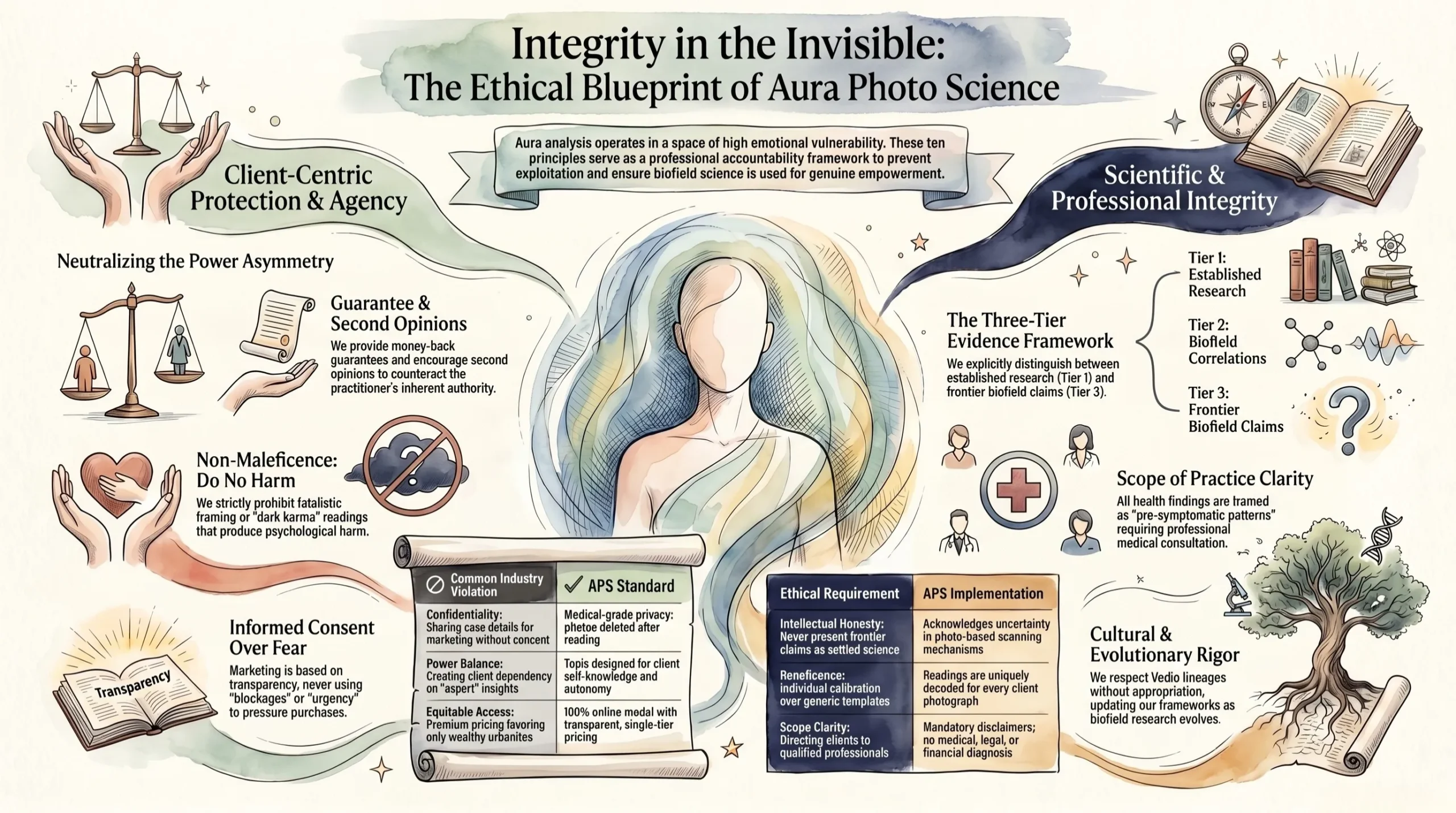
What Are the Ten Core Ethical Principles That Should Govern All Aura Research and Practice?
I want to present these ten principles not as abstract ideals but as practical standards with specific behavioural implications for every dimension of aura practice. Each principle is real and demanding. Each has a specific failure mode in common practice that I have observed. And each has a specific implementation at Aura Photo Science that I am willing to be publicly accountable to.
Ten Core Ethical Principles – What Each Requires, How Each Fails, and How Each Is Upheld at Aura Photo Science:
Ethical Principle | What It Requires of the Practitioner | How It Fails in Aura Practice (Common Violations) | How It Is Upheld at Aura Photo Science |
Intellectual honesty about evidence quality | Presenting claims at the evidence tier they actually occupy: Tier 1 (robust replicated research), Tier 2 (emerging evidence), or Tier 3 (frontier and proposed); never presenting frontier claims as settled science; acknowledging genuine uncertainty without using uncertainty to dismiss the entire field | Claiming that aura reading is ‘scientifically proven’ without specifying which aspects have which evidence quality; selectively citing supportive research while ignoring the limitations; presenting the entire field as either fully validated or entirely unverifiable; using quantum vocabulary loosely to create credibility without precision | Every article and reading communication at Aura Photo Science applies the three-tier evidence framework explicitly: Tier 1 findings (meditation’s epigenetic effects, HRV coherence research, acupuncture’s clinical evidence) are presented as established; Tier 2 findings are presented as strongly emerging; Tier 3 findings (quantum consciousness, photo-based scanning mechanism) are explicitly identified as frontier with honest acknowledgement of what independent validation has and has not yet been conducted |
Client autonomy and informed consent | Providing the client with sufficient, accurate information about what the reading involves, what it can and cannot assess, what the evidence basis is, and what the alternative approaches are — before the client makes the decision to proceed; ensuring the client’s decision is genuinely free from social pressure, fear, or false urgency | Using fear of negative consequences (‘you have a severe blockage that will harm you if not addressed’) to motivate purchase decisions; creating false urgency; withholding information about what the reading cannot assess; implying that refusing the reading carries health or life risks; using the reading relationship’s inherent power asymmetry to override the client’s considered judgment | Full public transparency about what the reading assesses, what evidence supports each dimension, and what genuine uncertainty exists — provided in articles like this one before the purchase decision; no fear-based marketing; no false urgency; explicit money-back guarantee that removes financial risk from the trial; the client’s informed choice is the only basis for engagement |
Non-maleficence: do no harm | Ensuring that the reading’s content, delivery, and prescriptions produce no foreseeable harm to the client; identifying categories of client vulnerability where specific reading dimensions require particular care; maintaining awareness that certain framing of readings can produce lasting psychological harm even when well-intentioned | Delivering fatalistic readings (‘your aura shows permanent damage’, ‘your karma is very dark’) that produce lasting harm without therapeutic justification; recommending abandonment of conventional medical treatment in favour of aura healing for serious conditions; producing readings that induce chronic anxiety about the client’s field state without providing adequate restoration guidance; prescribing practices without understanding contraindications | The mandatory health disclaimer on every reading and article; explicit guidance that aura analysis complements rather than replaces professional medical, financial, psychological, and legal advice; the reading’s construction around what is possible and available rather than what is blocked or absent; the practice restriction against fatalistic or permanent-deficit framing in any reading dimension |
Beneficence: genuine service to client wellbeing | Actively working to produce genuine benefit for the client through the reading — not merely avoiding harm but providing the most accurate, most precise, most actionable guidance the reading can offer; calibrating the reading to the client’s actual needs rather than to the practitioner’s preferred frameworks or most dramatic findings | Producing generic readings that could apply to any client without genuine individual calibration; prioritising findings that are most dramatically interesting rather than most clinically significant for the client’s specific situation; withholding difficult but important findings to avoid conflict; providing only positive reassurance when the honest picture includes genuine challenges requiring attention | The reading is individually calibrated to the specific field pattern identified in each photograph, not to a generic template; the honest picture includes both what is depleted or blocked and what is the highest available configuration; difficult findings are presented with the precise restoration prescription that makes them actionable rather than merely concerning |
Confidentiality and privacy | Protecting the client’s personal field information, health disclosures, and life-area sharing with the same confidentiality standards as any professional health consultation; obtaining explicit consent before using client information in case studies or testimonials; never identifying clients in public communications without explicit, specific, informed consent | Using client case details in teaching, marketing, or public articles without the client’s explicit informed consent; sharing readings or client field information with third parties without consent; using client stories in ways that identify them even without explicit naming (specific details that make identification possible to their community) | All case studies in public communications are either composite narratives, anonymised to genuine non-identification, or based on explicit written client consent for that specific use; client reading content is never shared with third parties; the photograph submitted for analysis is used solely for the reading purpose and is not retained beyond the reading delivery |
Scope of practice clarity | Remaining within the boundaries of what aura analysis can genuinely assess and prescribe; explicitly directing clients to qualified professionals for the dimensions of their situation that fall outside aura analysis competence; never allowing the aura reading’s broad life-area coverage to slide into substitute medical diagnosis, financial advice, legal guidance, or psychological therapy | Providing specific medical diagnoses based on the aura reading (‘your aura shows you have diabetes’ rather than ‘your pancreatic zone shows a pre-symptomatic depletion pattern that warrants discussion with your physician’); providing specific financial investment recommendations; conducting de facto psychological therapy through the reading relationship without the training and accountability structure of a licensed therapist | The reading consistently frames health findings as ‘pre-symptomatic field patterns that warrant professional consultation’ rather than as diagnoses; financial findings are framed as abundance consciousness patterns rather than specific investment prescriptions; the mandatory disclaimer on every reading identifies the professional categories whose advice the reading does not replace; explicit referral encouragement is built into readings where professional consultation is clearly indicated |
Cultural sensitivity and non-appropriation | Engaging with the Vedic tradition’s concepts and practices with the respect, accuracy, and cultural rootedness they deserve; not reducing five-thousand-year empirical traditions to marketing vocabulary; accurately representing the tradition’s nuance and complexity rather than selectively deploying its most marketable concepts; acknowledging the tradition’s living practitioners and lineage holders | Using Sanskrit terms as marketing decoration without understanding or communicating their actual meaning; presenting simplified or distorted versions of Vedic concepts because the accurate version is more complex than the audience will engage with; treating the Vedic tradition as a pool of exotic vocabulary to borrow credibility from without genuine understanding or respect for the tradition’s integrity | Every Vedic concept used in readings and communications at Aura Photo Science is presented with its accurate meaning, its traditional context, and its relationship to the modern biophysics vocabulary being integrated; the integration of Vedic and scientific frameworks is conducted with scholarly care rather than marketing opportunism; the tradition is engaged with as a living empirical system with its own rigorous internal standards |
Power asymmetry awareness | Maintaining awareness of the inherent power asymmetry between practitioner and client in aura reading: the practitioner holds specialised knowledge about dimensions of the client’s life that the client cannot directly verify; this asymmetry creates a vulnerability to exploitation that ethical practice must actively counteract through transparency, verification pathways, and explicit acknowledgement of what the client can and cannot independently confirm | Using the power asymmetry to create dependency (‘only I can help you understand your field’); discouraging clients from seeking second opinions; positioning the practitioner’s readings as unchallengeable; using the reading’s authority to influence major life decisions that fall outside the reading’s actual assessment scope; creating emotional dependency through the reading relationship | The reading explicitly encourages clients to cross-reference findings against their own experience and to consult other practitioners and professionals; the reading’s prescriptions are designed to increase the client’s own self-knowledge and field awareness rather than to create dependency on continued readings; the money-back guarantee is an explicit structural counterweight to the power asymmetry: if the reading does not deliver genuine value, the client’s recourse is assured |
Evidence-based practice evolution | Updating practice frameworks as evidence evolves; being willing to revise or abandon specific claims when new evidence contradicts them; actively engaging with the research that challenges as well as supports aura science; treating evidence as the primary guide for practice rather than tradition, commercial interest, or peer pressure | Continuing to make claims that new research has complicated or contradicted because revising them would be commercially inconvenient; dismissing challenging research without genuine engagement; treating the tradition’s authority as superior to empirical evidence when they conflict; updating only the research that supports the practice while ignoring the research that requires revision | The evidence tiers presented in communications are updated as the research develops; specific claims that new research has complicated are revised in public communications; the intellectual honesty about what is established versus frontier is a commitment to the research process rather than a fixed marketing claim; the practice evolves with the evidence rather than defending a fixed position against it |
Equitable access and non-discrimination | Providing the same quality of reading and the same standard of ethical practice to every client regardless of their economic circumstances, caste background, regional origin, gender, religious tradition, or any other identity dimension; ensuring that pricing, accessibility, and communication do not systematically exclude specific populations from the practice’s benefits | Pricing structures that make the complete reading accessible only to urban upper-middle-class and wealthy clients while presenting the practice as universal; communication styles that implicitly favour clients with specific educational or cultural backgrounds; differential quality of engagement based on the client’s apparent status; allowing caste or gender biases to influence the reading’s framing or the practitioner’s assumptions | The 100% online delivery model removes the geographic accessibility barrier that concentrates in-person aura services in affluent urban centres; the single transparent price with money-back guarantee removes financial risk; communication is calibrated to be accessible across educational backgrounds without condescension to any; the reading’s findings and prescriptions are not adjusted based on the client’s identity beyond the field-specific individual calibration the reading requires |
The intellectual honesty row is the one I consider most foundational, because it is the ethical principle whose violation is most invisible to the client and most widespread in the field. The client cannot assess the evidence quality of what the practitioner tells them. The practitioner who presents Tier 3 frontier findings as established science is committing a form of intellectual dishonesty that the client has no means of detecting. And this particular dishonesty is commercially convenient — a reading whose claims are presented as more certain than they are is a more reassuring and more satisfying purchase than one whose honest uncertainty is acknowledged. The temptation to overclaim is structural and constant.
The equitable access row is the one that most directly challenges the comfortable narrative that aura practice is a spiritual service available to all. In practice, high-quality in-person aura reading is concentrated in affluent urban centres, priced at premium rates, and conducted in an implicit cultural context that favours clients with specific educational and linguistic backgrounds. The 100% online delivery model, single transparent pricing, and money-back guarantee of the Aura Photo Science practice are not merely business decisions. They are ethical commitments to the principle that the practice’s genuine benefits should not be systematically available only to those who can afford the geographic and economic barriers to access.
How Does Ethical Practice Protect the Clients Most Vulnerable to Harm in Aura Work?
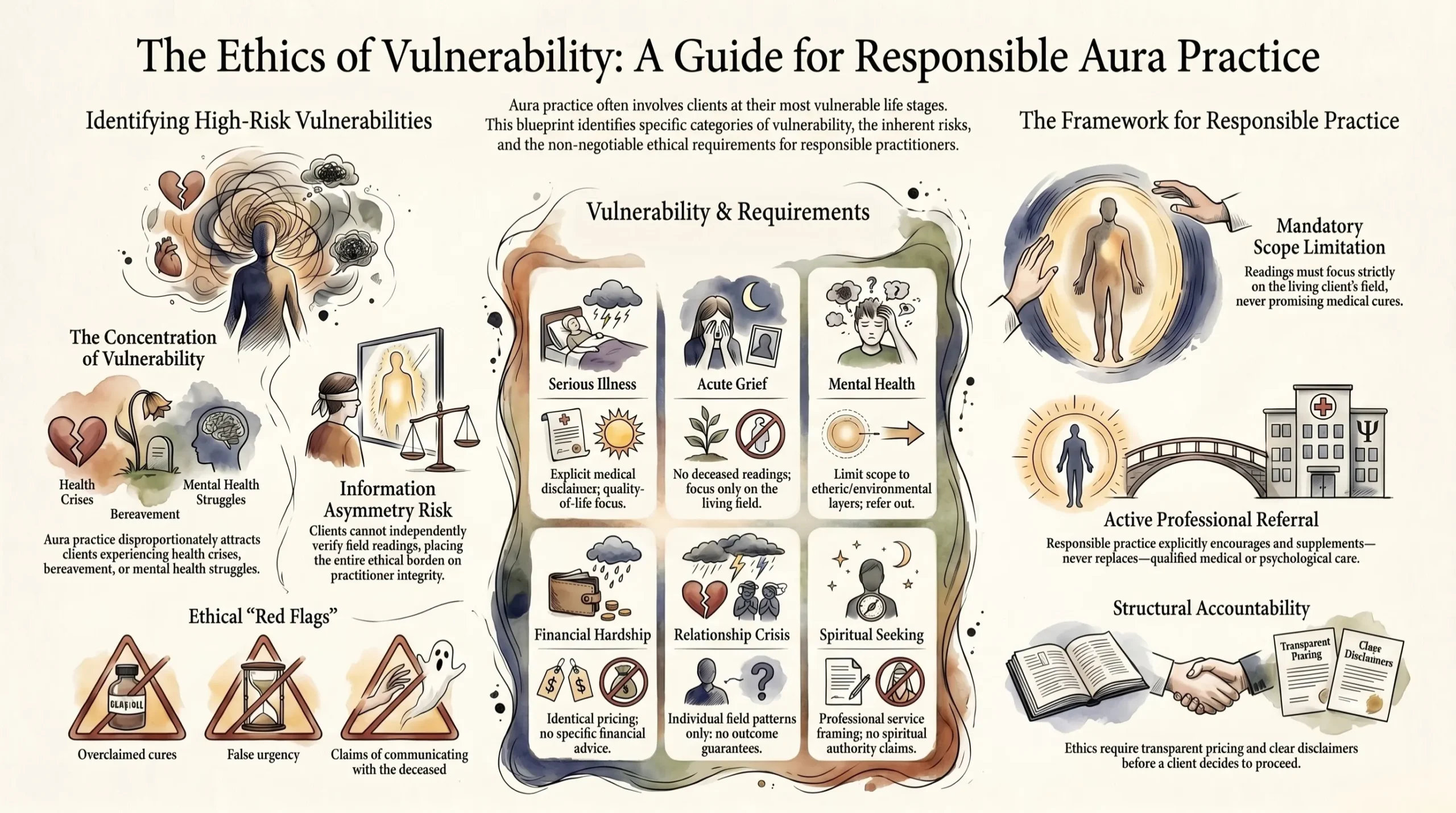
The client who arrives at an aura practitioner in genuine vulnerability deserves a higher standard of ethical care than the merely curious client making a considered service choice. Vulnerability amplifies every aspect of the reading relationship: it amplifies the power asymmetry; it amplifies the potential for harm from inaccurate or overclaimed findings; it amplifies the financial exploitation risk; and it amplifies the ethical weight of the practitioner’s choices about what to say, how to say it, and what to withhold. Understanding these vulnerability categories and their specific ethical implications is not a marginal refinement to basic ethical practice. It is the core application of the non-maleficence principle to the actual population that aura practice serves.
Six Vulnerability Categories in Aura Practice – Specific Risks, Ethical Red Flags, and What Responsible Practice Requires:
Client Vulnerability Category | Specific Risks the Vulnerability Creates | Ethical Red Flags That Signal Exploitation | What Responsible Aura Practice Requires in This Context |
Serious illness or terminal diagnosis (physical health crisis creating heightened susceptibility to hope-based claims) | The client’s desperation for recovery creates vulnerability to overclaimed healing promises; financial exploitation through repeated expensive sessions framed as necessary for survival; the reading’s authority displacing conventional treatment that would produce genuine benefit; false hope delaying grief processing when the prognosis is genuinely poor | Claiming the reading can cure the specific diagnosed condition; recommending reduction or cessation of prescribed medical treatment; framing the practitioner’s continued engagement as essential to the client’s survival; charging premium rates to seriously ill clients on the basis of urgency; creating dependency through the reading relationship at the client’s most vulnerable moment | Explicit, prominent disclaimer that aura analysis complements rather than replaces medical treatment for any diagnosed condition; reading framed entirely around quality of life, energetic support, and consciousness during the health journey rather than curative claims; active encouragement of full engagement with the medical care team; pricing identical to non-ill clients; explicit statement of what the reading can and cannot offer in a serious illness context before the client decides to proceed; referral to specialist integrative medicine practitioners where appropriate |
Acute grief and recent bereavement (emotional crisis reducing the capacity for rational evaluation of claims) | The bereaved client’s longing for connection with the deceased creates vulnerability to practitioners who claim to read the deceased’s aura or transmit messages; the raw emotional state reduces the capacity to evaluate claims with ordinary critical intelligence; financial and emotional exploitation during a period of maximum psychological fragility | Claiming to read or communicate with the aura of the deceased; offering repeated readings framed as necessary for the grief process to complete; creating emotional dependency through the reading relationship at the client’s most fragile point; charging premium rates for ‘special’ grief readings; using the reading to provide specific information the client’s grief makes them eager to receive regardless of its verifiability | Aura reading is restricted to the living client’s own field; no claims about the deceased’s aura or communications; the reading’s focus during bereavement is the client’s own field’s grief response, restoration needs, and the ancestral clearing dimension where genuinely relevant; explicit recommendation of qualified grief counselling as the primary support; the reading explicitly positioned as one supportive resource among several, not a substitute for human support and professional grief care |
Mental health vulnerability (active depression, anxiety disorder, psychosis, or trauma creating specific distortion risks) | Clients in psychotic or dissociative states may interpret aura readings in ways that reinforce delusional frameworks; clients with severe anxiety may use the reading’s findings as a focus for health anxiety and catastrophising; trauma survivors may experience the reading’s content as retraumatising without the structural support of a therapeutic relationship; clients with active depression may interpret negative findings as confirmation of worthlessness | Providing readings that confirm or elaborate psychotic beliefs about the client’s special field status or persecution; providing detailed negative findings to clients who are visibly in acute mental health crisis; positioning the reading as a substitute for psychiatric or psychological care; conducting a reading whose emotional content the practitioner would anticipate being destabilising without having the therapeutic training to manage destabilisation | Active mental health crisis is a contraindication for detailed field work at the emotional body and causal layer; the reading’s scope during mental health vulnerability is limited to the etheric and environmental dimensions where guidance is most clearly supportive; explicit recommendation of qualified mental health professional engagement as the primary care; the reading explicitly acknowledges its own limitations in mental health contexts; no claims about the field’s content that could reinforce delusional frameworks |
Financial hardship and scarcity (economic vulnerability creating susceptibility to abundance-promise exploitation) | Clients experiencing genuine financial hardship are particularly vulnerable to readings that promise wealth transformation; the desperation that genuine scarcity produces can reduce the capacity to evaluate claims with ordinary critical distance; financial exploitation through premium pricing targeted at clients who express financial urgency; repeated sessions framed as necessary for the abundance work to complete | Charging premium rates to clients who have expressed financial hardship on the basis that their urgency of need justifies the price; creating dependency through repeated abundance readings that promise results slightly beyond what each session delivers; framing the financial pattern as so severe that extraordinary intervention (and extraordinary payment) is required; using the reading’s authority to influence major financial decisions | Pricing is single, transparent, and identical regardless of the client’s expressed financial situation; the money-back guarantee is explicitly and prominently offered to financially vulnerable clients as a recourse; the reading’s abundance findings are framed as consciousness practices the client can implement independently, not as requiring ongoing practitioner engagement; no specific financial decisions (investments, business choices) are recommended based on the reading; referral to qualified financial advisors is explicitly encouraged for practical financial decisions |
Relationship crisis and romantic desperation (acute relational pain creating vulnerability to love-promise readings) | Clients in acute romantic pain are vulnerable to readings that promise relationship restoration, specific partner return, or romantic destiny; the pain of separation or loneliness can reduce the capacity to evaluate claims with ordinary critical intelligence; financial exploitation through repeated love readings framed as progressively approaching the desired outcome; dependency creation through the reading relationship during the client’s most emotionally vulnerable period | Claiming the reading can predict specific romantic outcomes (‘your partner will return’, ‘your soulmate will arrive by a specific date’); conducting repeated love readings framed as necessary for the romantic outcome to materialise; encouraging the client to make major life decisions (location changes, career changes) based on romantic predictions; creating emotional dependency through the reading relationship that substitutes for the human connection the client is seeking | Love & Connection readings are restricted to the client’s own field’s current state, patterns, and practices — not to predictions about specific other people’s future actions; no specific romantic outcome predictions are made; the reading focuses on what the client can genuinely influence (their own heart zone coherence, their broadcast frequency, their attachment pattern) rather than on external outcomes; referral to qualified relationship counsellors is explicitly encouraged where the relational pain is acute; the reading is a single structured assessment, not a repeated dependency relationship |
Spiritual seeking and existential crisis (deep meaning-seeking creating vulnerability to authority-claim exploitation) | Clients in the midst of genuine spiritual seeking or existential crisis are particularly vulnerable to practitioners who claim extraordinary authority, spiritual status, or access to ultimate truth; the longing for genuine guidance can override the ordinary critical faculties that would evaluate such claims sceptically; financial and relational exploitation through positioning the practitioner as the client’s necessary spiritual guide | Claiming personal enlightenment, special spiritual authority, or unique access to divine guidance that makes the reading categorically different from ordinary aura work; positioning the reading relationship as a spiritual discipleship rather than a professional service; encouraging the client to subordinate major life decisions entirely to the practitioner’s guidance; creating the expectation that continued engagement with the practitioner is essential to the client’s spiritual progress | The practitioner’s role is explicitly a professional service, not a spiritual authority relationship; the reading’s guidance is about the client’s own field’s nature and potential — not about the practitioner’s authority over it; the reading explicitly supports the client’s own developing discernment and self-knowledge rather than creating dependency on the practitioner’s judgment; the Vedic tradition’s legitimate wisdom is presented as a framework the client can engage with independently, not as the practitioner’s proprietary access |
The serious illness row is the one where the ethical stakes are highest and the potential for harm most direct. In my practice, I have worked with clients in the course of managing serious health conditions — cancer diagnoses, cardiac conditions, autoimmune disorders — and I want to be explicit about what I can and cannot offer them. I can offer a pre-symptomatic field pattern assessment that complements their medical care by identifying the field-level dimensions of their health situation that conventional diagnostics do not reach. I can offer practice prescriptions that the growing evidence base suggests produce genuine epigenetic health benefits. I can offer a framework for understanding the energetic dimension of the health journey that many clients find genuinely supportive alongside their medical treatment. What I cannot offer, and what I will never claim to offer, is a cure, a certainty about outcome, or a reason to reduce engagement with their medical care team.
A client from Mumbai — a fifty-two-year-old architect diagnosed with early-stage breast cancer who had chosen conventional treatment and was seeking complementary support — came to me with a specific and carefully formulated question: what does my energy field show about how to support my body during this period? The reading was conducted with every ethical safeguard the serious illness context requires: the finding was framed as field patterns that would support the conventional treatment rather than as an alternative to it; the prescribed practices (specific pranayama for immune support, yoga nidra for restoration cycle quality, environmental assessment for the sleeping zone) were all within the evidence-supported complementary health category; and the reading explicitly and repeatedly encouraged her to share the practice prescriptions with her oncologist. She described the reading’s most valuable contribution as ‘giving me something I could do to support my body that was genuinely grounded, not merely reassuring.’ That is what ethical aura practice in a health crisis context looks like.
The spiritual seeking row is the one where the specific Indian cultural context creates particular ethical obligations. The tradition of the guru-shishya (teacher-disciple) relationship in India is one of the most profound and most abusable in any cultural tradition. The relationship’s genuine depth and genuine transformative power are also the source of the profound harm that emerges when the relationship is exploited by practitioners who claim guru status without the genuine spiritual development that would make such a claim appropriate. An aura practitioner is not a guru. The reading relationship is not a discipleship. The practitioner’s knowledge of the client’s field is a professional skill, not a spiritual authority. Every client in the midst of genuine spiritual seeking deserves to receive this clarity before they engage, not discover its absence after.
What Are the Hardest Ethical Questions in Aura Research and How Should They Be Answered?
I want to engage with the four hardest ethical questions in aura research directly, because the practitioner who has thought through the hard questions before encountering them in practice is better prepared to respond ethically when they arise. And these questions do arise. In my practice, I have encountered versions of all four.
Four Hard Ethical Questions and the Honest Answers They Require:
- Should aura practitioners be permitted to work with seriously ill clients at all? Yes — with the specific ethical adaptations the context requires and the specific limitations the reading must acknowledge. The Ornish and Blackburn research has confirmed that consciousness and lifestyle practices produce measurable health benefits even in serious illness. Denying seriously ill clients access to genuine complementary support based on a blanket prohibition would itself be ethically problematic. The ethical requirement is not prohibition but calibration: explicit limitation to complementary support; explicit encouragement of conventional treatment; no curative claims; explicit scope-of-practice acknowledgement. A reading conducted within these parameters can produce genuine benefit. A reading conducted outside them can produce serious harm. The ethical distinction is not whether to work with seriously ill clients but how.
- Is it ethical to deliver a reading’s genuinely difficult findings to a client who did not explicitly request them? Yes — with the care that difficult findings require. Withholding clinically significant findings from a client because they are difficult is a paternalistic breach of the client’s autonomy. The client has the right to the most accurate picture the reading can provide, including the dimensions that are challenging. The ethical obligation is not to withhold difficult findings but to deliver them with the precision, the proportionality, and the restoration prescription that make them actionable rather than merely alarming. A difficult finding delivered without a restoration pathway is not honest practice. It is alarmism. A difficult finding delivered with its restoration prescription is the most important service the reading can offer.
- Is it ethical to read the aura of a space, relationship, or person at the request of a third party who has not consented to the reading? No — with one specific exception. Reading the field of a living person who has not consented to the reading — at the request of a parent, partner, employer, or other interested third party — is a privacy violation regardless of the reading’s intention. The field contains personal information of the most intimate kind: health patterns, emotional states, constitutional vulnerabilities. Accessing this information without consent violates the person’s autonomy over their own field’s information. The exception is the reading of a space — which belongs to the requesting client and which does not require the consent of the space itself. A home’s energy pattern can be read at the homeowner’s request. Another person’s field cannot be read without their consent.
- How should a practitioner respond when a client appears to be in acute psychological crisis during or after a reading? With immediate, unambiguous, and warm referral to qualified mental health support — and with the explicit acknowledgement that the reading’s scope does not extend to the care the client’s crisis requires. The practitioner’s role in this moment is not to continue the reading, not to provide therapeutic support beyond their training, and not to use the reading’s authority to manage the crisis. It is to clearly and warmly direct the client to the qualified human support that is available to them, to provide specific referral information where possible, and to ensure that the reading relationship does not become the only support structure the client in crisis has access to.
What Ethical Commitments Govern the Aura Life Guide Master Package Across All Five Life Areas?
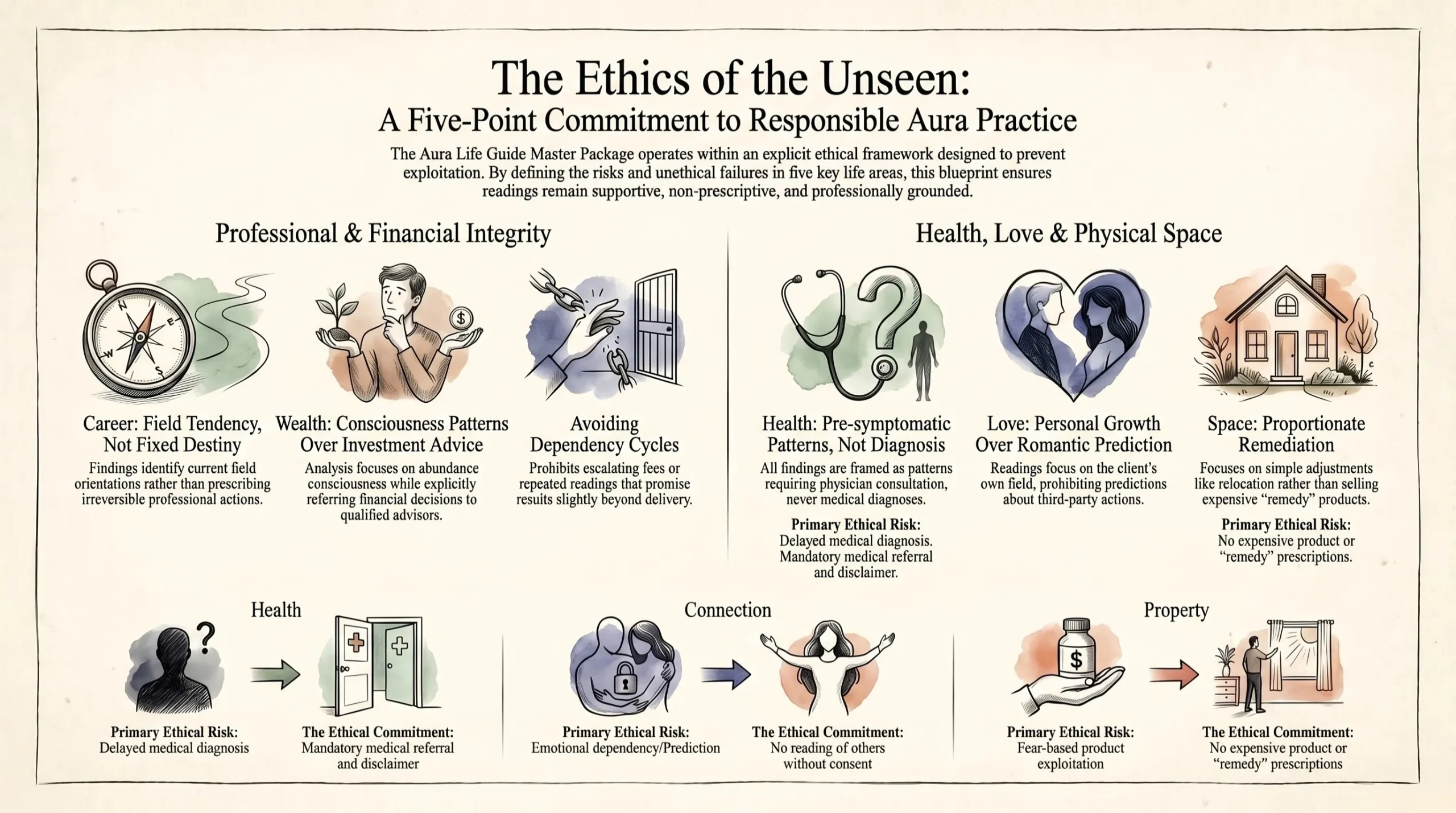
I want to make the ethical framework governing the Master Package as explicit and as publicly accountable as everything else about the practice. Because the client who chooses the Master Package deserves to know not only what it will deliver but what ethical standards it is committed to — in every life area, in every reading dimension, in every client interaction. Ethical commitments that are publicly stated are more accountable than ethical commitments that exist only in the practitioner’s private intentions.
The Aura Life Guide Master Package Ethical Commitments Across All Five Life Areas:
Life Area | The Specific Ethical Risk in This Area | What Unethical Practice Looks Like Here | The Ethical Commitment That Governs This Reading Dimension |
Career & Purpose | The reading’s authority about the client’s dharmic calling can be used to direct major irreversible life decisions (career abandonment, business closure, relocation) that fall outside the reading’s genuine competence to guide with certainty | Telling the client their current career is definitively wrong based on the aura reading alone; prescribing specific career moves (‘you must leave this company’, ‘this business will fail’) without the breadth of information a career counsellor or business advisor would use; framing the reading’s upper zone assessment as a certain map of the client’s fixed destiny rather than the highest available superposition within the current field configuration | Career findings are framed as field tendency and probability amplitude assessment, not as certain destiny prescriptions; the reading identifies what the field is oriented toward and what patterns are suppressing its expression, and prescribes practices the client can use to shift the probability amplitude — not irreversible external actions; major career decisions are explicitly encouraged to be taken with the advice of qualified career counsellors, business advisors, and trusted mentors in addition to the aura reading’s input; the reading’s authority is about the field’s current configuration, not about external circumstances the field does not determine alone |
Health & Vitality | Health readings carry the highest ethical stakes of all five life areas: incorrect readings, overclaimed healing promises, or insufficient referral to medical care can produce direct physical harm through delayed diagnosis, inappropriate treatment choices, or false reassurance | Diagnosing specific medical conditions based on the aura reading (‘your aura shows cancer’ rather than ‘a zone depletion warranting physician consultation’); recommending against prescribed medication or medical procedures; providing false reassurance about a health concern that warrants medical investigation; framing the reading’s health findings as sufficient without professional medical consultation; charging premium rates to seriously ill clients under urgency | The mandatory health disclaimer is presented prominently with every Health & Vitality reading; all health findings are framed as field-level patterns that are best investigated with a qualified physician, not as diagnoses; the reading explicitly and consistently encourages full engagement with the medical care system; the reading’s contribution is pre-symptomatic field pattern identification and practice prescription, not medical diagnosis or treatment guidance; emergency health concerns identified in the reading conversation are immediately redirected to emergency medical care |
Wealth & Abundance | Wealth readings create vulnerability to financial exploitation through premium pricing for urgency-framed sessions, specific investment recommendations that fall outside the reading’s competence, and dependency creation through repeated abundance readings | Recommending specific financial decisions (investments, business transactions, property purchases) based on the reading’s abundance pattern assessment; charging escalating fees to clients whose financial urgency creates dependency; framing the reading as predicting specific financial outcomes (‘your income will triple in six months’); creating ongoing dependency through repeated wealth readings that promise results slightly beyond the current session’s delivery | Wealth findings are restricted to the client’s own field’s abundance consciousness patterns: the root zone frequency, the solar plexus self-worth amplitude, the ancestral scarcity encoding — all addressable through practice, none requiring specific financial decisions; the reading explicitly recommends qualified financial advisors for practical money decisions; pricing is single, transparent, and guaranteed; the reading’s abundance prescription is a practice sequence the client implements independently, not an ongoing practitioner-dependent programme; no specific income or wealth outcome predictions are made |
Love & Connection | Love readings create vulnerability to prediction-based exploitation, emotional dependency, and the specific harm of directing a client’s relational decisions based on field assessments that have no ability to read the other person’s genuine intentions or future choices | Predicting specific romantic outcomes about specific other people (‘this person is your soulmate’, ‘your relationship will survive’, ‘avoid this person’) based on the reading of the client’s field alone; conducting repeated love readings framed as progressively approaching the desired relationship outcome; encouraging major relationship decisions (ending a marriage, pursuing a specific person) based on the reading alone; reading the aura of a person who has not consented to the reading through a third party’s photograph | Love & Connection readings are restricted entirely to the client’s own field: their heart zone coherence, their broadcast frequency, their attachment pattern, their causal samskara — all genuinely readable and all genuinely within the client’s own sphere of influence; no other person’s field is read without their explicit consent; no specific relationship outcome predictions are made; major relationship decisions are explicitly encouraged to involve qualified relationship counsellors; the reading supports the client’s own growing field clarity and self-knowledge, not their decisions about other people |
Property & Space Energy | Space energy readings create vulnerability to fear-based exploitation through catastrophising about geopathic stress or Vastu misalignment, and to unnecessary expenditure through prescriptions for expensive remediation products or services | Creating excessive anxiety about the home’s energy by framing geopathic stress or Vastu misalignment in catastrophic terms without proportionate guidance; recommending expensive products (crystals, yantras, space clearing services) as required remediation; prescribing complete home renovation based on the reading alone; reading the space energy of a home that belongs to a person who has not consented to the reading | Space energy findings are framed proportionately: the specific decoherence source, its likely field impact, and the most straightforward available remedy (often sleeping zone relocation or a specific directional adjustment) without catastrophising or escalating to expensive interventions; expensive remediation products are explicitly not recommended as first-line responses; the space reading is conducted only for the client’s own primary space; structural home changes based on the reading alone are explicitly discouraged without professional architectural and engineering consultation where relevant |
The Health & Vitality row carries the heaviest ethical weight of the five, and I want to address it with the directness it deserves. I have described in previous articles in this series how the Health & Vitality reading’s pre-symptomatic biophoton assessment identifies organ zone coherence depletion weeks to months before conventional diagnostic markers change. This is genuinely valuable. It is also genuinely demanding ethically: because identifying a pre-symptomatic pattern in a client’s health field places a specific responsibility on how that finding is communicated. The finding ‘your hepatic zone shows a pre-symptomatic depletion pattern consistent with the following risk factors’ is ethically very different from ‘your aura shows you have liver disease.’ The first is an honest field assessment that appropriately directs the client to professional investigation. The second is a medical diagnosis that falls entirely outside the reading’s competence and that can produce both false certainty and delayed appropriate care. The difference between these two framings is the difference between ethical and unethical health field practice.
The Love & Connection row contains the ethical commitment I consider most frequently tested in practice: the restriction against reading another person’s field without their consent. The client who arrives with a photograph of their partner, parent, or child, seeking a reading of that person’s field, is asking for something that feels reasonable from the client’s perspective and that would undoubtedly be commercially convenient to provide. The ethical refusal of this request is not an arbitrary limitation. It is the application of the most fundamental privacy principle to a context where privacy violation is particularly significant: the field contains the person’s most intimate health, emotional, and constitutional information, and accessing it without consent is a violation of the person’s autonomy over their own most personal information, regardless of the requester’s intentions.
A client from Ahmedabad — a thirty-five-year-old entrepreneur whose relationship with her business partner had deteriorated into a trust breakdown — arrived with photographs of both herself and her partner, seeking a comparative reading of both fields to determine whether the partnership could survive. The ethical response was to conduct a reading only of her own field: her solar plexus’ trust-discernment quality, her throat zone’s authentic expression pattern in professional relationships, and the causal layer’s partnership-pattern encoding — all genuinely within the reading’s competence and genuinely relevant to her situation. Her partner’s field was not read. The guidance she received was entirely about what she could genuinely understand about herself and what she could genuinely influence in the partnership dynamic — which turned out to be substantially more useful than a comparative reading would have been, because it was the truth about what the reading could actually offer rather than a reassuring narrative about both fields.
Are You Ready for the Reading That Is Accountable to Its Ethical Commitments?
Namaste, my friend — if this article has given you a clear picture of what ethical aura practice looks like — its ten core principles, its specific obligations toward vulnerable clients, its life-area-by-life-area commitments, and its honest engagement with the hardest questions — I hope it has also given you the framework to evaluate any aura service you encounter against these standards. The field you deserve is one that is intellectually honest about its evidence, transparent about its limitations, protective of your privacy and autonomy, and accountable for the guidance it provides.
The Aura Life Guide Master Package is built on exactly this ethical foundation. Five life areas. All seven zones. The complete integrated picture across Career & Purpose, Health & Vitality, Wealth & Abundance, Love & Connection, and Property & Space Energy. Every finding framed within its genuine competence. Every difficult insight delivered with its restoration prescription. Every claim presented at its honest evidence tier. Your privacy protected. Your autonomy respected. Your vulnerability acknowledged and protected rather than exploited.
Using our patented photo-scanning technology and Multiple Advanced Gadgets. Drawing on eight years of practice and 1,000+ readings. Delivered as a complete written Aura Life Guide within 24 to 48 hours. With our money-back guarantee — the structural expression of our accountability to you.
Three Steps to Your Ethically Grounded Aura Life Guide:
- Submit Photo – Upload a recent, clear photograph of yourself. Your complete field information — all five life areas, all seven zones, every layer from etheric to causal — is accessible through our patented photo-scanning technology and Multiple Advanced Gadgets, read within the explicit ethical framework this article has described.
- Expert Analysis – I personally decode your complete aura across all five life areas, applying the ten ethical principles as structural features of every reading dimension: intellectual honesty about evidence, individual calibration, scope-of-practice clarity, cultural respect, and the complete privacy and autonomy protections you deserve.
- Transform – Receive your personalised Aura Life Guide — complete five-area integrated analysis, honest difficult findings with restoration prescriptions, explicit professional referral guidance where appropriate, and the precise, individually calibrated practice protocol — delivered within 24–48 hours with our money-back guarantee.
⚠️ Disclaimer: Aura analysis and energetic guidance are for personal growth and awareness only. They are not a substitute for professional medical, financial, legal, or psychological advice. Please consult qualified professionals for any health or financial concerns.
Q1: Why do ethical standards matter more in aura research than in most fields?
Ethical standards matter more in aura research because of three structural features that create exceptional conditions for exploitation: the findings are largely unverifiable by the client using independent means, creating an information asymmetry that only the practitioner’s integrity can counterbalance; the field consistently attracts clients at their most emotionally vulnerable — in health crisis, relationship pain, financial distress, or existential uncertainty; and the absence of professional licensing, accountability structures, or regulatory oversight means that no external mechanism corrects unethical practice before it harms clients. These three features make the practitioner’s internal ethical commitment the only consistent protection the client has.
Q2: What are the ten core ethical principles for responsible aura practice?
The ten core ethical principles for responsible aura practice are: intellectual honesty about evidence quality (presenting claims at their actual evidence tier); client autonomy and informed consent (free, informed decisions without fear or false urgency); non-maleficence (no foreseeable harm through reading content, delivery, or prescription); beneficence (actively serving client wellbeing through precise guidance); confidentiality and privacy (protecting client field information professionally); scope of practice clarity (directing clients to qualified professionals beyond the reading’s competence); cultural sensitivity and non-appropriation (engaging with the Vedic tradition with scholarly respect); power asymmetry awareness (actively counteracting the practitioner’s authority advantage); evidence-based practice evolution (updating frameworks as research develops); and equitable access (ensuring systematic inclusivity).
Q3: What ethical red flags should clients look for in an aura practitioner?
Key ethical red flags in aura practice include: claims that the reading can cure specific diagnosed conditions or is superior to conventional medical care; using fear of negative consequences to motivate purchase decisions; creating false urgency or recommending repeated sessions framed as necessary for results to materialise; reading another person’s field without that person’s consent; making specific romantic, financial, or health outcome predictions with certainty; positioning the practitioner as an unchallengeable spiritual authority; discouraging second opinions or professional consultations; creating emotional dependency through the reading relationship; and charging premium rates to clients who have expressed acute vulnerability.
Q4: Is it ethical for an aura practitioner to work with seriously ill clients?
Yes — within specific ethical parameters. Aura practice can provide genuine complementary support for seriously ill clients through pre-symptomatic field assessment and evidence-supported practice prescriptions (pranayama, yoga nidra, environmental optimisation). The ethical requirements are: explicit, prominent acknowledgement that aura analysis complements rather than replaces medical treatment; no curative claims for the specific diagnosed condition; active encouragement of full engagement with the medical care team; sharing practice prescriptions with the oncologist or relevant specialist; pricing identical to non-ill clients; and explicit scope-of-practice clarity before the client decides to proceed.
Q5: What ethical commitments govern the Aura Life Guide Master Package?
The Aura Life Guide Master Package operates under specific ethical commitments: Career & Purpose findings are framed as field tendency assessments with major decisions encouraged to involve qualified career advisors; Health & Vitality readings carry a mandatory health disclaimer and explicit medical referral with no diagnoses made; Wealth & Abundance findings are restricted to consciousness patterns with no specific financial decision recommendations; Love & Connection readings are limited to the client’s own field with no other person’s reading without consent and no romantic outcome predictions; Property & Space findings are framed proportionately with no catastrophising; and the money-back guarantee is a structural expression of accountability across all five areas.